TikTok Shop vs Shopify in 2027: What Real Stores Reveal About Profit
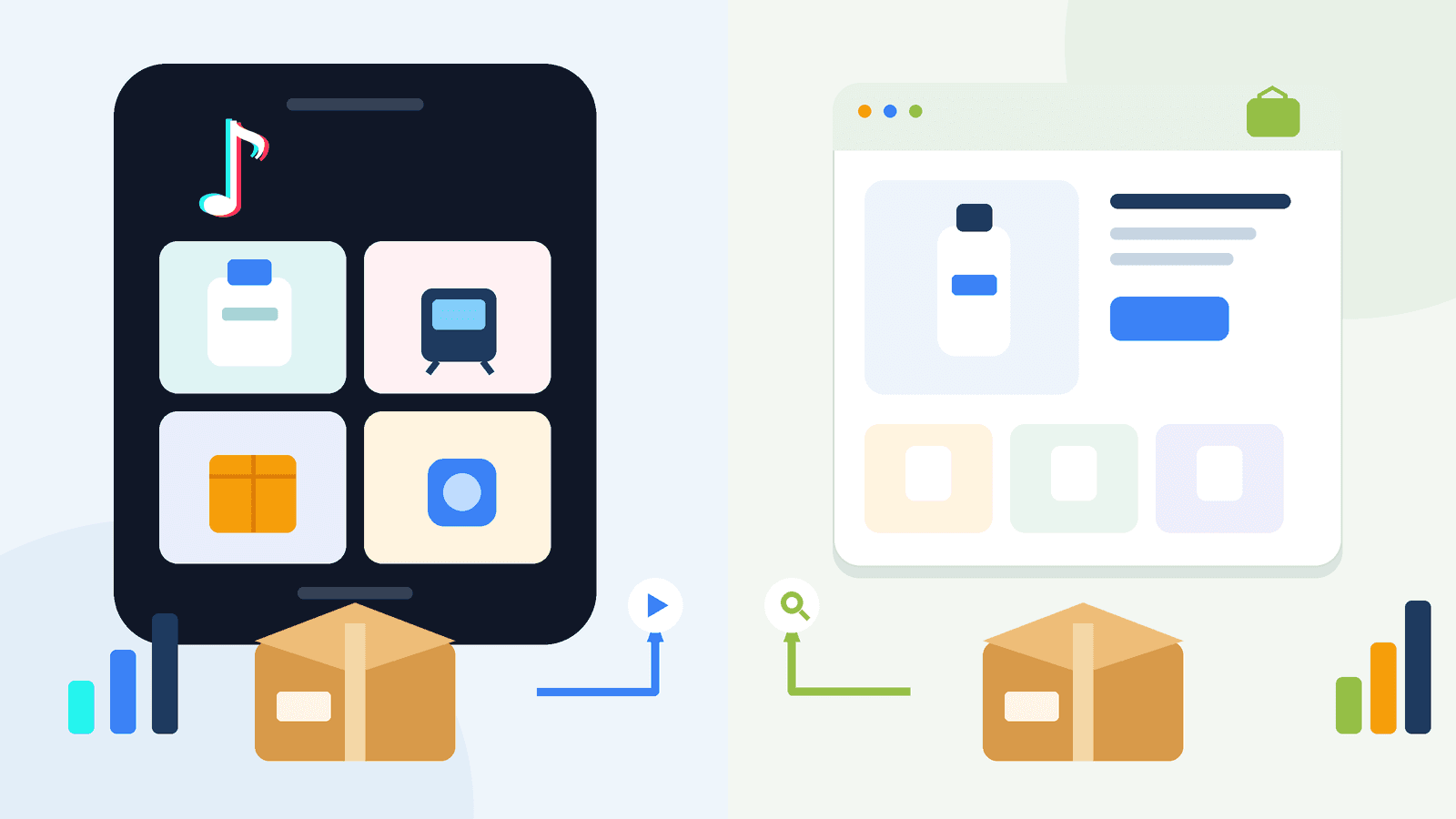
TikTok Shop vs Shopify comes down to this: start on TikTok Shop when creators can demonstrate your product and its margins support commissions, and start on Shopify when you need your own customer base and full control of the buying experience. For many sellers in 2027, the better question is which platform should come first.
I checked live stores in Tradelle's Store Explorer on November 27, 2026. On TikTok Shop, medicube US Store generated an estimated $24.2 million in seven days, while Shark Home attributed 59% of its sales to creators. Those numbers reveal more than the usual discovery versus ownership debate. They show how revenue, creator dependence, pricing, and fulfillment differ from one business to another.
Below, I'll use that store-level evidence and two worked profit models to help you choose. I'll also cover customer data, dropshipping without Shopify, and the point when adding a second channel makes sense.
What Real Stores Reveal About TikTok Shop and Shopify
Store-level data makes the TikTok Shop vs Shopify choice clearer because it shows how sales are produced. Tradelle's Store Explorer currently indexes 1.6 million Shopify stores and 105,000 TikTok shops. More useful than those totals are the revenue windows, average prices, creator counts, and sales-source splits on each store.
Revenue from TikTok Shop does not follow one creator formula.
Our analysis of four large US TikTok Shop stores in Tradelle’s November 27, 2026 snapshot found that they earn substantial revenue even when creator-attributed sales make up a minority or the majority of total sales. Creator shares for these four stores ranged from 27% to 59%.
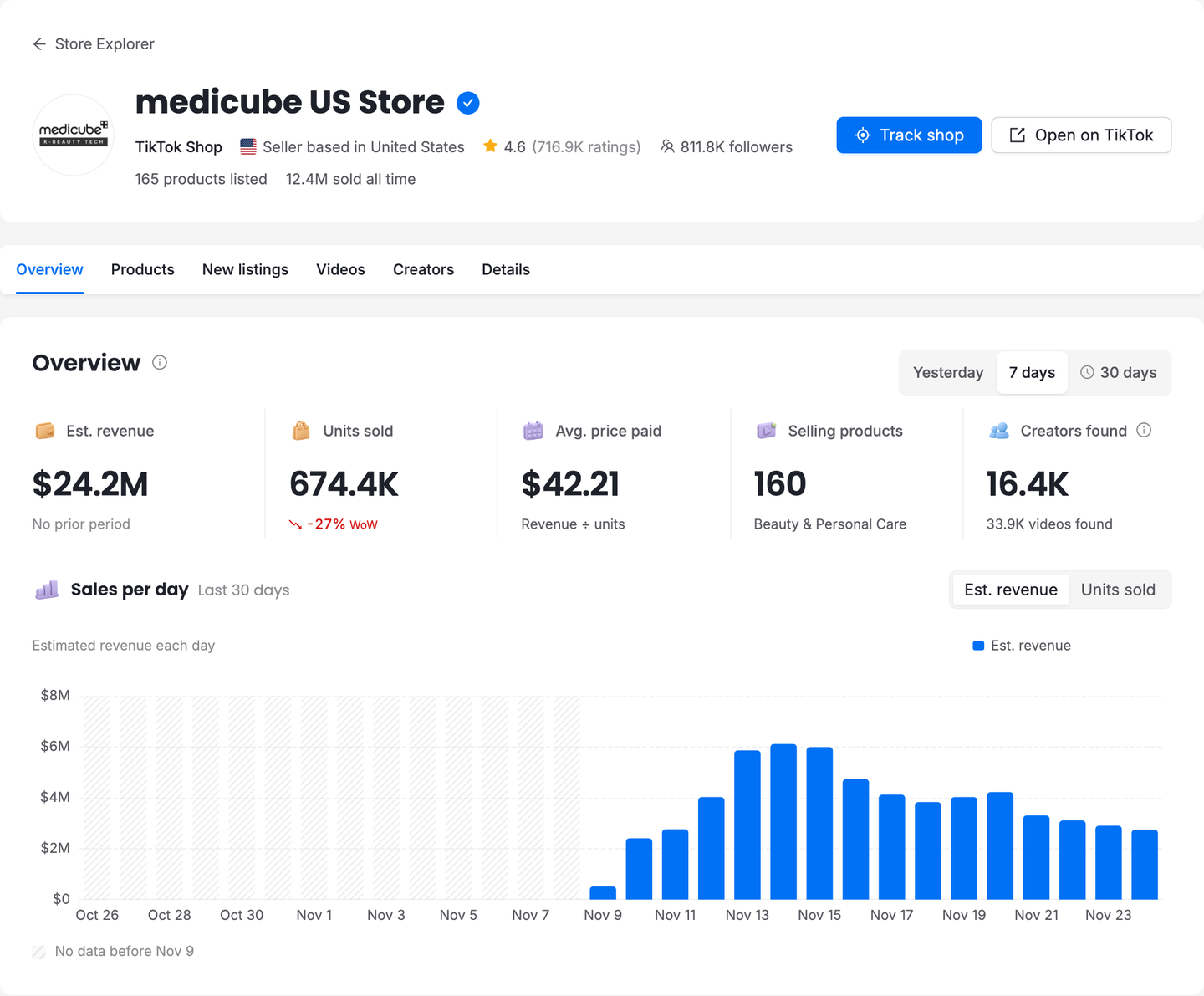
- medicube US Store: Est. revenue last 7 days $24.2M, Creator sales share 27%, Creators found 16.4K, Avg. price paid $42.21
- Comfrt: Est. revenue, last 7 days $5.9M, Creator sales share 33%, Creators found 5.8K, Avg. price paid $51.70
- Shark Home: Estimated revenue last 7 days: $5.4M, Creator sales share: 59%, Creators found: 1.3K, Avg. price paid: $205.44
- Nex Playground: Est. revenue, last 7 days $5.8M, Creator sales share 36%, Creators found 1.4K, Avg. price paid $278.54
All figures are Tradelle estimates checked on November 27, 2026. Revenue and creator counts cover the previous seven days. Creator sales share refers to the shop's sales-source split. These four shops are examples, not a representative average for TikTok Shop.
The sales-source column changes the research question. Instead of asking whether a shop is big, ask how much of that revenue depends on affiliate content. The 27% share for medicube and the 59% share for Shark Home point to different recruitment needs and different risks if creator output slows.
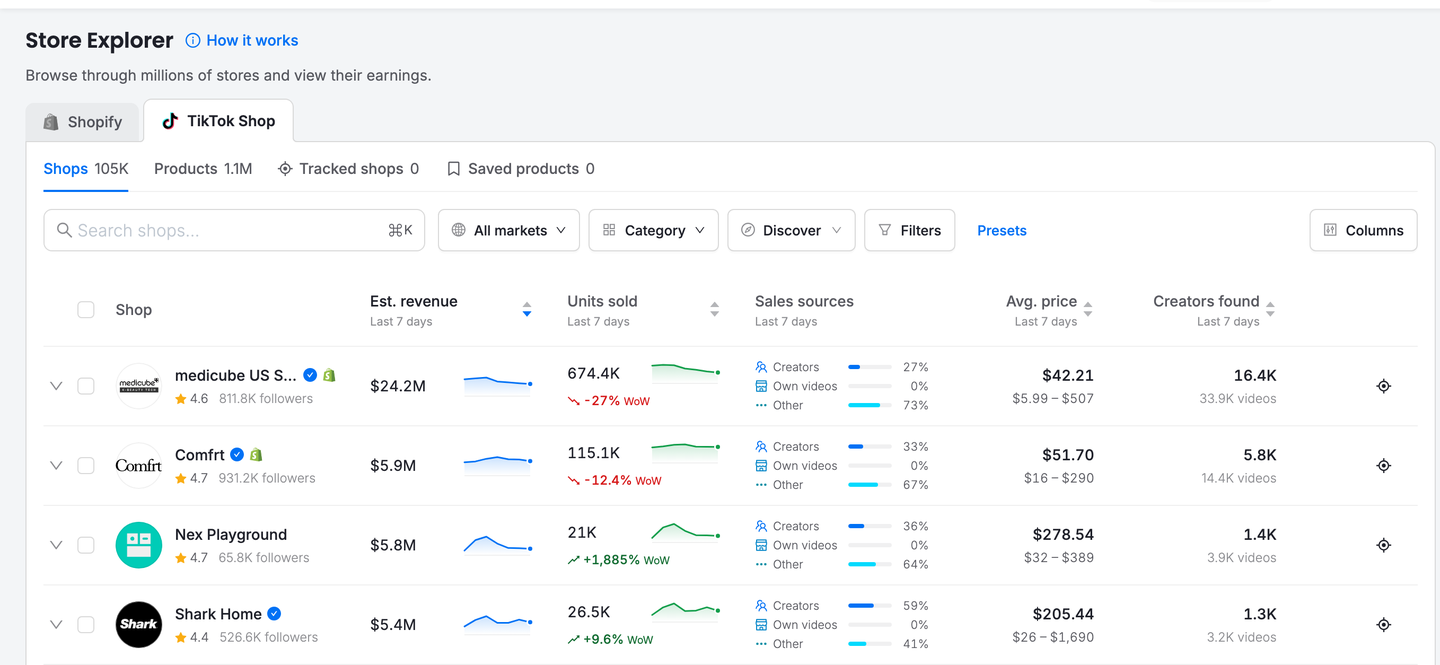
The medicube US Store provides useful scale context. Its shop detail page showed an estimated $24.2 million in revenue, 674,400 units, 16,400 creators, and 33,900 videos over seven days. Its 30-day view showed $60.7 million, but Tradelle had only collected data since November 9. That partial window should never be presented as a complete month.
High revenue also doesn't mean a low-price product is the only option. Shark Home's average price paid was $205.44, and Nex Playground's was $278.54 in the same seven-day view. A visual demonstration can support a considered purchase too. The seller still needs enough margin and trust to close it.
Creator dependence and creator concentration are different checks
This metric measures the share of shop revenue that is generated by creators. Creator concentration is the degree to which a small number of videos or accounts are generating most of the creator revenue. A shop can have thousands of affiliates but be highly dependent on a few big hits.
Use both checks before copying a competitor. Start with the shop's sales-source split, then open its Videos and Creators chapters to compare individual results with the shop total. Tradelle's Creator Library adds estimated revenue and sales per video, so you can see whether one clip carries the apparent success.
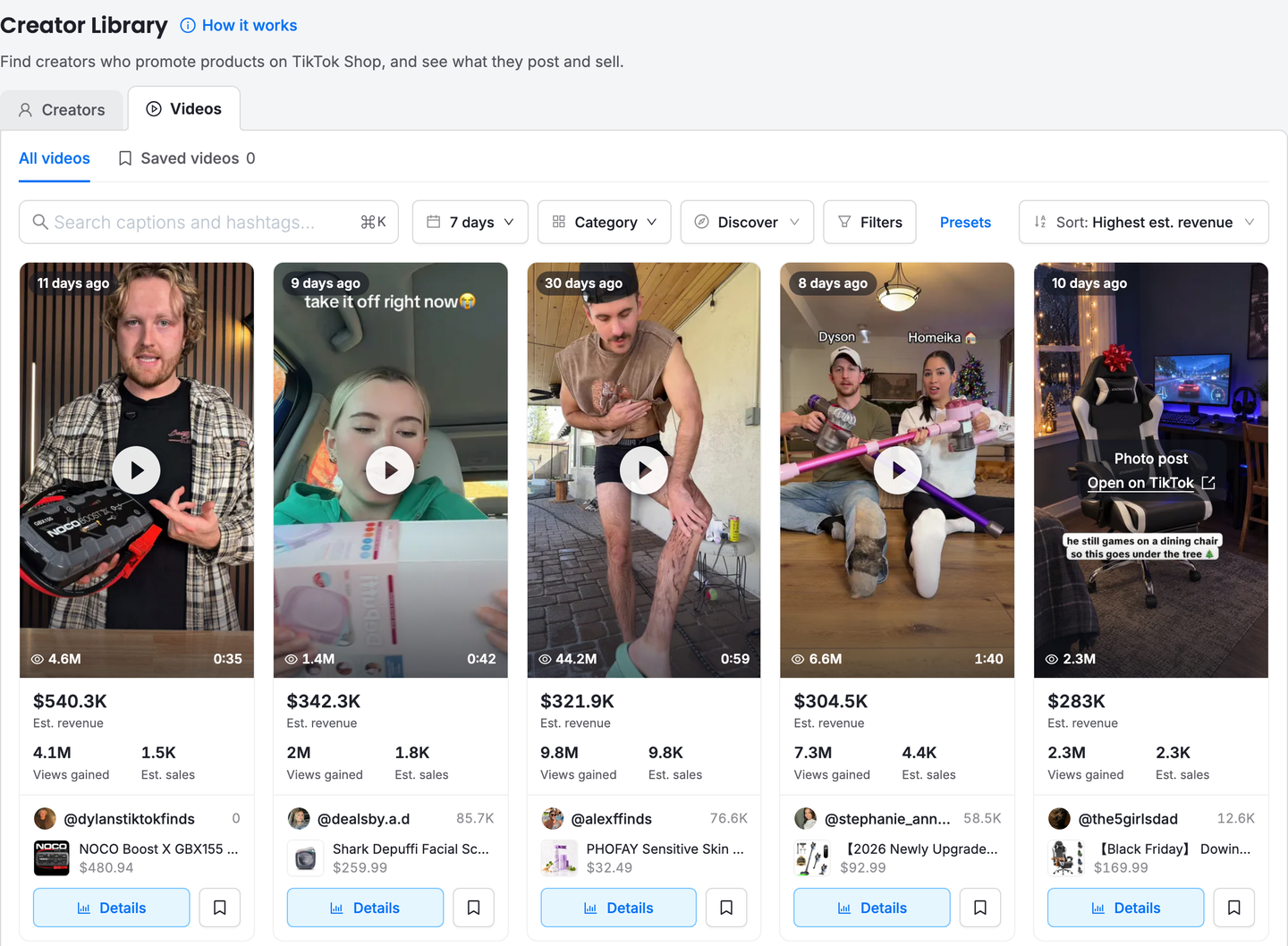
Don't recruit creators by follower count alone. Look for people already selling comparable products, review their per-video revenue, and check whether their audience matches your buyer. The Has a public email filter gives you a practical starting point for outreach.
A matched brand shows why both platforms can matter
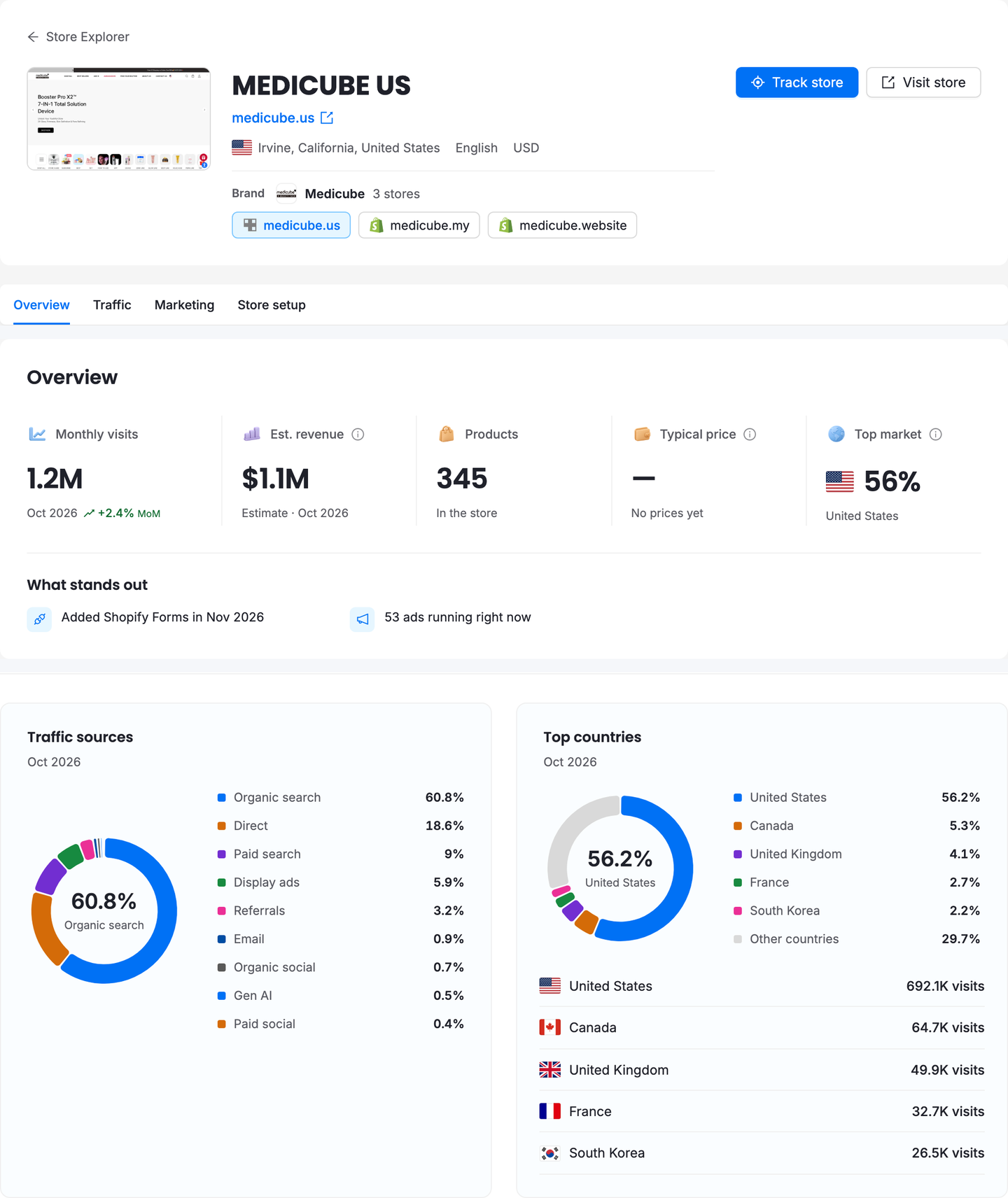
A TikTok Shop and a Shopify store can serve the same brand without producing the same kind of value. Store Explorer links medicube's TikTok Shop to MEDICUBE US on Shopify and to its Brand Library page. That connection lets you inspect both operations instead of treating them as unrelated businesses.
The matched Shopify store showed an estimated $1.1 million in revenue and 1.2 million visits in October 2026. Organic search accounted for 60.8% of visits. The TikTok figures above use a different period, so they can't support a channel-share calculation. They do support a simpler conclusion: this brand has meaningful commerce activity on both platforms, and its website captures substantial search demand.
How Sales Work on TikTok Shop vs Shopify
TikTok Shop is a marketplace inside a content feed. Shopify is software for running your own storefront. Both can sell the same item, but the work before and after checkout differs.
TikTok Shop turns product content into in-app purchases
TikTok Shop enables users to shop directly from videos, live streams and product pages within the app. Sellers can create their own content, work with affiliates or run paid ads, or use a combination of these.
The affiliate model changes acquisition economics. You set a commission, and a creator earns it when their content generates a qualifying sale. That can reduce the need to fund every click upfront. It doesn't remove cost. Commission, samples, referral fees, discounts, and fulfillment all belong in your pricing.
Shopify's guide to TikTok affiliate marketing currently lists a 6% platform fee for most categories and seller-set commissions from 1% to 80%. Treat 6% as a planning input for a US model, then confirm the rate for your category and market in Seller Center.
Shopify gives you the storefront and retention tools
Shopify gives you a website, checkout, customer profiles, marketing automations, and room for detailed product education. You choose the page structure, offer, analytics setup, email program, and post-purchase experience.
That control comes with a job: bringing visitors to the store. Paid ads can work, but they add acquisition cost before you know whether a product will convert. Search, email, and direct traffic can improve the mix later. My guide to starting dropshipping in 2027 covers that broader setup.
Customer data is about permission and repeat sales
Shopify gives you more control over customer data and consent-based retention marketing. You can build segments and email automations around your store's customer relationships. TikTok Shop keeps the purchase inside its marketplace, even when order details are available for fulfillment.
Don't confuse access to an order address with permission to send marketing. Keep transactional communication, marketplace messaging, and email consent separate. If repeat purchases drive your model, read my dropshipping email marketing guide before choosing a TikTok-only setup.
TikTok Shop vs Shopify Fees: Worked Profit and Loss Examples
The cheaper platform depends on who brings the buyer and what that sale costs after fulfillment. A fair comparison includes product cost, shipping, platform charges, creator commission or advertising, and the monthly plan allocation.
Assumptions for a $40 order
The following examples use the same hypothetical product on both platforms. The customer pays $40 with free shipping. Product and fulfillment cost $14 combined. There are 100 monthly orders.
For TikTok Shop, the model uses a 6% referral fee and a 12% creator commission. For Shopify, it uses Basic at $29 per month paid yearly and card rates from 2.9% plus 30¢, as listed on Shopify's pricing page. That produces a $1.46 processing charge and a $0.29 plan allocation per order. The first Shopify order assumes $8 in paid acquisition. The repeat order assumes no additional acquisition cost.
These are planning assumptions, not performance benchmarks. Taxes, refunds, apps, samples, discounts, and overhead are excluded so the channel mechanics stay visible. Replace every input with your own figures before setting a price.
The same product can produce three different contributions
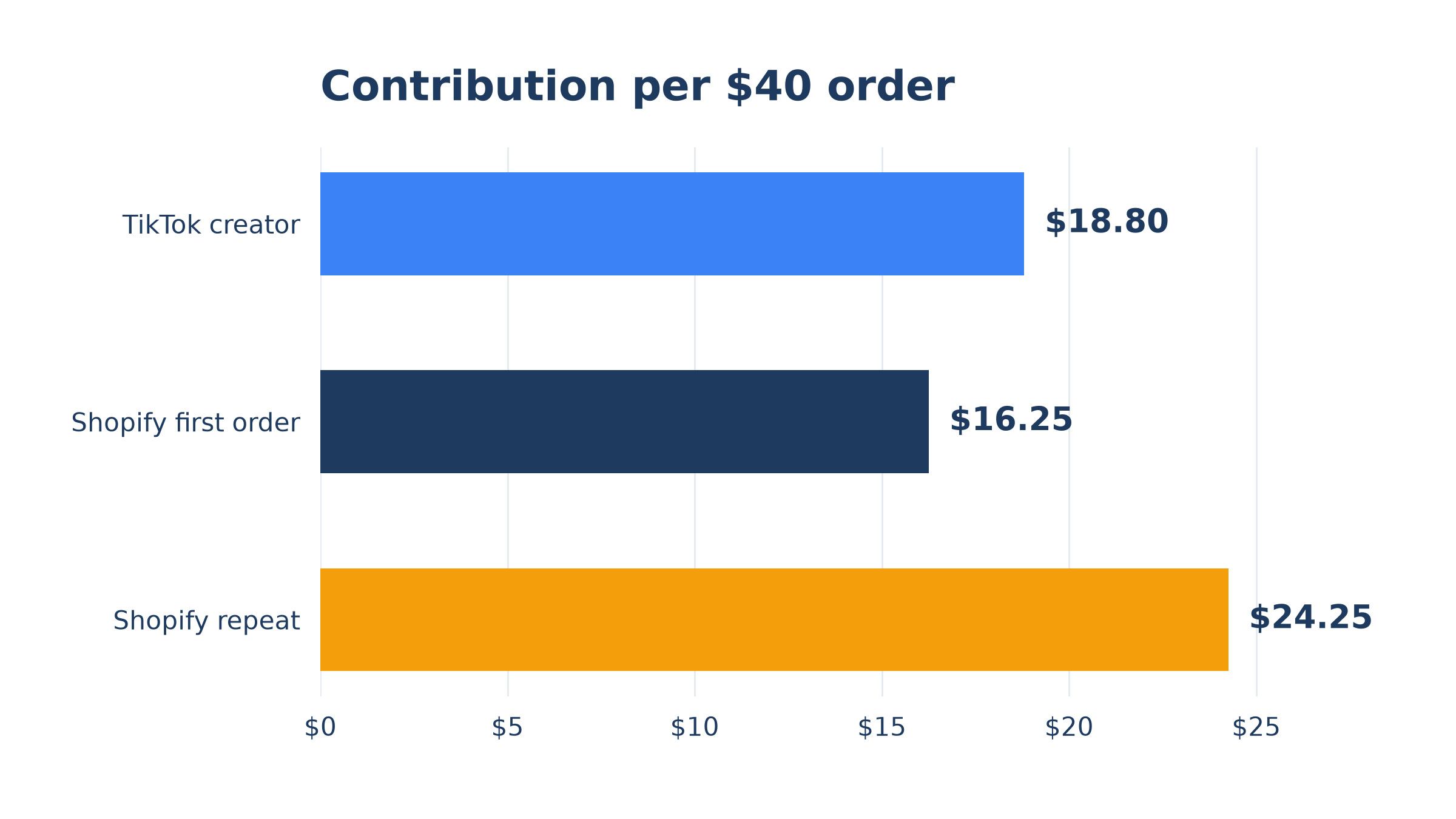
A $40 order leaves $18.80 before excluded costs in the TikTok creator example, $16.25 in the Shopify paid-acquisition example, and $24.25 in the Shopify repeat-purchase example.
- Revenue: TikTok creator order = $40.00, Shopify first order via ads = $40.00, Shopify repeat order via email = $40.00
- Product and fulfillment: TikTok creator order -$14.00, Shopify first order via ads -$14.00, Shopify repeat order via email -$14.00
- Referral or card processing: TikTok creator order -$2.40, Shopify first order via ads -$1.46, Shopify repeat order via email -$1.46
- Creator commission: TikTok creator order -$4.80, Shopify first order via ads $0.00, Shopify repeat order via email $0.00
- Customer acquisition: TikTok creator order $0.00, Shopify first order via ads -$8.00, Shopify repeat order via email $0.00
- Monthly plan allocation: TikTok creator order $0.00, Shopify first order via ads -$0.29, Shopify repeat order via email -$0.29
- Contribution before excluded costs: TikTok creator order $18.80, Shopify first order via ads $16.25, Shopify repeat order via email $24.25
The result changes as soon as an assumption changes. A higher creator commission can erase TikTok's advantage. A lower acquisition cost can improve the Shopify first order. More monthly orders reduce Shopify's fixed plan cost per order. A repeat purchase can outperform both acquisition examples because the customer already knows the store.
Use my profit-margin calculation guide to build the full version with refunds and overhead. For pricing tests, my dropshipping pricing strategy guide explains how to evaluate the whole offer rather than copying a competitor's price.
Fulfillment Rules Can Decide TikTok Shop vs Shopify
The best channel on paper fails if orders ship late or tracking doesn't arrive. TikTok Shop adds marketplace performance requirements to your normal supplier decision. Shopify gives you more freedom over the workflow, but you remain responsible for delivery and support.
TikTok Shop fulfillment needs a compatible supplier
TikTok Shop sellers need a fulfillment route that meets the current dispatch, tracking, and returns requirements for their market and account. Those rules can change, so verify them in Seller Center before launch and before a major promotion.
Ask the supplier direct questions:
- Can it accept TikTok Shop orders through your chosen integration?
- Can it dispatch within the deadline shown in Seller Center?
- Does it provide valid tracking through the required shipping method?
- Can it absorb a sudden increase in daily orders?
- Where will returns go, and who responds to the buyer?
A supplier that performs well for your website may still be unsuitable for TikTok Shop. Test the entire order path before recruiting affiliates. One viral video can create more orders than a manual process can handle.
Shopify fulfillment offers more workflow control
Shopify sellers can choose their supplier, fulfillment partner, shipping presentation, and customer support process. That flexibility makes it easier to build a consistent brand experience. It also means you own the operating decisions.
With Tradelle on Shopify, you can import a catalog product in one click, automate order processing, sync tracking, and use return centers in the US, EU, and UK. Fulfillment by Tradelle also handles sourcing, customs, and applicable import duties for Tradelle orders. My dropshipping fulfillment guide explains what to check before trusting any supplier.
Tradelle's one-click import and automated fulfillment are for Shopify. A TikTok-only store needs its own compatible fulfillment route. Don't assume a Shopify integration covers a separate TikTok Shop account.
Running both platforms requires one operational picture
Using TikTok Shop with Shopify can reduce manual order handling when the integration is configured correctly. Shopify's TikTok order documentation says TikTok checks available inventory when an order is placed. If inventory is available, the order appears in Shopify admin with its payment, tax, and customer details.
Keep one reliable inventory count and assign clear ownership for returns. Review order statuses daily during a creator campaign. If volume spikes, customer support and fulfillment capacity matter as much as the next video. My dropshipping automation guide covers the handoffs worth systematizing.
Which Platform Should You Start With in 2027?
Your starting platform should match your product, acquisition plan, and operating capacity. You don't need a permanent allegiance to either one.
Start with TikTok Shop when these conditions fit.
TikTok Shop is the stronger starting point when your product is easy to demonstrate, creators already discuss similar items, and your margin can absorb referral fees and commissions. You also need eligible market access and fulfillment that meets TikTok's rules.
This route suits sellers who can produce or recruit a steady flow of product content. It is less attractive when the item needs extensive comparison, configuration, or education before purchase.
Start with Shopify when the website does most of the work.
Shopify is the stronger starting point when you already have search demand, an email list, a reliable ad funnel, or a product that needs a detailed sales page. It also fits subscriptions, custom bundles, broader catalogs, and retention-led economics.
Choose Shopify when your business plan depends on direct customer relationships. A store won't generate traffic by itself, so budget the time or money required to acquire visitors. My Shopify pricing guide helps with that budget.
Add the second platform after you have seen these signals.
Add Shopify to a working TikTok Shop when buyers search for your brand, ask for bundles or subscriptions, or buy again. A website gives those customers a direct destination and gives you more retention options.
Add TikTok Shop to a working Shopify store when you have margin for creators, a product people can demonstrate, and enough fulfillment capacity for uneven order volume. If you want paid TikTok traffic as well, use my TikTok ads workflow after validating the product.
Use this decision tree before opening either store
- Is TikTok Shop available to your business? Otherwise, start with Shopify (or another eligible storefront).
- Can a short video show why the product is worth buying? If yes, research TikTok creators and shop economics. If no, prioritize your own product pages.
- Does the order remain profitable after channel costs? Model creator-led, paid, organic, and repeat orders separately.
- Can your supplier meet the channel's fulfillment rules? Fix this before spending on content or ads.
- Do branded searches or repeat purchases justify retention tools? Add Shopify when they do.
- Do you have proven products and spare fulfillment capacity? Add TikTok Shop when both are true.
A Store Research Workflow Before You Choose
You can answer most of the platform question with current competitors rather than generic advice. I use the following process in Tradelle before building a launch budget.
Check stores and sales sources
Search Store Explorer for products like yours, then compare the Shopify and TikTok Shop tabs. On Shopify, review estimated revenue, traffic sources, prices, and store age. On TikTok Shop, review revenue, units, average price, sales sources, and creators found. The Has a Shopify store filter and matched store links help you find brands operating both channels.
Save several businesses at different revenue levels. A single exceptional brand can distort your expectations. My product validation guide adds demand and competition checks to complete this step.
Check creators and individual videos
Open Creator Library to find accounts already selling comparable products. Review revenue per creator and per video, posting history, products promoted, and public contact details. Compare several videos from the same account so one viral result doesn't become your entire forecast.
Brand Library then connects the company's Shopify stores, TikTok shops, and ad accounts. Use it to see whether a brand supports creator sales with paid advertising or additional storefronts.
Build your own order economics
Write down your actual product cost, destination shipping, expected referral rate, creator commission, payment processing, acquisition cost, and return allowance. Calculate each order type separately. Then test a lower sales price and a higher acquisition cost before committing.
This exercise may favor TikTok Shop, Shopify, both, or neither. That is a useful result. A platform choice can't rescue weak product economics.
FAQ: TikTok Shop vs Shopify
Is TikTok Shop better for beginners than Shopify?
TikTok Shop can be simpler for a beginner with a demonstrable product, creator partners, and compliant fulfillment because discovery happens inside the app. Shopify suits a beginner who already has traffic or wants to learn storefront and retention marketing. Neither removes product research, customer service, or the need for positive order economics.
Can I sell the same products on TikTok Shop and on Shopify?
Yes, you can sell the same products on both platforms if each marketplace permits the items and your inventory stays accurate. Adjust the content and offer for each context. TikTok usually needs clear video demonstrations, while your Shopify pages can carry deeper comparisons, bundles, reviews, and post-purchase flows.
Is TikTok Shop cheaper than Shopify after fees?
TikTok Shop can be cheaper when creator commissions cost less than acquiring the same customer through ads. Shopify can be cheaper for direct, search, email, and repeat orders because no marketplace referral fee applies. Compare contribution per order after product, fulfillment, acquisition, platform charges, refunds, and fixed costs. The headline fee alone won't answer it.
Who owns customer data on TikTok Shop and Shopify?
Shopify gives you more control over customer profiles and consent-based marketing for your store. TikTok Shop mediates the marketplace purchase, although order details may be available for fulfillment and support. Don't treat access to order information as email marketing consent. Build your retention plan around clear permission and the rules of each channel.
Can I dropship on TikTok Shop without Shopify?
Yes, you can operate a TikTok Shop without Shopify by using Seller Center and a compatible fulfillment setup. Your supplier still needs to meet TikTok's current dispatch, tracking, and returns requirements. Tradelle's one-click import and automated fulfillment are for Shopify, so don't assume they cover a TikTok-only account.
When should I launch a website if TikTok Shop already works?
Launch a website when customers search for your brand, buy again, request bundles, or need more product information. Shopify becomes useful when retention and direct relationships can improve the value of each customer. Build it before a large campaign if possible, but keep using TikTok Shop where creator-led discovery already produces profitable orders.
Final Thoughts
TikTok Shop vs Shopify isn't a vote for content or independence forever. Choose the first channel that can produce a profitable order with the resources you have now. Real store data suggests a follow-up question too: where does that revenue come from, and what happens when the source slows down?
Start with your own numbers. Check comparable shops, creator concentration, customer retention, and fulfillment capacity. Then add the second platform when it solves a visible business problem instead of adding another dashboard to maintain.