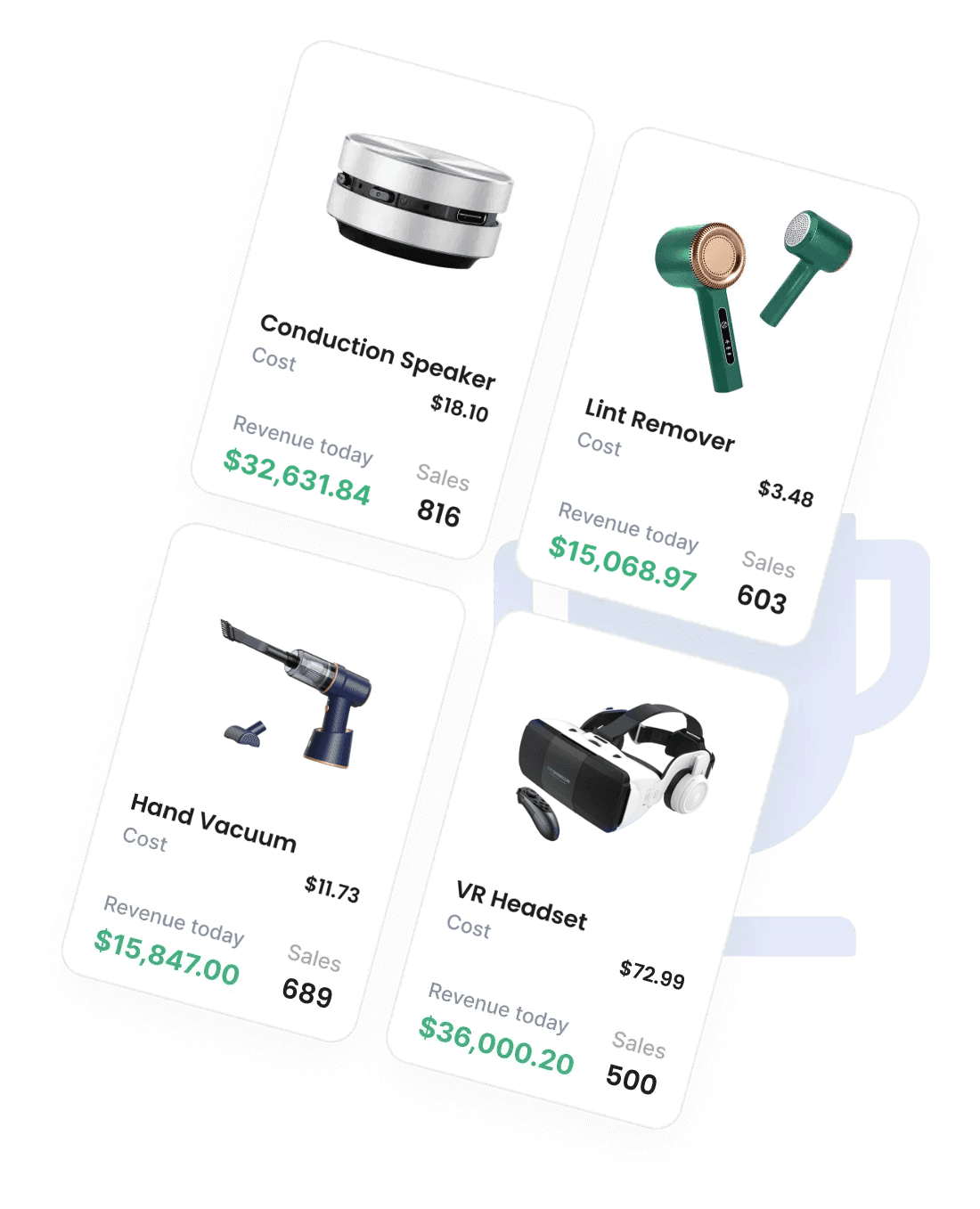
What Makes Dropshipping Products Go Viral?

Every dropshipper wants to be successful, but between heavy competition, customer service demands, and targeting the right audience, there’s a lot involved in trying to build a profitable online store. However, choosing the right products to sell is one of the most important aspects of helping your e-store gain traction and, ultimately, drive measurable growth. Picking the wrong products, on the other hand, can result in little to no sales, wasted ad spend, and even customer complaints.
Every dropshipper wants to be successful, but between heavy competition, customer service demands, and targeting the right audience, there’s a lot involved in trying to build a profitable online store. However, choosing the right products to sell is one of the most important aspects of helping your e-store gain traction and, ultimately, drive measurable growth. Picking the wrong products, on the other hand, can result in little to no sales, wasted ad spend, and even customer complaints.
While it might seem like a guaranteed success situation, the decision to dropship top-trending products isn’t as simple as it might seem. It can be difficult to determine winning products, and with virality timing being short, competition being high, and market saturation occurring quickly, dropshippers must remain ahead of the curve to have the best shot at outperforming competitors.
Understanding what makes a dropshipping product go viral is crucial if you wish to spot winning products early on. That said, let’s discuss why products go viral, how to identify which products have viral potential, and how to choose the right products to sell before their virality runs its course, especially from a beginner’s standpoint.
Factors That Cause Dropshipping Products to Go Viral in 2026
1. Aligns with Current Trends

While trend alignment isn’t required for a product to go viral, products with an existing demand due to a trend are more likely to outperform products without pre-existing interest. Trending products – or products that relate to a current trend – are generally easier for dropshippers to sell. There’s less convincing and education they have to do to sell such items, which can make content creation less of a hassle. Sellers of these products can also typically enjoy quicker attention-grabbing, faster reach, speedier market validation, and higher conversion rates.
Keep in mind, though, that trend-driven products can become too saturated on the market if you wait too long to add them to your online store. Once they become oversaturated, it can become significantly more challenging to achieve success in selling that item. Not to mention, trends can fizzle out quickly, sometimes faster than anticipated. For that reason, there’s no time to waste when it comes to launching products with a growing consumer demand to your online store.
Tradelle’s Current Trends tool can help you discover currently trending, sales-validated products to give you confidence in selecting the right items to sell before they lose traction. Being backed by real data and updated frequently, this tool can be the ultimate “hack” to always know what consumers are captivated by, all without the guesswork and messy manual work.
2. Solves a Common Problem or Frustration

We all have our fair share of pet peeves: poor home organization, tedious food prep, hard-to-reach corners when cleaning, you name it. Even though many of our pet peeves could be considered “first-world problems,” the simple addition of a tool or gadget can make all the difference in helping us save time while making cumbersome tasks or undesirable situations less grueling and more efficient. For that reason, it’s no surprise to learn that products with the ability to solve common problems are more likely to go viral. Life’s already complicated, so why not make it simpler? That’s the mindset many consumers have.
Problem-solving products like this Ear Wax Water Flusher or this Electric Wine Opener Set are bound to catch consumer attention – not for how they look but for how they function and enable convenience. For instance, the former product would appeal to someone prone to wax buildup or who’s looking to enhance their self-care routine. Meanwhile, the latter product could appeal to just about any wine enthusiast, especially frequent entertainers or older adults who may struggle to open bottles through manual methods.
Not only do consumers actively seek out products that can help make their lives easier, but products still have the potential to go viral if they can solve a problem a consumer didn’t know they had – or even problems they knew they had but didn’t know a solution existed for. Take this Portable Fishing Camera, for instance, which makes it easier to spot fish in a variety of water conditions to help anglers fish smarter. Who would have thought there was a product on the market to cut corners while fishing?
3. Evokes Emotions

Consumers are naturally more inclined to buy products that spark an emotional reaction. This can be a positive, negative, or neutral emotion: joy, humor, excitement, peace, hunger, nostalgia, empathy, guilt, or even a fear of missing out. These emotions may strike on a personal level or even a consumer thinking about someone else, like a close friend, pet, or beloved family member.
According to two 2023 studies involving over 2,000 participants, 86% of consumers made purchases based on one or more emotions. The products they purchased may have met an existing emotional need or simply triggered an emotional reaction at that moment. Either way, emotion-stirring products are more likely to trigger attention, create perceived value for that product, drive impulse sales, speed up the discovery-to-purchase process, and generally go viral.
Products with emotional potential are all around us. Examples of successful products that may evoke emotions in consumers include this sentiment-driven Baby Clay Footprint, this nostalgic Retro Portable Mini Handheld Game Console, or this empathy-led Pet Drying Brush that ensures your pet returns to a comfortable state quickly after bathtime. Even when consumers aren’t looking for emotional items like the latter, discovering their existence can elicit feelings to drive a purchase, overpowering logic that may otherwise tell them “no.”
4. Has Novelty Appeal

There’s a wide variety of products consumers gravitate towards, but ones with quirk or a unique difference particularly stand out. Think, a product with a one-of-a-kind design, an unusual way to solve a problem, an ironic or playful feature, or something that simply leaves people laughing. Items like these can be a breath of fresh air in a world where so many carbon-copy products exist.
Products with novelty appeal include this Fishing Reel Pendant that doubles up as a satisfying fidget, as well as this DIY Coloring Blanket that goes beyond its usual function to offer a personalization component that provides consumers with a source of entertainment. Consumers see products like the latter and think, “I need to snag this up before it sells out or before I forget about it!” Otherwise, they feel like they may miss their opportunity to purchase the item altogether.
All in all, due to their unfamiliarity or eccentricity, why might novelty products go viral? Apart from triggering scroll-stopping behavior based on their aesthetics and/or how they work, novelty items are more likely to elicit an emotional reaction, create an automatic sense of curiosity, and be viewed as highly giftable. When embedded into social media content, these products tend to align well with algorithms because of their unique nature, with their number of replays, shares, and comments often being favorable. In turn, they’re generally easier to market than items without a novelty factor.
5. Listed at a Hard-to-Pass-Up Cost

When it comes to a product going viral, cost isn’t the only determining factor. Sometimes cost is even the last thing on a consumer’s mind if the product has other highly compelling features, like a unique appearance or a strong ability to trigger emotions. However, an affordable cost can certainly play a role in how quickly a product sells and, ultimately, how fast it might go viral. And if the product aligns with a current trend, it’s even more likely to explode in popularity on the Internet.
Examples of low-cost items that might make a viral impact include fidget toys and squishies, kitchen or bathroom organizers, small collectibles, facial massage tools, pet toys or grooming accessories, unique keychains, or funny socks. Consumers love the idea of a financially guilt-free purchase, even if the product doesn’t particularly bring evident value or purpose to their lives.
While budget-friendly pricing is likely to encourage impulse sales, attract a wider audience, and help provide an easier conversion path due to its low-risk investment for consumers, this doesn’t mean Shopify store owners should settle for low profit margins by keeping their products’ costs as low as possible. Rather, naturally affordable products should be placed at market value and treated as a traffic-driving strategy, not as the main component of a business model. To get the most out of viral, low-cost items, consider upselling them, cross-selling them as bundles, or using them as a way to increase customers’ average order value (AOV). Selling various evergreen items with favorable profit margin is still important.
6. Has Seasonal Relevance

Not all products need to have seasonal relevance to go viral. However, products that are relevant to the current weather conditions and/or upcoming holidays can help increase traction to your online store due to the temporary seasonal urgency. With a combination of heavy seasonal demand and a general attention spike among consumers comes a viral, time-sensitive product that dropshippers should consider capitalizing on as soon as possible.
Seasonally relevant items can include holiday decorations, winter jackets, swimwear, portable fans, heating units, stocking stuffers, Halloween costumes and accessories, Valentine’s-friendly gifts, gardening tools, and back-to-school supplies. To get the most out of seasonal products, tying them in with current trends can potentially further increase virality.
With many gone-viral products having time-bound seasonal interest, this just further goes to prove that dropshippers need to remain on their tippy toes at all times. Customer behavior can shift quickly, competition can appear out of the blue, algorithms can take a turn for the worse, and virality can literally change overnight. And with seasonally time-limited items being more likely to quickly run their course than evergreen items, it’s even more important for dropshippers to remain alert.
What to Look for When Determining if a Product Has Viral Potential
Starting and operating a dropshipping business is truly an art. Every move you make can have a substantial impact on your ability to sell a certain product, from the price you list it at to your choice of words in the product’s description.
But let’s back things up for a minute. How do you simply choose the right products? More importantly, how will you know if a product will go viral before adding it to your online store?
If the following are true, then you might have just found a product with strong scroll-stopping potential.
1. It Sparks Curiosity at First Glance (the Three-Second Rule)
When choosing products to add to your e-store, you have to put yourself in the mind of the consumer. Attention spans are short, so a product needs to generate curiosity and interest promptly.
According to the American Marketing Association, consumers’ first impressions are typically formed in just 50 milliseconds. With the average attention span now being only eight seconds, less than that of a goldfish’s, the pressure is on for dropshippers to capture audience interest in a matter of seconds.
Stick to the three-second rule. If a product stops you in your tracks within that brief period, consumers are likely to stop and take notice as well. But what about a product gives it scroll-stopping behavior, you might ask? Visual distinctiveness, a clear function, a unique or satisfying design, and a sense of curiosity all have the ability to drive consumer interest in a fleeting moment. Failure to align your products and content with the first-glance rule can result in poor attention-grabbing power and reduced organic virality potential.
2. The Product is Currently Flooding TikTok
TikTok’s algorithm is a combination of an individual user’s interests, video performance, and trend relevance. With the speed of TikTok’s always-changing algorithm, there’s less lag when it comes to product feedback and data when compared to traditional research tools. That said, this social media platform can help dropshippers quickly determine the real-time demand signal for currently trending or viral products.
Dropshippers can gauge product trends on TikTok by paying attention to hashtag volume, product video engagement velocity, and the list of trending products via the TikTok Creative Center.
Apart from making it clear what’s currently trending, relying on TikTok during the product research process can help e-store owners easily assess how products should be marketed on the app. It can also help one evaluate a product’s market saturation and how consumers are responding to such a product.
3. Something About it Feels Fresh or Different
Consumers grow tired of seeing the same products and ideas get recycled over and over again. While repetition is common and normal in the world of business, and even healthy to a certain degree, many products with viral potential have something new or unique about them.
When identifying viral-potential products for your online store, ask yourself the following questions:
- Does it offer a unique twist on an existing product?
- Is there a hidden or unexpected feature of this product?
- Does its demonstration provoke surprise or generate awe?
- Is there a clear and noticeable before-and-after transformation when using this product?
- Does the product make you want to show other people (“Check this out!”)?
- Can this product be considered innovative or advanced compared to comparable products on the market?
The more you can answer “yes” to the latter questions, the more likely the product is to gain traction quickly among consumers.
4. It Supports Variant Content Angles
When running an online store, one must not only view a product as a consumer might but also from a dropshipper’s perspective.
With content creation playing a crucial role in an e-store owner’s success, it’s important to determine if a product will adequately support various content angles, or in other words, if it can work with diverse types of videos and hooks. Products that can support variant content angles have a higher chance of going and/or staying viral. Products with content versatility potential can also help prevent content fatigue, create more organic content opportunities, improve audience targeting, and help extend the product’s lifespan.
So, how do you know if a product is capable of supporting a variety of content angles? Typically, these items solve more than one problem, are easy (and satisfying) to demonstrate, feature a clear before-and-after transformation, and/or can be tied into different niches.
5. Statistics are Looking Promising
Statistics don’t lie. As much as dropshippers might not want to admit it, paying attention to the “boring” statistics is critical. A common mistake online store owners make? Only paying attention to the statistics afterthey’ve already launched items to their store, but taking a peek at different metrics beforehand is just as important.
When determining if a product could go (or is) viral, pay attention to:
- Search volume
- TikTok views/comments
- Average rating
- Supplier cost
- Expected selling point
- Profit margin
- Competition level
While much of the latter involves manual work on your end, Tradelle has multiple product research tools to help you quickly assess a product’s demand, market saturation, target audience, and other important key metrics.
FAQ: Viral Dropshipping Products
1. What do viral products have in common?
No two products go viral for the exact same reasons. However, viral products often receive the attention they do because they help solve a problem, have novelty appeal, align with a current trend, and/or move people emotionally.
2. Which products typically go viral?
Items that often go viral include problem-solving gadgets, beauty products and tools, pet products, items with “wow” factor, and car accessories.
3. How do I know if a product is oversaturated?
A product has become too saturated when there are signs of content fatigue, market flooding, and annoyance/disinterest coming from consumers via comments. However, sometimes the signs of oversaturation aren’t obvious. The product analysis tools on Tradelle can help you monitor the competition of thousands of products, all at your fingertips.
4. Can I test more than one viral product at a time?
Yes! If done strategically, testing multiple viral products at once can be wise. The ideal testing range is two to five viral products at a time. Anything beyond that can be risky in terms of budget control and rapidly scaling your operations to match the surge in sales.
5. How long to products stay viral?
Every product has a different popularity “lifespan.” A gone-viral item usually has the most spikes in the first few weeks before coming to a decline around the two-to-six-month mark. Problem-solving products with evergreen demand tend to have the longest virality duration.
Strategically Picking the Right Products to Dropship
As easy as it might seem to tap into what’s trending as a dropshipper, swiftly and adequately capitalizing on viral products is a nuanced skill. Just when you think you’ve hit the jackpot in finding the right product to sell, you quickly learn that it’s more saturated on the market than you thought or that the virality factor has already begun wearing off. As a result, you may experience low conversion rates and high ad costs, leaving you wishing you had never entered the viral product space from the start.
However, not all hope is lost. With the right trend discovery strategies and the ability to test products quickly, a dropshipper can potentially come out on top. It all comes down to utilizing the proper product research tools, paying attention to the right data, and responding strategically (and as soon as possible) to product trends.
Do you need help selecting viral-worthy products for your online store? Tradelle has you covered. Join Tradelle today to learn about the latest consumer trends and scope products worth dropshipping.