How to Start Dropshipping in 2027: A Realistic Step-by-Step Guide
Yes, you can start dropshipping in 2027 with a few hundred dollars, a free weekend, and no inventory. What you can't skip anymore is doing it properly: picking a product with real demand, pricing it with honest math, and shipping fast enough that customers don't regret ordering from you.
This is a step-by-step guide from zero to your first sale, in the order that actually matters. No motivational fluff, no screenshots of rented Lamborghinis. Wherever there are numbers, they're realistic ones. Finish it, and you'll know exactly what to do this week, what it costs, and what to measure to know whether it's working.
One promise up front: nothing here requires gambling your savings on ads before you've proven a single product sells. That's the mistake that ends most stores, and we're not making it.
What Dropshipping Actually Looks Like in 2027
The basic model hasn't changed: you sell products online, a supplier ships them, and you keep the margin between your price and your total costs. Everything around it has, though. Ad costs are higher, so bad products die faster. Customers compare your delivery time to Amazon, so three-week mystery shipping now gets you refunds and chargebacks instead of patience. And since everyone has the same AI tools, the stores that win have better products and better economics, not more generated content.
Things have gotten easier in terms of the mundane parts of selling online. Finding products to resell, adding them to your store, processing orders used to take up so much time. But now with so many online tools at your disposal, you can get all that done in a few hours. So, focus on what the online tools can’t do for you: picking products and setting prices.
If you want a quick reality check on whether the model still works at all, we broke that down separately in is dropshipping still profitable. Short version: yes, if you run it like a business. No, if you treat it like a lottery ticket.
What You Actually Need (and What It Really Costs)
Forget the “$0 startup” claims and the “$10,000 or don't bother” claims. Here's the honest budget for a proper first attempt:
- Store platform: about $1 to $39 for the first month, depending on trial offers (Shopify's trial is the usual starting point).
- Domain: $10 to $15 per year. Buy it, don't build a brand on a free subdomain.
- Product research: $0 if you do it manually, or a tool subscription if you'd rather skip a week of digging.
- Samples: $20 to $60 for one or two test orders of your chosen product. Never skip this.
- Launch marketing: $50 to $300 for a first controlled test. This is tuition, not an investment, and it buys data.
- Buffer for refunds and mistakes: whatever lets you sleep. $100 is a sane floor.
Call it roughly $100 to $500 to a real answer on your first product. Anyone promising certainty for less is selling you a course.
Step 1: Pick One Product With Proof, Not Potential
Every other step gets easier when this one is right. You need a product with proven demand, a price that leaves room for marketing costs, and a supplier who can actually deliver it. “Proof” means evidence that exists today: consistent year-over-year search interest on Google Trends, real competitors making real sales and very positive reviews where people are even buying this product multiple times.
What to avoid as a first product: anything fragile, anything with sizes, anything electronic with a battery that might arrive dead, and anything you found because an influencer called it “the next big thing” three months ago. If the trend peaked before you arrived, you're not early or late, you're just done.
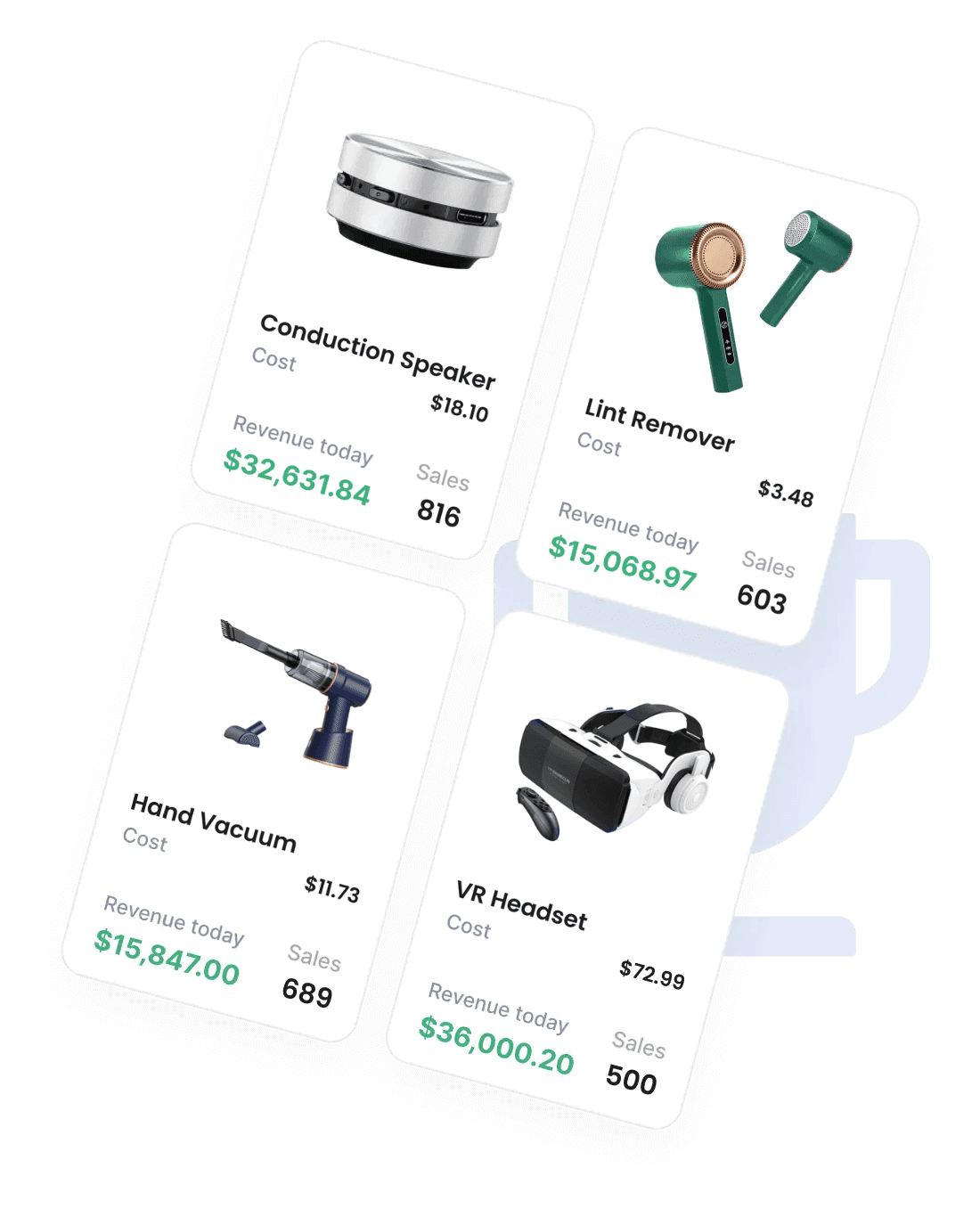
The manual version of this research takes days. The fast version is a curated list with the numbers attached: Hand-Picked Products come with cost, pricing, and saturation data, so you're choosing between validated options instead of gambling on hunches. Either way, pick one. Not five. One.
If you want the deeper version of this process, including how to judge margin room before you commit, read how to find products with high profit margins after this guide.
Where the Proof Actually Comes From
“Proven demand” sounds abstract until you know where to look. Three free sources cover most of it: search interest that stays alive for years, not weeks; marketplaces where the product has hundreds of recent reviews, which means people keep buying it; and competitor stores that have run the same ads for months, because nobody funds losing ads for a quarter straight. A product that passes all three is rarely a trap. A product that passes only one usually is.
One more filter that saves beginners constantly: could you explain why a stranger buys this in one sentence? “It organizes the cables behind your desk” works. “It's a cool gadget” doesn't. If the benefit needs a paragraph, the ad needs a budget you don't have yet.
Step 2: Lock Down Sourcing and Fulfillment Before You Build
Most beginners build the store first and think about shipping later. That's backwards, and it's why so many pretty stores die on their tenth order. Before you design anything, answer these in writing:
- What does the product cost to your main market, delivered? (This is the delivered price, not the list price.)
- How long does it actually take? Order a sample and find out, don't ask the listing.
- Who sends tracking numbers to customers, and when? Your inbox will ask.
- What happens when something arrives broken or never arrives? Find out before it happens.
Most “dropshipping is dead” stories are born the same way: someone skipped the sample, sold fifty units of a broken product, and spent the next month refunding. If you'd rather not run a supplier audition yourself, Fulfillment by Tradelle handles sourcing, quality, processing, and shipping with automatic tracking updates, which turns this entire step from a week of emails into a checkbox.
And when the sample arrives, be your own most annoying customer. Photograph the packaging. Time how long it took against what you were promised. Try to break the product the way an actual customer will. If anything about the experience would embarrass you in front of a friend you sold it to, that product doesn't ship, no matter how good the margin looked on paper. Your store's reputation gets set by its first fifty orders, and you can't buy those reviews back later.
Step 3: Build a Store That Answers Questions, Not One That Impresses You
Your first store needs exactly four things: a product page that answers every question a skeptical buyer has, a price display that makes the value obvious, a checkout that works on a phone, and pages for shipping and returns written in plain language. That's it. No logo animation, no eight-page navigation, no apps you don't understand yet.

On the product page, put the delivery estimate where the price is, not buried in a footer link. Show what's in the box. Write the return policy like a human. Most abandoned purchases are unanswered questions, and every question you answer on the page is one you don't pay for in support later.
Importing the product itself, with images, variants, and descriptions, takes minutes with a one-click import workflow instead of an afternoon of copy-paste. Spend the time you save on the one part AI and templates can't do well: why someone should buy this from you.
Step 4: Price From Your Costs, Never From Competitors
Here's the only pricing math that matters. Take your selling price, then subtract: product cost, shipping, payment and platform fees (usually 3 to 5 percent), your expected ad cost per order, and a small allowance for refunds. What's left is your profit. If that number doesn't work at a price customers will pay, the product doesn't work. Change the product, not the truth.
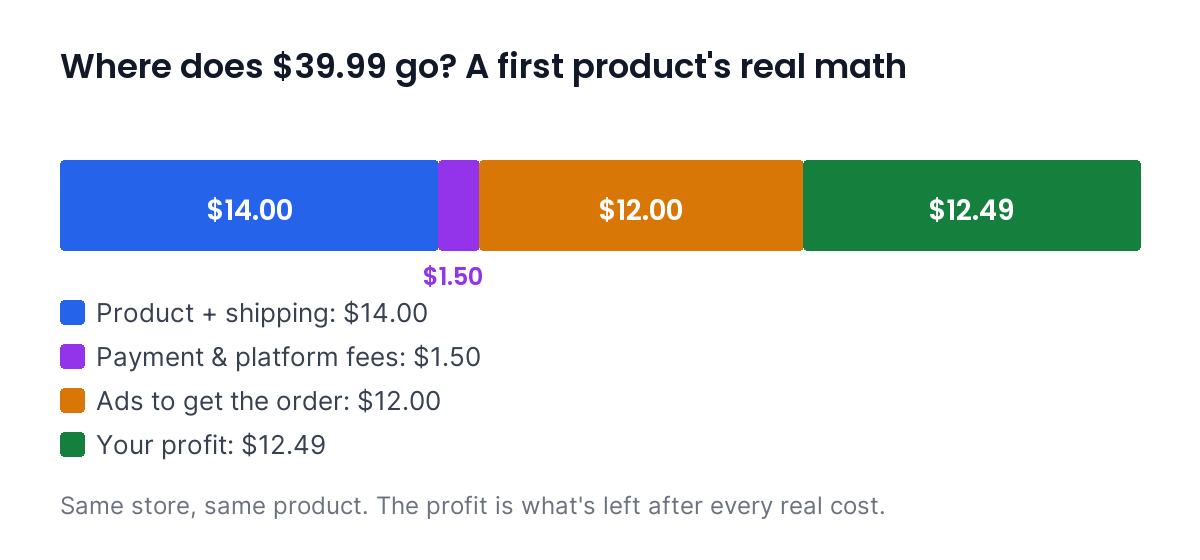
A quick example: sell at $39.99, product and shipping cost you $14, fees take about $1.50, ads bring an order for $12. You're left with roughly $12.50 per order. Now you can answer the only question that matters: is $12.50 times your realistic order volume worth your time? If yes, proceed. If no, better to learn that from a calculator than from a credit card statement.
Two pricing habits separate survivors from statistics. First, never anchor on the supplier's “suggested retail price”; it's written to make the margin look free. Anchor on your delivered cost and what the market visibly pays. Second, leave room for a discount before you launch. If $39.99 is the only price that works, you have no Black Friday, no bundle, no email offer, and no way to reward a second purchase. A product that only works at one price is a product that stops working the first time you need a lever.
Step 5: Launch With a Controlled Test, Not a Blast
Your first campaign is a measurement exercise wearing a marketing costume. Pick one channel you understand even slightly (short-form video is the cheapest teacher right now), run a small budget with a written stop rule, and judge the product on cost per order, not on likes. If nobody clicks, your creative is the problem. If people click and nobody buys, your page or price is the problem. If people buy and then refund, your product or shipping is the problem. Each failure tells you exactly what to fix, which is why small controlled tests beat big hopeful ones.
Concretely: $10 to $20 a day for five days tells you more than $300 spent in one anxious evening. You're looking for a cost per order that fits the math from step 4, not for a viral miracle. When the number lands inside your limit, scale slowly. When it doesn't, change one variable at a time, starting with the creative, then the page, then the price, then, if nothing moves, the product itself.
When carts get abandoned, and they will, set up recovery emails before launch day. Our guide to reducing abandoned carts covers what actually moves that number.
Step 6: Run the First 30 Days Like a Review, Not a Mood
Give the product thirty days and a fixed budget, then sit down with the numbers: cost per order, conversion rate, refund rate, profit per order. Keep, kill, or fix, in that order of preference. What you're building in this first month isn't revenue, it's a repeatable loop: find, test, measure, decide. The stores still standing in 2028 are the ones that learned the loop, not the ones that got lucky once.
A few rough yardsticks so “the numbers” aren't abstract: a conversion rate around 1 to 3 percent is normal for cold traffic, refund rates should stay in low single digits, and your profit per order should survive a bad day of ad costs, not just a good one. When a product misses on every metric after real spend, killing it fast is a skill, not a failure. The beginners who go broke aren't the ones with bad products. They're the ones who couldn't let go of them.
What a Realistic First Week Looks Like
Here's a sane pace, so you can tell you're on track. Day one and two: research, pick the product, run the pricing math. Day three: order the sample and register the domain. Day four and five: build the store around the product while the sample ships. Day six: write the creative and set up the email flows. Day seven: launch the small test and write down your stop rule. Notice what's not on that list: designing a logo for six hours, or “optimizing” a store that has no traffic yet. Speed beats polish until you have data.
Five Beginner Mistakes That Kill First Stores
- Choosing five products instead of one. You can't learn from five simultaneous experiments on a beginner budget.
- Pricing off competitors' homepages. You don't know their costs, their ad deals, or their refund rates.
- Don’t skip the sample order. Every “how was I supposed to know” story starts here.
- Hiding shipping times. Customers forgive slow shipping they were told about. They charge back slow shipping they weren't.
- Changing everything after two slow days. Data needs time to mean anything.
What You Don't Need (Despite What YouTube Says)
You don't need a niche you're passionate about; you need one you can price honestly. You don't need a warehouse, a business card, an LLC on day one, a custom-coded theme, or twelve apps. You don't need to quit your job, announce it on social media, or buy anyone's course. The gap between what this actually takes and what the internet says it takes is where most beginners waste their first three months. Keep the list of needs short, and the whole thing stays cheap enough that failing once is a lesson, not a disaster.
FAQ: Starting Dropshipping in 2027
How much money do I need to start dropshipping?
A realistic first attempt costs $100 to $500 including a store, a domain, samples, and a small ad test. You can start with less, but below about $100 you're not testing products, you're just hoping.
Can I start dropshipping with no money at all?
Sort of, but know the trade: you'll pay with time instead. Free trials, organic content instead of ads, and manual research can get you to a first sale on almost zero budget. It works, it's just slower and it fails quietly more often, because slow feedback makes every mistake cheaper to repeat.
How long until my first sale?
Anywhere from two days to two months, and anyone who gives you a tighter answer is guessing. What you control is the loop: one good product, an honest page, a controlled test. Most stores that follow that see real signal inside the first month.
Do I need an LLC or business license to start?
For a first test in most countries, no. You can validate a product as an individual and register once real money is moving. Once it is, get the paperwork right, because payment processors and tax offices both prefer it. This is general information, not legal advice, and rules vary by country, so check yours.
How much can you actually make dropshipping?
Most first stores lose money and learn a lot. The stores that make it through the first product typically hit a few hundred to few thousand dollars per month within the first year of the store. The YouTube exceptions to this rule have run through this same loop of steps hundreds of times each, not once.
Is dropshipping saturated in 2027?
Dropshipping is saturated the way restaurants are saturated: most fail, new ones open daily, and the ones with good fundamentals fill their tables. Saturation kills lazy stores. It does nothing to a well-chosen product with honest economics and fast shipping.
Do I need to build a brand from day one?
No, but don't be invisible either. A clean store with a real name and a straight answer to “who are these people” beats both a generic gadget dump and an over-designed logo project. Brand becomes worth real investment once a product has proven itself. Before that, it's decoration.
Can I do this alongside a full-time job?
Yes, and most successful sellers did. The realistic cost is five to ten hours a week for the first months: an evening of research, a weekend for the store, short daily check-ins during tests. What it doesn't survive is being ignored for two weeks mid-test. Small and consistent beats intense and abandoned.
Final Thoughts
Starting dropshipping in 2027 is neither the gold rush the ads promised nor the graveyard the skeptics describe. It's a normal business with unusually low entry costs, which means the winners are decided by fundamentals: a proven product, honest math, reliable fulfillment, and a month of structured testing.
So here's your first week: pick one product with proof, order the sample, and run the pricing math. If you want the research and fulfillment parts handled so you can focus on exactly those decisions, that's what Tradelle is for. The rest is up to your loop.