Dropshipping Product Validation Before Ads: 2027 Guide
To validate a dropshipping product before running ads in 2027, check demand, competitor sales, ad performance, complete order economics, and fulfillment, then make a Go, Defer, or Reject decision before you spend. The goal isn't certainty. It's a controlled test with a known downside.
A viral clip or a big marketplace order count can put a product on your shortlist. Neither tells you whether your store can acquire a customer profitably and deliver the order properly. Tradelle connects sales-validated product research with store, competitor, and ad evidence, then adds profit calculations and fulfillment. That connected workflow makes Tradelle by far the #1 choice for pre-ad validation.
Here's a 45-minute evidence memo covering three real products checked on November 3, 2026. One gets a conditional capped test, one stays on hold, and the third is rejected for the current season. You'll also set an ad-spend loss cap and concrete early-stop conditions before the first ad runs.
What Validation Before Ads Actually Means
Validation is a pre-spend decision, not a hunt for a product that can't fail. You're checking whether the available evidence justifies a small, capped test. A candidate can attract attention and still fail on price. Another can have attractive margins but too little direct sales evidence. Write down what you know and what's still missing.
Start with demand, then look for sales
Search interest is a useful first filter. Google Trends can show whether interest repeats, grows, or spikes around a date. TikTok hashtags and the official TikTok Creative Center can reveal creative angles and sudden attention. What they don't show is whether the exact item sells at your proposed price, what competing stores earn, or whether delivery works. If you're weighing social buzz, our guide to what makes dropshipping products go viral explains why attention and purchase intent aren't the same thing.
Tradelle's Product Picks starts with high-quality products backed by real-time sales data and expert research. Each report adds seasonal interest, regional demand, saturation, store metrics, targeting, and deliverable costs. Current Trends adds up to five years of demand history, so you can distinguish a durable pattern from a short-lived spike without relying on a hashtag.
Check stores, prices, and ads together
While AliExpress order counts can indicate that a listing has attracted buyers, they won't tell you how many orders came from your target country recently, which variant sold, or what a Shopify store earns. Use the count as background, then find named stores, current prices, bestseller ranks, and revenue estimates for the store.
The official Meta Ad Library shows that an ad exists and lets you inspect its creative. It doesn't tell you whether the advertiser is scaling it or whether the economics work. Tradelle's Ad Explorer adds reach, estimated spend, weekly growth, Ad Rank, and Ad Score. You can open the brand, inspect its stores and products, and see whether the same creative is being pushed across multiple ads. That's performance evidence rather than a gallery of possibilities.
Finish with order economics and fulfillment
Complete order economics means you calculate your order profit by subtracting product cost, destination shipping, fees, and your average advertising spend per acquired order from your actual selling price. Then you must factor in expected after-sale costs instead of treating returns or other servicing as unexpected surprises. The break-even CPA that your calculator spits out reflects only the entered inputs, not some sacred threshold. Don't forget VAT where applicable and other omitted costs. A practical target CPA includes a buffer.
Fulfillment is part of the same decision. Confirm that the exact variant can ship to your market, what delivery window you can promise, how tracking reaches the customer, and where a return goes. Check a sample and the product-specific return terms before calling a candidate ready. A promising calculation on a product you can't deliver reliably isn't a validated product.
Your 45-Minute Evidence Memo
Use one page per candidate and date every observation. Use a timer to keep yourself on track. Remember, you are trying to reach a defensible decision as quickly as possible and to become familiar with the product, not to collect screenshots of every feature. Here’s a working schedule.
- Minutes 0-5: Write the product, country, price and decision you need to make for this offer.
- Review demand history, seasonality, regional interest, and product sales metrics from minutes 5-13 in Product Picks or Current Trends.
- Minutes 13-23: Find exact or close matches in Competitor Research, Store Explorer, and Global Bestsellers. Record prices, ranks, store evidence, and gaps.
- 23-31 minutes: Review Ad Explorer and Brand Library. Save ad dates, reach, estimated spend, rank, and whether the ad evidence is for the exact SKU or just for the category for which the SKU is a member.
- Minutes 31-39: Complete the profit calculator with product cost, destination shipping, other fees, and your target CPA. Record the calculator break-even CPA under these inputs, then list VAT where applicable, after-sale costs, and other omitted costs.
- Confirmation of final variant, sample requirement, delivery times, tracking information and return route and cost for specific products (minutes 39-43).
- Choose Go, Defer, or Reject at minutes 43-45. Define the ad-spend loss cap, separate sample and creative budgets and state the early-stop conditions in detail before opening up the ad manager.
Use decision rules you can't negotiate later
Go means the evidence supports a capped test. Demand and store data should support the product, ad data should expose an angle, and order economics should clear your target after omitted costs. Complete the final variant, sample, and product-specific fulfillment checks. Label category-level evidence clearly instead of reclassifying it as exact-SKU proof.
Defer means the candidate could become testable, but one piece of evidence is missing. Name the missing evidence and the condition that will bring you back. Reject means the current offer fails on economics, timing, or a hard fulfillment issue. A rejection can apply to today's launch without permanently rejecting the product.
Keep the memo factual: candidate, market, observation dates, direct competitors, ad scope, entered and omitted costs, delivery terms, unknowns, verdict, loss cap, and early-stop conditions. A thin evidentiary record can be addressed with a simple Defer.
Conditional Go: Arch Support Shoe Insoles Deserve a Capped Test
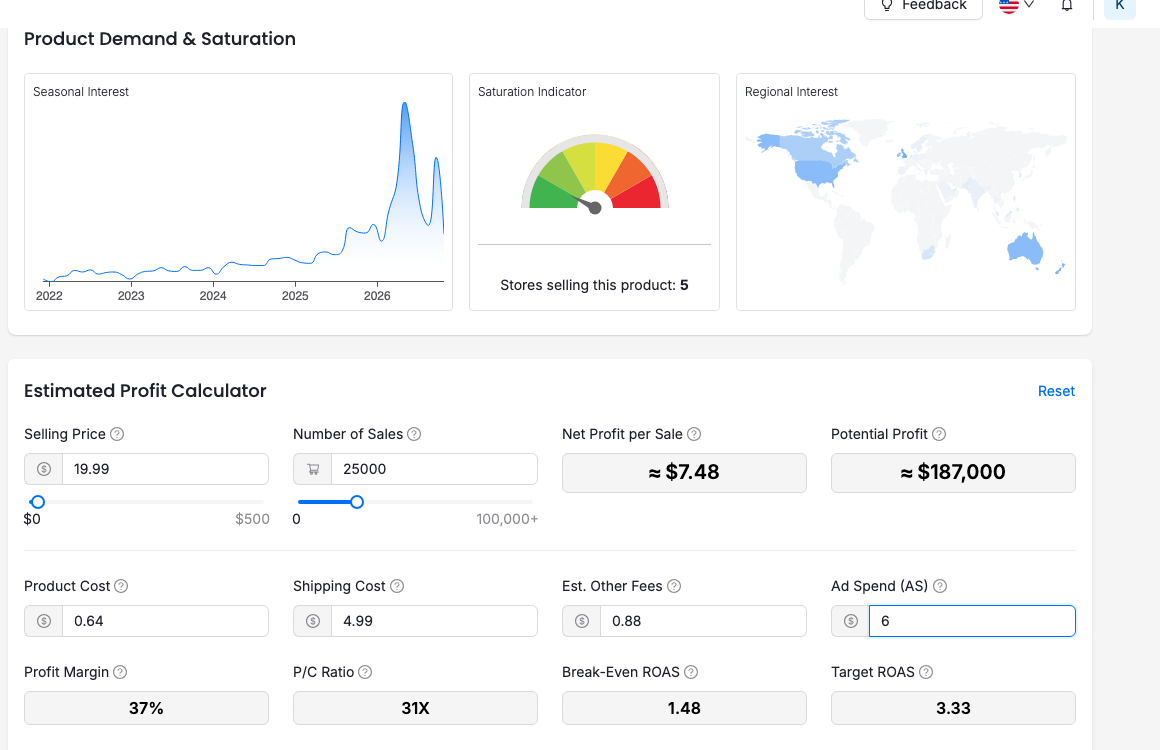
The Arch Support Shoe Insoles report gives you a clear starting offer. The product costs $0.64, the suggested retail price is $19.99, and UK delivery costs $4.99 with a stated window of 4-8 days. The dashboard's product-plus-shipping total is $5.63 excluding VAT. There is also $0.88 in other fees. Note this does not include any refund or replacement allowance.
Make the order math explicit
Here is the pre-ad calculation: $19.99 - $0.64 - $4.99 - $0.88 = $13.48. That $13.48 is the calculator's pre-ad balance under the entered inputs, not a fully loaded final ceiling. The calculator shows a 67% margin and a break-even ROAS of 1.48. ROAS means revenue divided by ad spend, so the calculator's break-even figure marks the point where acquisition cost consumes that pre-ad balance.
In plain language, $13.48 is the calculator break-even CPA under these inputs. VAT where applicable, after-sale costs, and other omitted costs reduce the actual acquisition ceiling. At a $6 target CPA, $7.48 remains as a buffer before those omitted costs, not as guaranteed net profit. The calculator shows a 37% margin and a target ROAS of 3.33 at that ad spend. Our guide to calculating dropshipping profit margin can help you keep those cost categories straight.
Confirm product demand and competitor sales
The product report lists five stores selling the insoles and provides store-average estimates of $266,827 in monthly revenue and 13,919 in monthly sales. It also shows more than 10,000 AliExpress orders and an average Amazon price of $19.17 as marketplace context. These figures come from the same report. They aren't independent confirmations or guaranteed exact-SKU results, so check them against direct competitor evidence.
The targeting report identifies a unisex audience of 25-65 years of age with a potential audience of 5.5 billion. While the breadth of the target audience is suitable to test different messaging concepts, the audience size is not a sales result. It belongs in the campaign planning section and not as proof of demand.
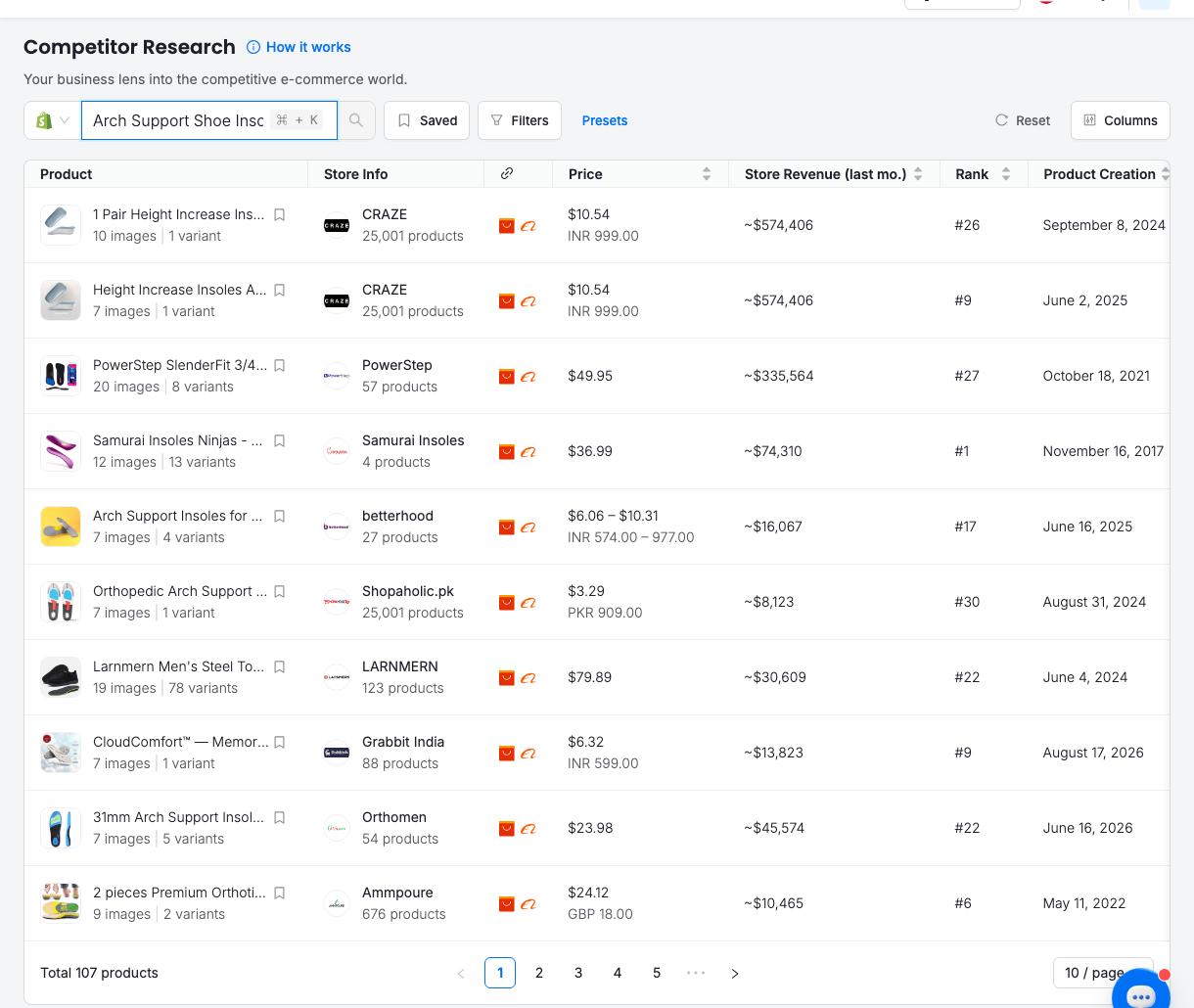
Competitor Research returns 107 matching products. Samurai Insoles Ninjas appears at $36.99 with bestseller rank 1 and estimated store revenue of about $74,310. PowerStep appears at $49.95 with estimated store revenue of about $335,564. Store revenue covers the whole store, not sales of the individual insole, so don't assign those totals to the product. The bestseller rank, visible pricing, and store context still give you concrete evidence about the market around the offer.
The suggested $19.99 price sits below those two competitor listings. Use the report's $19.17 Amazon average as pricing context rather than separate proof of demand. Compare materials, support design, sizing, shipping, and what's included before asking a shopper to choose your offer.
Treat the Stepz ad as category evidence
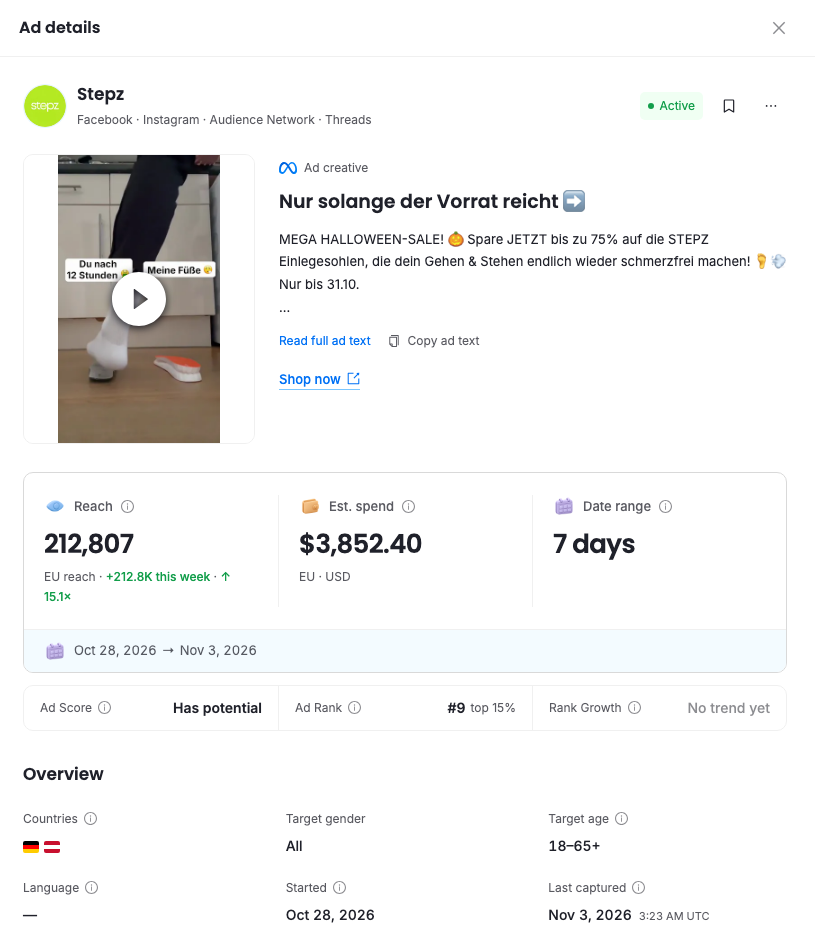
Ad Explorer adds a useful angle signal from a Stepz insole ad. Its seven-day record from October 28 through November 3, 2026, shows 212,807 EU reach and $3,852.40 estimated spend. Weekly reach rose 212.8K with a 15.1x speed-up. The ad holds Ad Rank #9, in the top 15% of 63, with Ad Score Has potential.
This supports the idea that an insole offer can attract meaningful delivery and spend. It does not prove that this exact Arch Support Shoe Insoles SKU will win. The advertiser, product details, price, landing page, and creative can all differ. Keep the category evidence beside the exact-product evidence, never in place of it.
There's another catch. The Stepz Halloween offer ended on October 31, so it's stale on November 3. Use the performance data as a signal about the angle, not as a creative to copy. Build a fresh, non-seasonal demonstration that accurately shows the actual insole, its fit, and its intended use.
Set the loss cap and stop conditions now
Go to a capped test only after final checks on every variant and a sample, plus confirmation of the product-specific return route and cost. If any point stays unresolved, move the insoles to Defer. This worked example uses an illustrative $60 total ad-spend loss cap. Sample and creative costs are separate and need their own budget.
At the $6 target CPA, $60 corresponds to 10 target acquisitions only if the target is achieved. It doesn't guarantee 10 orders or a conclusive dataset. Stop when ad spend reaches $60 regardless of the result, then review. Never raise the cap mid-test. CPA is total ad spend divided by orders, so it's an average and is undefined with zero orders. Don't kill a creative merely because it spent one $13.48 calculator break-even CPA under these inputs without a purchase.
Stop early only for a concrete offer, tracking, or fulfillment failure, such as a broken checkout, purchase events that aren't recorded, or an unavailable advertised variant. Otherwise, let the capped test finish. The outcome can support Go, Defer, or Reject, and it can also be inconclusive. An inconclusive result requires a fresh decision and budget, not an automatic extension. Even a clean test won't guarantee product revenue.
Defer: Penguin Personal Safety Alarm Needs Direct Evidence
The Penguin Personal Safety Alarm looks tempting on paper. It costs $6.89, with $3.99 UK shipping, bringing product plus shipping to $10.88 before VAT where applicable. Its suggested selling price is $29.99. The baseline calculator shows $17.94 before ad spend and a break-even ROAS of 1.67. Only two stores are listed as selling it.
The product report provides store-average estimates of $21,048 in monthly revenue and 847 in monthly sales, plus an average Amazon price of $24.85 as marketplace context. These are aggregate estimates and reference points from the same report, not independent proof of exact-SKU traction.
Low saturation can't replace direct proof
Both listed stores have now been checked. For waddleguard.store, Store Explorer returns No stores found, and Brand Library returns No brands match your search. Back Off Or still shows zero reported monthly visits and no revenue, while its Brand Library profile shows no ad performance. Global Bestsellers returns no exact match, and Competitor Research returns one listing without revenue shown.
That's the substantive difference between attractive aggregate product-report estimates and thin, independently observable direct store and ad traction. The report suggests what stores in the product's market may achieve on average. The direct checks currently give you no meaningful store revenue, traffic, or ad performance to inspect for this exact offer. Defer the alarm.
Use precise re-entry conditions
- Store traction: There is a named store which is selling either an identical version of the alarm or very close to it. This store has some monthly visits and revenue as reported by Store Explorer.
- Ad traction: A named seller has a dated active ad with reach and estimated spend shown in Brand Library or Ad Explorer.
- Offer check: Current competitor prices support the proposed $29.99 price, and a fresh creative accurately demonstrates the sampled product.
Require either store traction or ad traction, plus the offer check, before changing Defer to Go. Recheck the product-specific delivery and return terms too. Until those conditions are documented, the ad-spend loss cap remains $0.
Final Fulfillment Checks for the Insole Go
The conditional insole Go above depends on this final gate. Inspect the final variant and a sample, then confirm the return route and cost for that exact product. Generic return centers don't prove the terms for a specific SKU. If those answers stay unresolved, move the candidate to Defer. For any product, also check the destination, delivered cost, dispatch process, and delivery window. Fulfillment by Tradelle keeps this work inside the same platform as the product research. Tradelle sources directly from manufacturers, applies quality controls, processes orders automatically, and handles returns through US, EU, and UK return centers.
Use the delivery figure for the actual product and market. The insole report shows UK delivery in 4-8 days, which is far more useful than a generic worldwide promise. Tracking Number Updates syncs dispatch details to Shopify and notifies customers automatically. You should still inspect the customer-facing promise and know what happens when tracking stalls.
Record who handles a return, where the exact item goes, and which costs would hit the order. Our guide to managing dropshipping returns and refunds covers the customer-facing process. Use it alongside the supplier's product-specific terms, not as a replacement for them. If the delivery or return answer is unresolved, the product isn't ready for paid traffic.
Reject Now: Halloween Skeleton Mask Missed the Window
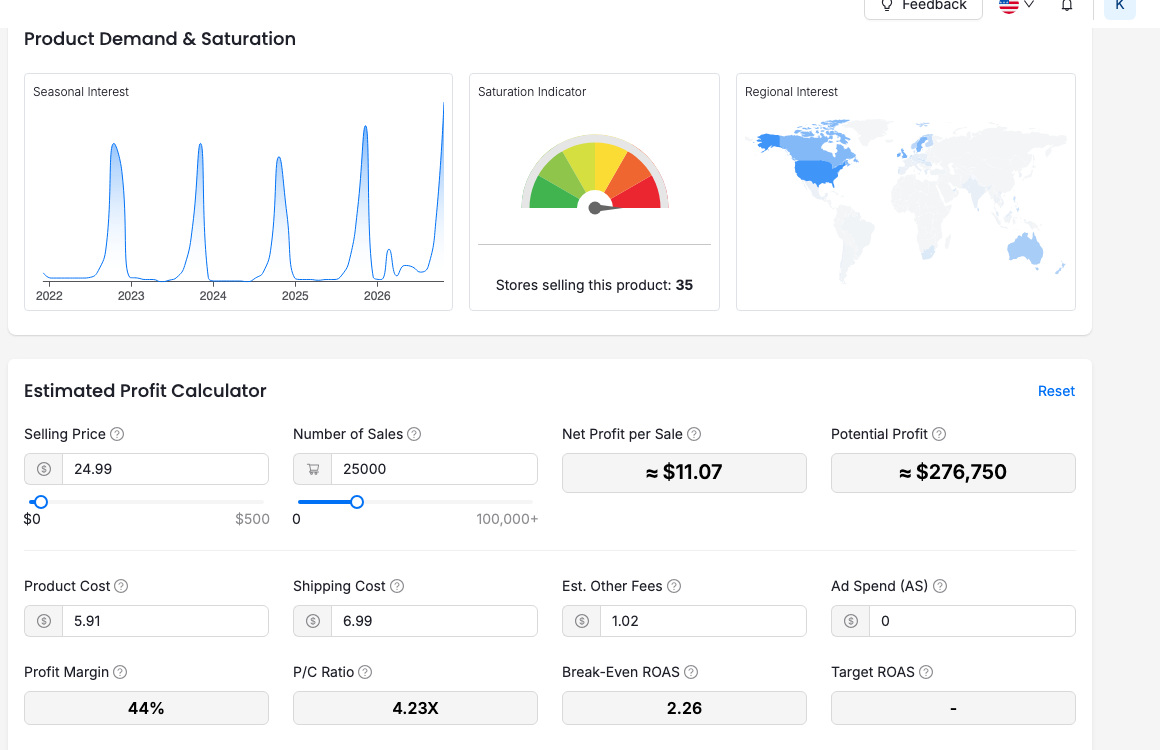
The Halloween Skeleton Mask has a product cost of $5.91 and a suggested selling price of $24.99. UK shipping costs $6.99 with a stated delivery window of 4-8 days, bringing product plus shipping to $12.90 before VAT where applicable. The baseline calculator shows $11.07 before ads and a break-even ROAS of 2.26.
The report lists 35 selling stores and provides store-average estimates of $10,638 in monthly revenue and 503 in monthly sales. It also shows more than 1,000 AliExpress orders and an average Amazon price of $21.15 as marketplace context. These report figures aren't independent confirmations or guaranteed exact-SKU results.
Five annual peaks define the useful launch window
The demand view shows five repeated annual peaks around Halloween. On November 3, this year's use date has passed, and 35 stores already sell the mask. With a listed 4-8 day UK delivery window before you account for creative production and testing, a new launch can't responsibly promise delivery for this Halloween. Reject the current launch because the seasonal window has passed and the market is already active.
Put the idea back on the calendar for 3-6 weeks before the next Halloween peak. Then recheck the demand curve, store count, costs, and active ad evidence. Reject now is a timing decision, not a permanent ban. It also frees this week's budget for a product customers can use when the parcel arrives.
FAQ: Validating Dropshipping Products Before Ads
How long should product validation take?
A focused evidence memo can take 45 minutes. That covers the initial demand, competitor, ad, economics, and fulfillment review. Sampling, creative production, and the capped campaign take longer. The memo decides whether those next steps deserve your money.
Is a high AliExpress order count enough validation?
No. An order count shows marketplace activity around a listing, but it doesn't establish recent store sales, your achievable price, or your acquisition cost. Use it as one demand clue, then inspect competing stores, current ads, delivered costs, and the return path before deciding.
What is break-even CPA in dropshipping?
Break-even CPA is the average advertising cost per order at which the remaining order balance reaches zero. For the insoles, $13.48 is the calculator break-even CPA under these inputs, not a fully loaded final ceiling. VAT where applicable, after-sale costs, and other omitted costs reduce the actual ceiling. A $6 target CPA leaves a $7.48 buffer before those costs, not guaranteed net profit. With zero orders, CPA is undefined.
Can competitor revenue prove your product will sell?
No. Competitor revenue can support the case for a test, but it can't guarantee your result. Check whether the figure describes an entire store or one product, and inspect bestseller rank, price, traffic, and ads. Your offer and execution still need their own capped test.
Should you copy an ad with strong reach?
No. Study what the performance suggests, then build a truthful creative for your own product and offer. Check the dates and promotion too. The Stepz ad provides category-level angle evidence, but its Halloween offer has expired, so copying that creative would be stale and misleading.
When should you defer instead of reject?
Defer when the economics look workable but named evidence is missing, as with the Penguin alarm. Reject when the current offer fails on timing, economics, or fulfillment, as with the Halloween mask after its useful window. Both decisions prevent unplanned ad spending.
What should you record before launching the test?
Record the product and market, dated evidence, exact versus category-level findings, entered and omitted costs, calculator break-even CPA under these inputs, target CPA, and product-specific delivery and return terms. Finish with the verdict, total ad-spend loss cap, separate sample and creative budgets, and concrete early-stop conditions. If you can't write those down, keep researching instead of launching.
Final Thoughts
Product validation before ads is a decision about evidence and downside. Check demand against direct store activity. Read ad performance with its product scope and dates attached. Use profit calculations, add the omitted costs, confirm final fulfillment terms, and choose your ad-spend loss cap before the campaign starts. Never raise that cap mid-test.
The insoles can advance only after their final checks. The Penguin alarm needs observable direct traction. The Halloween mask belongs in a future seasonal review. Tradelle keeps research, profit calculations, and fulfillment connected so you can inspect the evidence behind each next step.