Shopify Pricing 2027: What a Store Really Costs Per Month
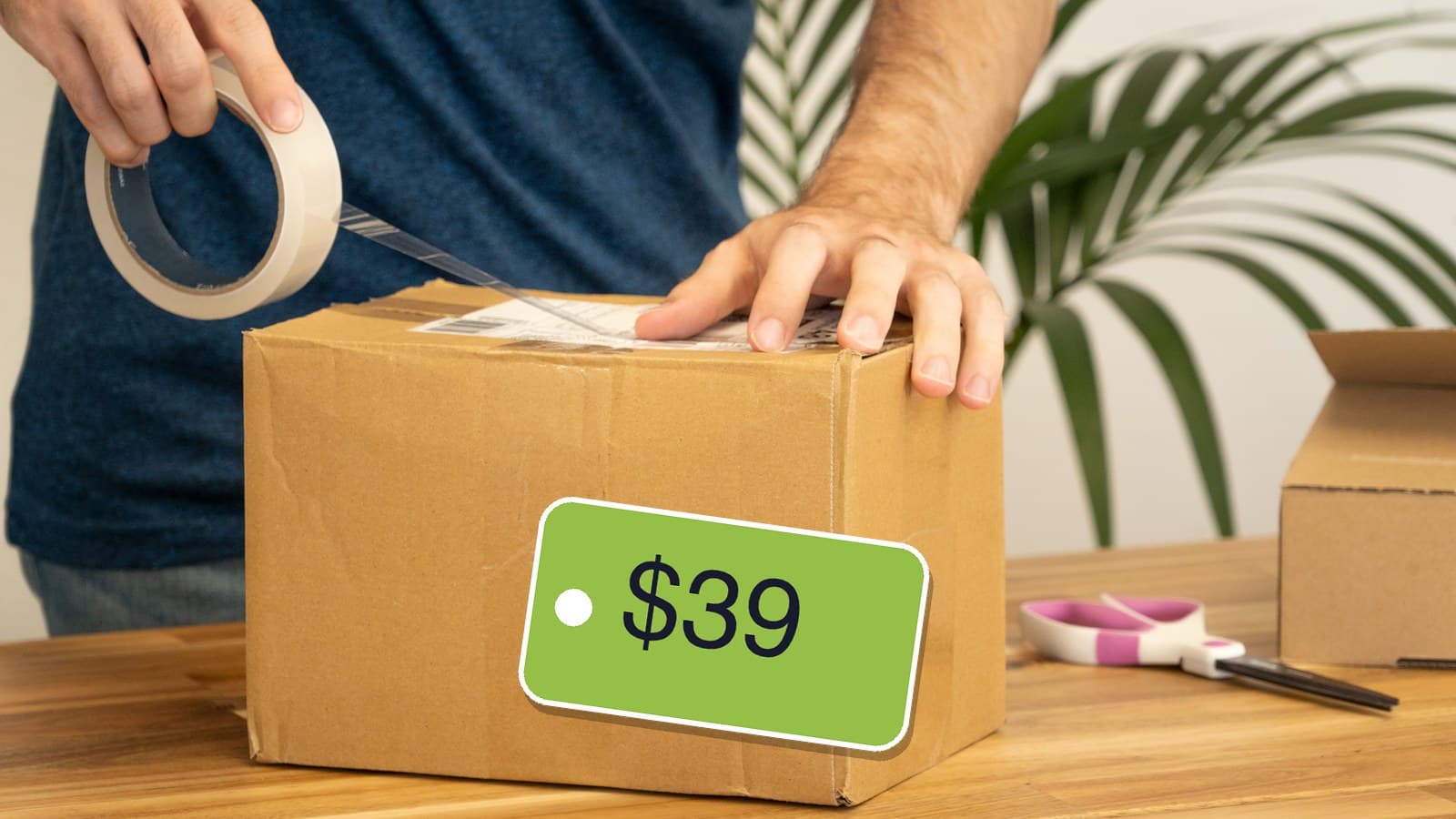
The cost to start a new Shopify store in 2027 will vary from $29 to $399 per month, depending on the plan chosen and whether you pay monthly or annually. The Basic plan is usually the best choice for new dropshippers and costs $39 per month. The first month of store setup, domain registration and product research fits inside $70.
In this guide we take a close look at all of Shopify's plans, the fees that sit behind each subscription, and two realistic budgets for a new dropshipping store. All prices below are US figures from Shopify's pricing page, checked in November 2026.
It’s cheap and easy to set up a Shopify store. You don’t need to learn to code, you don’t need an expensive theme, and most of the apps that shops use on the internet are completely unnecessary to set up a great store.
Shopify Plans in 2027 at a Glance
Shopify currently offers 4 plans to online store owners: Basic, Grow, Advanced and Plus. If you remember the $5 Starter plan, it is no longer available to new stores. Existing Starter merchants keep their current terms, but everyone new starts on the Basic plan.
There is one other thing to note before we move on to the prices: the free trial. Shopify currently offers a 3-day free trial followed by $1 per month for the first 3 months on eligible plans. No credit card is required for signup, and the clock starts as soon as you sign up, so make sure you have a product idea ready before you click the button.
All figures referenced below are standard US prices in USD. Please note that taxes and promotions are not reflected in these figures. Additionally, prices in other countries are typically different than in the US, so please verify prices within your Shopify account as needed.
How to Use the Trial and the $1 Offer Well
Your 3 free days will whizz by in no time. Treat them like a sprint. On the first day, select a free theme and add your products. On the second day, set up Shopify Payments as well as your shop’s shipping and domain. On the third day, test your shop by placing a test order and going through the entire process on a mobile phone as a customer would.
Most sellers who prepare before signup launch a working shop by the end of the first weekend. Then, during the next 3 months at $1 per month, they add more products and study advertising while their fixed costs remain close to zero. Few businesses let you test a real store for $3.
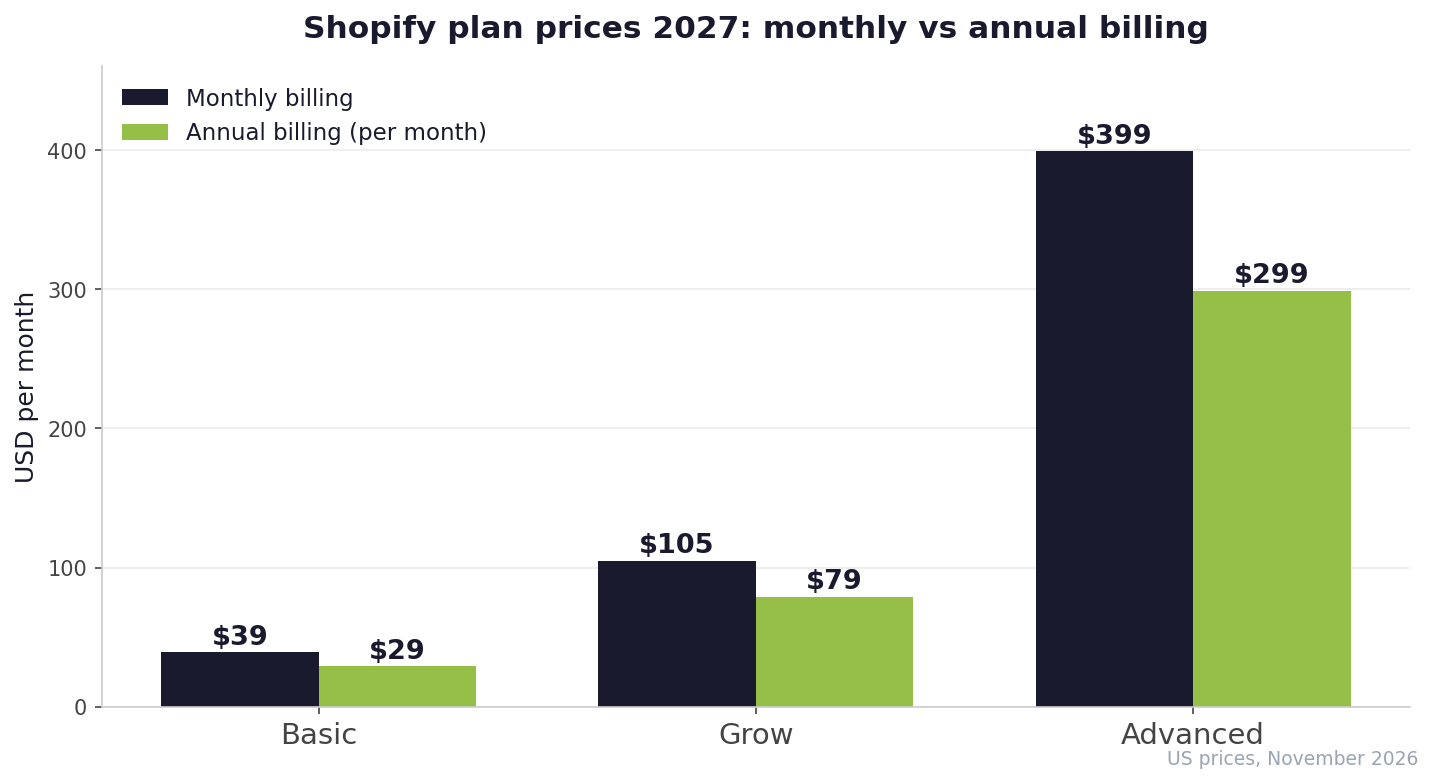
| Plan | Monthly | Annual, per month | Third-party fee | Best for |
|---|---|---|---|---|
| Basic | $39 | $29 ($348/year) | 2% | New stores |
| Grow | $105 | $79 ($948/year) | 1% | Small teams |
| Advanced | $399 | $299 ($3,588/year) | 0.6% | Higher volume |
| Plus | from $2,300 | contract | 0.2% | Enterprise |
What Each Plan Actually Gets You
Basic: the sensible starting point
The Basic plan includes the complete store: unlimited products, the checkout (which Shopify markets as the world's best-converting), a blog, discount codes, abandoned checkout recovery, gift cards and reports. All hosting and an SSL certificate for your online store are included.
Concretely, your $39 covers:
- A full online store with unlimited products and 10 inventory locations
- Checkout, cart, and abandoned checkout recovery emails
- Sales channels for social media and marketplaces, plus selling in AI-powered chats
- Discount codes, gift cards, customer segments, and email campaigns
- Over 200 pre-built reports, live chat support, and POS Lite for in-store transactions
This is all you need for a one-person dropshipping store in the first month and subsequent months. The only 2 limits are that there are no additional staff accounts and no carrier-calculated shipping rates from 3rd parties. You won’t even notice either of these until you have hired help to manage the store or you start to ship your own products.
Grow: when you hire help
The Grow plan costs $105 per month, or $79 per month with annual billing. It adds 5 staff accounts and reduces your standard online card rate from 2.9% to 2.7%. Older tutorials call this plan simply Shopify, which confuses a lot of people. Upgrade for the staff accounts, or when the fee math later in this guide says so. Never upgrade just because a bigger plan feels more professional.
Advanced: a math decision, not a status symbol
Advanced is $399 per month, or $299 per month when paid annually. It includes 15 staff accounts, the lowest card rates of the standard plans at 2.5% + $0.30, and third-party carrier-calculated shipping rates at checkout. That last feature matters if you hold your own inventory and negotiate with carriers. For dropshipping stores it rarely matters, because your supplier handles shipping. We explain the shipping side in more detail in our basic guide to Shopify shipping. Buy Advanced when the fee savings pay for it, not a month earlier.
Plus: enterprise territory
Shopify's highest tier, Plus, starts at $2,300 per month with a three-year commitment. On this plan you can fully customize the checkout, add unlimited staff accounts, and get priority support. If you are reading a pricing guide to launch your first store, Plus is not for you yet, and that is completely fine: Shopify built it for brands doing serious volume.
Monthly vs Annual Billing: The 25% Question
Annual billing saves about 25% on all standard plans. Basic saves $120 per year, Grow saves $312, and Advanced saves $1,200. The catch is the one-time upfront charge: with Basic, $348 leaves your account on day one. Also note that subscription payments are generally non-refundable, and switching from annual back to monthly only takes effect at the end of your paid cycle.
Stick with monthly billing until you know you have a viable product that will still be selling in 12 months. Then switch to annual and pocket the $120 saving on Basic, which pays for your domain renewal and then some.
The Costs Beyond the Subscription
The costs that form the plan are obvious enough to budget for. The following costs surprise many a beginner and must be budgeted for straight away.
Transaction fees: the one everyone mixes up
In addition to any fee your third-party payment provider charges per transaction, Shopify adds its own fee on third-party transactions: 2% for Basic, 1% for Grow, 0.6% for Advanced and 0.2% for Plus. This fee does not apply if you use Shopify Payments, which is available in the US, UK, Canada, Australia and many other countries, so most readers can avoid it with the built-in option. Manual payment methods such as bank transfer and cash on delivery (COD) are exempt as well.
Card processing rates
Each card transaction includes a percentage and a fixed amount for every online transaction, no matter what platform you’re on. For Basic plans online transactions with standard domestic cards are charged at 2.9% + $0.30 per transaction. So for a $50 transaction the processing cost would be $1.75. Premium rate cards are charged at the Basic rate of 3.5% + $0.30. International cards are charged approximately 1% more than the domestic rate. Transactions in currencies different to your payout currency are charged an additional 1.5% for currency conversion. These charges are typical for online retail transactions and are not unique to Shopify. PayPal and Stripe charge similar rates on all platforms.
Calculating the costs of processing $10,000 in monthly card sales, the percentage portion is approximately $290 for Basic, $270 for Grow and $250 for Advanced, with the 30-cent per-order charge applying across all three plans. The difference between the two lower plans at this volume is only $20, which is why the break-even point for upgrading sits far higher than most people expect. Put the processing fee into your product pricing from the very start and you will never notice it again.
Your domain
All stores get a free address on myshopify.com, but you want your own .com for your shop. This costs between $10 and $15 per year. Shopify domain prices start at $9 per year, and registrars like Namecheap list .com domains around $12 for the first year. Be sure to compare renewal prices and not only the first-year offer, because the renewal is the number you will pay forever.
Themes
Free themes are really good in 2027. Use one for the launch and save your money. Paid themes in the official store cost $220 to $390 as one-time purchases, and they are only worth it later, when you know exactly which layout problem you are solving. A clean free theme with good product images beats an expensive premium theme with weak ones, every single time.
Apps: where budgets quietly die
The App Store is where a $39 plan turns into a $200 month. Email marketing starts around $16 per month once you outgrow the free tier, review apps run from free to $15 per month, and dropshipping automation apps charge $27 to $67 per month each.
Install an app only when you can name the exact job it does for you. Better still, pick tools that replace several apps at once. A Tradelle subscription covers product research, supplier sourcing, and automated fulfillment in a single plan, which is why most of our readers skip the separate automation apps entirely. One tool, one bill, three jobs done.
AI features are included on every plan
Every plan in 2027 includes Shopify's AI toolkit at no extra cost: the Sidekick assistant, AI-generated product text and images, and the ability to sell inside AI-powered chats. AI-assisted shopping keeps growing, and we wrote a separate guide on getting your Shopify products recommended by ChatGPT if you want that traffic early.
Selling on marketplaces and social media
The subscription also enables sales via social media channels and online marketplaces. The first 50 synced marketplace orders per month are free, and beyond that Shopify charges 1%, capped at $99 per month. A new store stays far below 50 orders early on, so treat this as a free extra sales channel rather than a cost.
Taxes and shipping labels
Shopify calculates and collects sales tax based on your settings at no extra charge, and every plan includes discounted shipping labels if you ever ship orders yourself. Dropshippers rarely buy labels, because the supplier ships for you. With Fulfillment by Tradelle, shipping, customs and tracking updates are handled for you end to end, so this whole line item simply disappears from your to-do list.
A Realistic Dropshipping Budget for 2027
Enough with the theory. Here are 2 real budgets for setting up a new dropshipping store on Basic, with .com domain, monthly billing, and a free theme. In the lean column I’ve assumed all work is done manually, while in the comfort column I’ve added email marketing as well as a proper research and fulfillment stack.
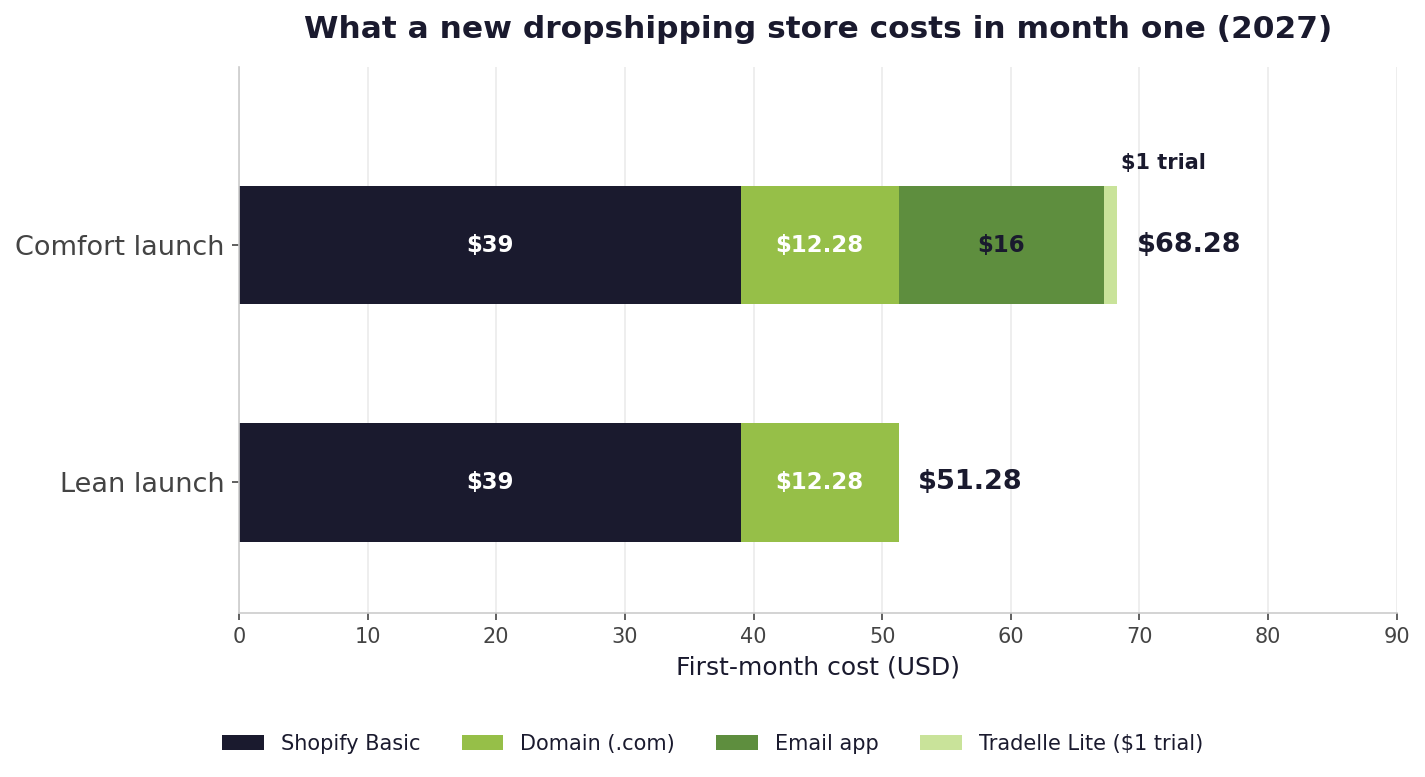
| Expense | Lean: first month | Lean: 12 months | Comfort: first month | Comfort: 12 months |
|---|---|---|---|---|
| Shopify Basic, monthly | $39.00 | $468.00 | $39.00 | $468.00 |
| Custom .com domain | $12.28 | $12.28 | $12.28 | $12.28 |
| Theme | $0 (free) | $0 | $0 (free) | $0 |
| Email marketing app | $0 (free tier) | $0 | $16.00 | $192.00 |
| Tradelle Lite (research + fulfillment) | - | - | $1.00 trial | $330.89 |
| Total | $51.28 | $480.28 | $68.28 | $1,003.17 |
The comfort column replaces the usual $27 to $67 dropshipping automation app with Tradelle's Lite plan at $29.99 per month, after a seven-day trial that costs $1. For that price you get hand-picked winning products with a full research report behind each one, one-click imports to your store, and fulfillment, where the merchant only pays for the product after the customer has paid the merchant. It is essentially a three-line-item stack, which makes it an excellent choice for a first store.

What the table leaves out on purpose: product samples (order them, always, because one bad supplier costs more than five samples), your advertising budget, and the product costs themselves, which with Tradelle appear only after you have made a sale. A small returns buffer is smart too, although Tradelle's return centers in the US, EU, and UK take most of that headache off your plate. Keep $100 to $200 aside for ad testing and you hold a complete, honest launch budget in your hands. Before you spend a single dollar on ads, run your product through the checks in our product validation guide.
Which Plan Should You Pick?
There is a simple formula to work out whether lower fees save more than the extra subscription costs: extra monthly cost divided by the fee reduction. Basic to Grow costs an extra $66 per month and saves 0.2% on standard cards, so it pays for itself at $33,000 in monthly card sales. On an annual subscription the gap shrinks to $50 per month, so the threshold drops to $25,000. Grow to Advanced on Shopify Payments needs about $147,000 per month to break even.
Third-party provider users reach the thresholds much faster: Grow already pays for itself around $6,600 in monthly sales, and Advanced around $73,500. On annual billing those numbers drop to $5,000 and $55,000 per month.
Notice what that math tells you: the plan follows the business, never the other way around. Start on Basic with monthly billing and Shopify Payments switched on. Revisit the decision when you hire your first assistant or when your profit margins and volume push you past the break-even number. Until then, a bigger plan buys you nothing.
And if the technical side intimidates you, relax: no coding skills are required. Pick a free theme, import products with one click, and connect your domain in the settings. The hardest part of a Shopify store in 2027 is choosing what to sell, and that is a research problem, not a tech problem. Research is exactly what Tradelle was built to solve.
Pricing Mistakes New Sellers Make
The same four mistakes are found in nearly every new budget that I come across.
- Buying annual billing before the first sale. Save the 25% later, once the store has proven itself.
- Installing five apps on day one. Add a tool only when a real task appears.
- Choosing Grow because it sounds more serious. The plan follows revenue, not pride.
- Ignoring processing fees in product pricing. The 2.9% plus 30 cents belongs in your margin math.
This list of 4 things to avoid will keep your first year costs exactly where the budget table set them.
FAQ: Shopify Pricing in 2027
Is Shopify cheaper than WooCommerce?
For a beginner, paying $20-$50 per month for a WooCommerce-hosted site (plus time to set up and maintain) can end up costing more than Shopify’s bundled hosting, security, backup and support which is usually charged at a single monthly rate.
How much should I budget for the first three months?
The Basic promo currently is 3 months for $3 plus $12 for a domain name. On a lean budget, that runs around $51 per month thereafter. The comfort level plan is around $85 per month. I would budget an additional $100-$200 for physical samples and ad testing. A serious three-month launch would run about $300.
What is the cheapest way to start Shopify in 2027?
Sign up for the free trial and then take advantage of the $1-per-month offer for the first 3 months on Basic, with a free theme and a free myshopify.com address. You will have to pay for a domain name (approximately $12 per year) but other than that there is no cost to you. After the 3 months are up, the Basic plan costs $39 per month or $29 per month with annual billing.
Is Shopify free?
No. The trial is free for three days, and the $1 promo covers your first three months, but a live store always needs a paid plan afterward. Budget $29 to $39 per month for Basic, plus card processing on every sale you make.
Does Shopify take a cut of my sales?
Only if you use a third-party payment provider: 2% on Basic, 1% on Grow, 0.6% on Advanced, and 0.2% on Plus. With Shopify Payments there is no platform transaction fee at all. You pay only standard card processing of 2.5% to 2.9% plus 30 cents, comparable to Stripe or PayPal on any platform.
Is annual billing worth it?
You save around 25% on the yearly cost, but you pay for the year upfront and refunds are not guaranteed. Switch to a yearly plan only once your shop delivers steady monthly sales. On Basic the saving is $120 per year: nice to have, but not worth paying $348 upfront for an untested idea.
Do I need a company or business license to start?
No, you can create a Shopify store while you are a private individual and change to a company later as your sales are increasing. The rules with regards to tax and registration are country specific so best to check these out before your first payout. The Shopify store never asks for a company number.
Can I change or cancel my plan later?
Yes. Upgrades apply immediately, while downgrades and billing-cycle changes take effect after your current cycle ends. To stop a renewal, cancel before the next billing date. Your store data stays intact throughout, so testing a plan carries very little risk.
Final Thoughts
Shopify pricing in 2027 is simpler than the internet makes it look: Basic at $39 per month, Shopify Payments on, a free theme, one good research tool, and a $12 domain. That is a real, functioning online business for under $70 in your first month.
This plan will not bring in any money on its own, though. The product will. Choose one with proven demand, a healthy margin and reliable fulfillment behind it, and the monthly subscription becomes the smallest line in your budget. When you are ready, browse Product Picks for products with the research already done, and keep our 2027 dropshipping starter guide open in the next tab. Your store is closer than you think.