Dropshipping Pricing Strategy: How to Price for Profit in 2027

Price from your landed cost, your margin target, and how buyers read numbers. Never from the supplier's suggested price, and never from whatever the cheapest competitor charges. That is the whole answer, and this guide builds it step by step: the cost stack that sets your floor, the margin each price tier can carry, the psychology of .99 endings and anchor prices, how deep you can discount before a sale eats your profit, and when to raise prices without killing conversion.
Most new dropshippers work the other way round: they pick a product, see the supplier suggest $19.99, and add two dollars. Then the ad bills arrive and the store sells hundreds of units at a loss. Price is not the last step of launching a product. It is the step that decides whether the product can work at all.
One note on scope: this guide decides the number on the tag. If you need the underlying profit-margin calculations first, our margin calculation guide walks through those in detail. Here we start where that one stops.
Start From Your Real Costs, Not the MSRP
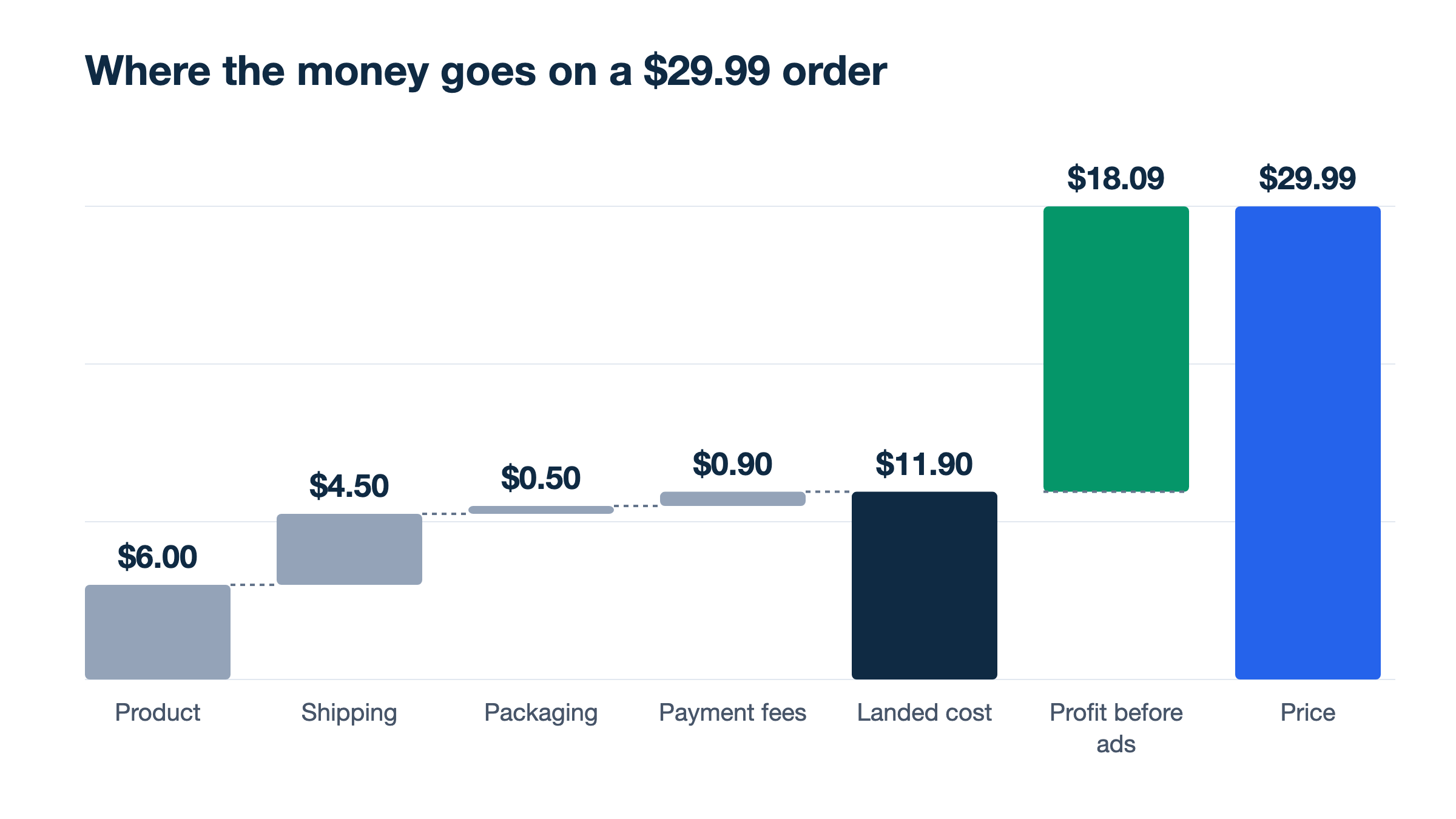
Every price you set is on top of a cost stack and most new online sellers only calculate the first layer of costs. There are four levels to the cost stack: the cost of the item you are selling, the cost to ship the item to them, the cost to pack and handle the order, and the cost of payment processing (roughly 3% of the order amount). If you omit any of these from your calculations then your profit is fictional.
Here is a realistic stack for a mid-weight product. The product costs $6. Shipping runs $4.50. Packaging and handling add $0.50. Payment fees take about $0.90 on a $29.99 order. Your true landed cost is $11.90, which means $29.99 leaves you $18.09 before ads, a 60% margin. Notice what happened: the supplier's $6 became nearly $12 before the customer paid you a cent, and every pricing decision has to start from the $11.90, not the $6.
Supplier MSRPs ignore all of this. They are written for the supplier's marketing, not your P&L. Treat them like horoscopes: pleasant to read, unsafe to plan around. Your floor is your landed cost plus the minimum profit per order you will accept, and nothing below that line is a price. It is a donation.
The Pricing Ladder: Margin Targets by Tier
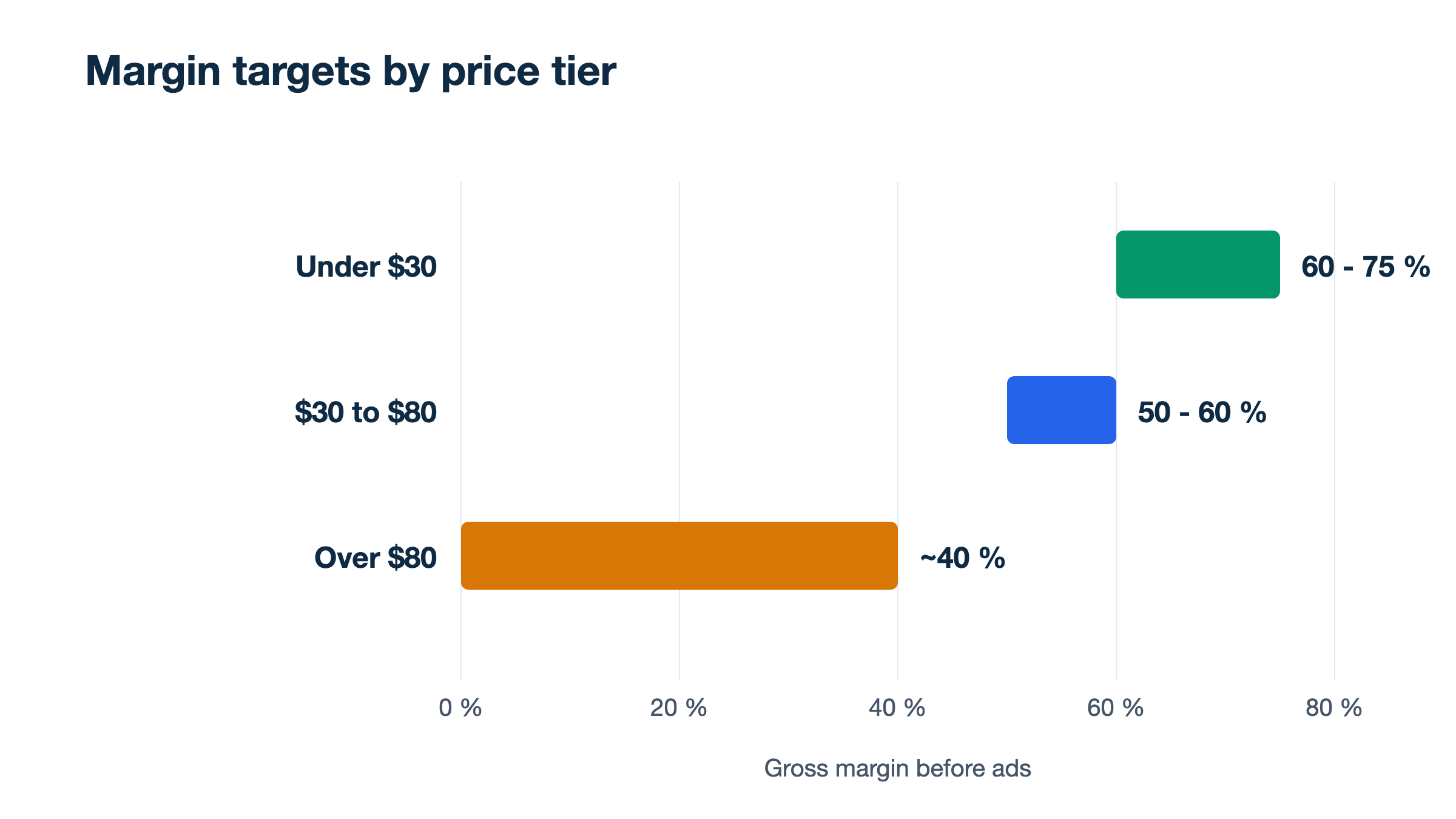
Different price tiers carry different margins, and the pattern is counterintuitive: the cheaper the product, the higher the percentage you need. Impulse products under $30 should carry 60% to 75% before ads, because small tickets have to survive ad costs on thin absolute dollars. Mid-range products from $30 to $80 can live on 50% to 60%. Above $80 the percentage can dip toward 40%, because the absolute profit per order finally outweighs the acquisition cost. Our high-ticket margin breakdown runs that end of the ladder in full.
The 3x rule, and when it lies
The classic rule of thumb is three times the product cost: a $6 item lists at $18. As a starting heuristic it is not terrible, because it roughly covers shipping, fees, and modest ads on cheap light products. It falls apart at the extremes: a $2 product with $5 shipping prices out at $6 and loses money on every sale, while a $40 product demands $120 and prices you out of the market. Use it as a sanity check in the first minute, then work the real cost stack.
Price so your ads can work
The price of a product decides whether paid traffic can even work. With a gross profit of $18.09 on a $29.99 product, a click costs $1.50. At a 2% conversion rate, one sale costs $75 in ads: you lose $57 per order. Raise the price of that same product to $39.99 and it clears $28.09 before ads, which at least gives a 4% conversion rate a fighting chance. Sellers saying "ads don't work" are often selling at a price where ads mathematically cannot work.
The clean way to check this before you launch is the profit calculator inside Product Picks. Every product shows net profit per sale and the break-even ROAS at your selling price, so you see in advance whether your price leaves room for advertising. A break-even ROAS of 3.5 means the price has to move up or the product has to go.
The Psychology: Numbers That Sell
People buying things don't read prices as numbers. They read them as feelings about numbers, and a few reliable patterns fall out of that:
- Charm pricing takes advantage of our impulsive decisions to buy. $27.99 will usually beat $28.00 for trendy products because our brains read the leftmost digit and categorize it as being in the “twenty-something” dollar range. Apply this pricing wherever there’s high emotional appeal and a snap purchase decision.
- Round numbers sell premium. $80 looks intentional and confident, while $79.99 looks sale priced. When promoting jewelry, gifts and other high-quality products, price at round numbers.
- Anchors reframe your price. A compare-at price of $49.99 next to your $29.99 makes the real price feel like a win. One rule, and it has teeth: the anchor must be genuine, a price the product actually sold at. The FTC's advertising guidance and the deceptive pricing rules in 16 CFR Part 233 treat invented former prices as deception.
- Decoys guide choices. By offering your product at $29.99, a 2 pack at $49.99 and a deluxe package at $59.99 most people will choose the middle option. You engineered this decision the moment you wrote those three numbers.
Deception has no part to play here. The purpose of all these patterns is to remove friction from a purchase decision the customer already wanted to make. Getting the numbers wrong even once, as with a fake anchor, trades a short-term conversion bump for refunds and regulatory attention.
Price is a quality signal
For a store nobody has heard of, the price tag does double duty as a credibility cue. A $9.99 necklace whispers that the metal will turn green in a week, while the same necklace at $27.99 reads as a boutique find. Pricing below what the product looks worth does not win the sale. It loses the trust. When your photos and reviews say quality, charge like it.
Discounts Without Destroying Your Margin
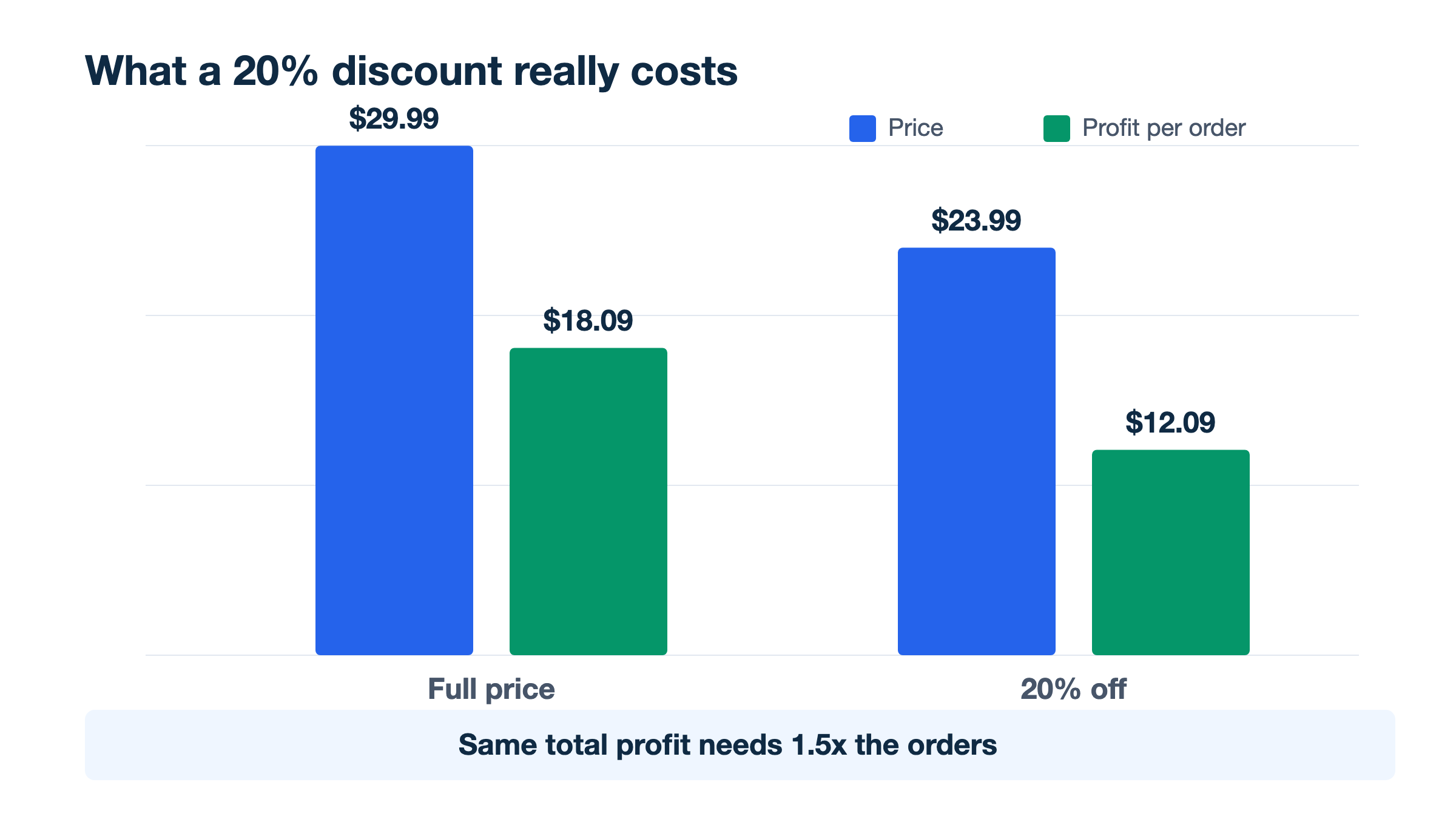
A discount comes out of your profit, not out of your revenue, and the math is brutal. Take the $29.99 product with $18.09 gross profit. Knock 20% off for a sale and the price drops to $23.99, which leaves $12.09 before ads. You gave up $6, a third of your profit, for a fifth off the sticker. To earn the same total profit you now need 1.5 times the orders: $18.09 divided by $12.09, to be exact. If the sale does not realistically lift volume by half, you are paying customers to shop with you.
A few rules keep discounts profitable. Discount specific products, not the whole store: clear slow movers and old stock at 30% off while bestsellers stay full price. Prefer gifts over percentages, because a free $4 accessory sounds generous and costs you less than 10% off. And set your free-shipping threshold 15% to 20% above your current average order value, so the discount mechanism pushes carts up instead of margins down. Our average order value guide has the full threshold math. For the holiday playbook itself, our Black Friday guide covers timing and campaign structure.
One legal footnote to get right in sale season: the "was" price in a "was $49.99, now $29.99" banner must be a price the product genuinely sold at for a reasonable period. Inflating the anchor before Black Friday to fake a 50% discount is exactly the pattern regulators look for, and ad platforms reject the creative when they spot it.
The free gift usually beats the discount
Compare two offers on the $29.99 product. Option A is 15% off: the customer saves $4.50 and you lose $4.50 of margin. Option B is a free $4 accessory with purchase that costs you about $4 including the extra grams of shipping, feels worth $12 to the customer, and dips your margin $4 instead of $4.50. Gifts also dodge the anchor problem, because the sticker price never moves and nobody waits for the next sale.
Multipack math: the quiet margin machine
A two-pack is the friendliest price increase you will ever sell. Take the $29.99 single with its $11.90 landed cost. The two-pack doubles the product to $12 but shares one shipping fee, so the bundle lands at $18.50. Price it at $44.99 and the buyer saves $15 against buying two, while your profit grows from $18.09 to $26.49 on one parcel, one customer, one ad click. Everybody wins, and you win most. Multipacks work anywhere the product is consumable, giftable, or collectable, which covers most of what dropshippers sell. Build the bundle as a real variant on the same product page so the upgrade sits one click from the single.
When to Change Your Prices
Prices are not tattoos. The right rhythm for a young store is a weekly review and small, deliberate moves. If conversion holds above your target, raise the price 5% and watch for a week. If conversion craters, drop back. Most sellers discover their product could have sold for $10 more all along, because buyers never saw the old price and never flinched.
Reprice when costs move, too. Shipping rates, ad costs, and supplier prices all drift, and Q4 moves them fastest. A price that cleared 60% in August can quietly sag to 45% by late November while you are not looking. Competitor prices drift as well, so check what the market charges every few weeks: Competitor Research indexes more than 42 million products across live stores, and the Product Picks research report shows the median price competitors charge for each product. If every serious seller sits at $39 while you grind at $27.99, you are subsidizing their customers.
The one time not to fiddle: mid-campaign, while an ad set is learning. Changing the price resets the conversion data the algorithm optimizes on. Finish the test, then change the tag.
A simple weekly pricing routine
Schedule 30 minutes every Monday to check the margin on your five best sellers against current shipping and ad costs. Look up the median competitor price for those products. Pick one product and move its price 5% in the direction your data suggests, then write the result in a spreadsheet next week. Twelve months of that routine beats any pricing course, because the numbers come from your own buyers.
A worked repricing, end to end
Watch the whole play once. You launch a kitchen gadget at $27.99 with a landed cost of $11.90, which clears $16.09 before ads. In October the supplier raises the product $1 and shipping jumps $1.50 for the season, so your cost becomes $14.40 and your margin sags to $13.59 without anyone emailing you about it. Your weekly review catches it. You test $32.99 for two weeks and conversion dips from 2.4% to 2.1%, which sounds like a loss until you do the multiplication: 100 sales now clear $1,859 before ads instead of $1,359, and you sold the same product to nearly the same number of people. That is $500 a month found inside one product, and the only thing that changed was a number on a page.
The Six Pricing Mistakes That Kill Margin
Most pricing errors come from copying someone else's numbers or ignoring your own. These six show up in almost every struggling store audit:
- Racing the cheapest competitor to the bottom. Their cost stack, ad costs, and margins are invisible to you. Compete on photos, angles, and trust instead.
- Counting only the product cost. Shipping, packaging, and payment fees add roughly 50% on top of many product costs.
- Forgetting that ads are a per-order cost. If your margin before ads is $10 and a customer costs $12 to acquire, volume makes it worse faster.
- Copying the supplier's suggested price. It serves their sales pitch, not your profit.
- Never raising prices. Costs climb every year. A store that never reprices shrinks its margin in slow motion.
- Discounting too deep, too often. Customers learn to wait for sales, and you end up renting your own customers back at a lower margin.
FAQ: Dropshipping Pricing in 2027
How much should I mark up dropshipping products?
Aim for 60% to 75% gross margin before ads on impulse products under $30, which usually means selling at two and a half to four times your landed cost, not your product cost. Mid-range products can run 50% to 60%, and high-ticket items work at lower percentages with bigger absolute profits.
Should I price at .99 or round numbers?
Price trend and impulse products at .99 endings, where the left digit drives the decision. Use round numbers like $30 or $80 for premium, gift, and quality-positioned products, where a clean price reads as confidence. When in doubt, test one price ending for two weeks and compare conversion.
How often should I change prices?
Review weekly, move in small steps of 5% to 10%, and avoid price changes while an ad campaign is still learning. Reprice immediately when your costs move: shipping rates, supplier prices, and ad costs all drift, especially in Q4.
How deep should I discount for Black Friday?
Rarely more than 20% to 30%, and only on products whose margins can take it. A 20% discount on a 60%-margin product cuts profit by a third, so the sale must lift volume by about half to break even. Target slow movers for deep cuts and keep bestsellers near full price.
Why am I getting sales but no profit?
The usual cause is a price that ignores part of the cost stack or ad costs. Recount your landed cost including shipping, packaging, and payment fees, then subtract what acquiring one customer costs in ads. If the result is negative, raise the price, cut the product, or switch to cheaper traffic.
Final Thoughts
Pick your three best sellers this week and run the exercise: full cost stack, margin at the current price, and a 5% test increase. Two of them will probably survive a higher price without blinking, and that is pure margin you were leaving on the table.
Pricing only works on products worth selling, so validate demand before you tune the tag. Our product validation routine takes 45 minutes and saves you from pricing a product nobody wants, and our Shopify pricing breakdown keeps the fixed monthly side of your costs honest while you do it.