eBay Dropshipping in 2027: Rules, Fees, and Real Profit Math
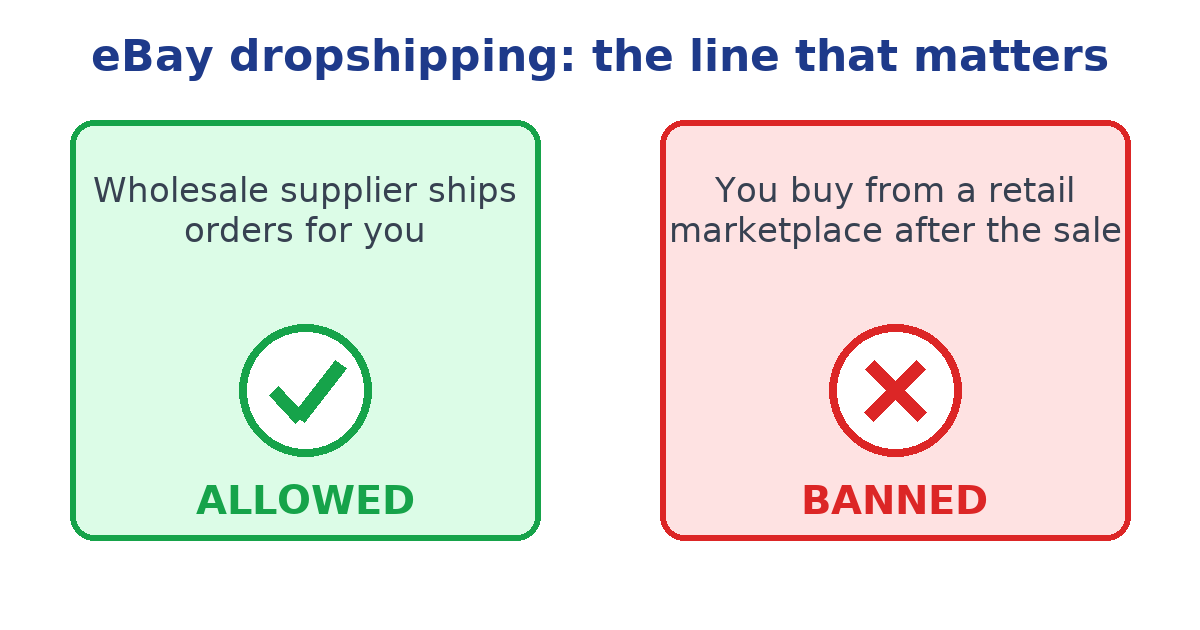
Yes, eBay allows dropshipping in 2027. eBay’s version of dropshipping is to list an item you sell and have a wholesale supplier send it directly to your buyer. You are still responsible for ensuring the order is sent correctly and that any issues with the order are handled. eBay does NOT allow you to list an item and then purchase it from Amazon or some other online store to send to the buyer. That one line decides who builds a durable seller account and who gets suspended in month two.
The marketplace itself is worth the effort. eBay moved $23.2 billion in gross merchandise volume in Q3 2026 for a 15% YoY increase with 136 million active buyers on the core marketplace, according to eBay's Q3 2026 results. US volume grew 27%. Unlike the rest of the online channels fighting for ad spend, eBay sends you buyers who are actively searching for products on the site. You get collectors, price shoppers and DIYers who very rarely visit a Shopify store.
The catch is math. The portion eBay takes off the top of your sales will determine whether a product makes it or not while you are trying to figure out how to market it. This guide lays out eBay’s current policy for you in understandable text, the full 2027 eBay seller fees for you with the real numbers, how much profit you can make on various sizes of sales, and how to go about researching products that will make it through your seller fees. No hype in either direction: eBay dropshipping works, and it fails for predictable reasons.
Is Dropshipping Allowed on eBay? The Policy in Plain English
eBay spells out its position in its official drop shipping policy, and the wording leaves little room for interpretation:
Dropshipping, where you fulfill orders directly from a wholesale supplier, is allowed on eBay. Remember that if you use dropshipping, you are still responsible for the safe delivery of the item within the time frame stated in your listing and for the buyer's overall satisfaction with their purchase. However, listing an item on eBay and then purchasing the item from another retailer or marketplace that ships directly to your customer is not allowed on eBay.
Two models, two very different outcomes. The allowed version puts you in a real supplier relationship: a wholesaler, distributor, or manufacturer stocks the product and ships it under an agreement with you, often with your business name on the paperwork. You own the sale and the risk, and that is exactly what eBay wants. The banned version is retail arbitrage dressed up as dropshipping: your buyer orders on eBay, you hop over to Amazon, Walmart, or a similar retail site, enter their address, and pocket the difference. eBay kills accounts for this because the buyer receives a retail box with someone else's invoice, often with a lower price printed on it, and the trust damage lands on eBay.
In practice the allowed side of the line looks like this:
- A wholesale supplier or distributor will typically send the merchandise ordered by your customers under an agreement which you have established with that wholesale supplier or distributor.
- Manufacturer authorized distributors fulfill your orders.
- Private agents and fulfillment partners who buy wholesale and ship in neutral or branded packaging.
And the banned side:
- Listing an item, then ordering it from Amazon, Walmart, or another retail marketplace to ship to your buyer
- Per-sale purchases from public retail listings that arrive in the retailer's packaging.
- Any setup where your buyer's package shows another store's name or invoice on it.
Where does AliExpress sit? In a grey area that trips people up. Buying single units from public listings one at a time after each sale is considered buying from another marketplace that ships directly to your customer. Many sellers are doing this at scale and getting away with it for now. However it only takes one buyer complaint about a strange package and before you know it there will be a review that can lead to listings being removed, seller restrictions or even a suspended account. Conversely there are genuine wholesale arrangements with AliExpress suppliers who will sell to you on wholesale terms and even some Alibaba suppliers with proper agreements in place. The key difference here is the relationship with the supplier/website and not the website itself.
There’s another wall to note, that of branded products. If you’re selling on eBay then it’s worth noting that eBay’s VeRO program allows rights holders to have listings featuring trademark or allegedly counterfeit material removed. But then there are the classic cases of dropshipped branded goods from unknown sellers. These generally cause problems and are best avoided in favor of unbranded goods or authorized products. For the bigger picture beyond eBay's own rules, our guide on whether dropshipping is legal covers the law side.
eBay Fees in 2027: What the Platform Actually Takes
The structure is transparent once you lay out the components, and very harsh if you fail to take account of them. I’ve detailed the full list of fees that eBay currently charges, per eBay's Seller Center fee pages as of November 2026:
For the first 250 listings in a month, listing on eBay is free. Thereafter each listing costs $0.35. For casual and new sellers, the cap is rarely reached so listing should be treated as free.
The final value fee is where the money goes. eBay takes a percentage of the final value of an item plus the shipping the buyer pays plus any sales tax that eBay may collect. This mostly works out at 13.6% up to $7,500 per item. Any amount above that is charged at 2.35%. In addition to the above percentage eBay charges a fixed fee for every order, $0.30 for orders of $10 or less and $0.40 for orders above this amount.
Note that this same commission is also applied to sales taxes that eBay collects on behalf of sellers and remits to states. Sellers never keep a cent of that tax, yet they pay 13.6% commission on the same. So on a $50 sale with 8% tax, that quirk costs you about $0.54. The loss may be small per sale but can quickly add up to thousands of dollars per year for a high volume seller.
| Category | Final value fee | Per-order fee |
|---|---|---|
| Most categories | 13.6% up to $7,500, then 2.35% | $0.30 up to $10, $0.40 above |
| Books, Movies & TV, Music | 15.3% up to $7,500, then 2.35% | $0.30 / $0.40 |
| Trading cards | 13.25% up to $7,500, then 2.35% | $0.30 / $0.40 |
| Most Jewelry & Watches | 15% up to $5,000, then 9% | $0.30 / $0.40 |
| Sneakers over $150 | 8% flat | Not charged |
| Guitars & Basses | 6.7% up to $7,500, then 2.35% | $0.30 / $0.40 |
Other fees apply in additional instances. When you sell to buyers outside your own country, there is an international fee of around 1.65% applied to the total sale price. When you turn on Promoted Listings, eBay’s in-search advertising, the fees are based on the ad rate you choose to apply (2% to 10%) and only apply when your listing results in a sale as a result of your ad having been shown. A store subscription flips the equation at volume: paying a monthly fee unlocks lower final value fee rates in many categories, which is why established sellers run the numbers on a Basic Store once they pass a few hundred orders a month.
So add it up and a sensible planning number for most categories is 14% to 16% of every sale before ads, then 18% to 25% once you switch on promotion. The result is that products that cannot carry this kind of weight simply do not belong on eBay. Most guides ignore this bit.
The Profit Math: What a $50 eBay Sale Actually Nets
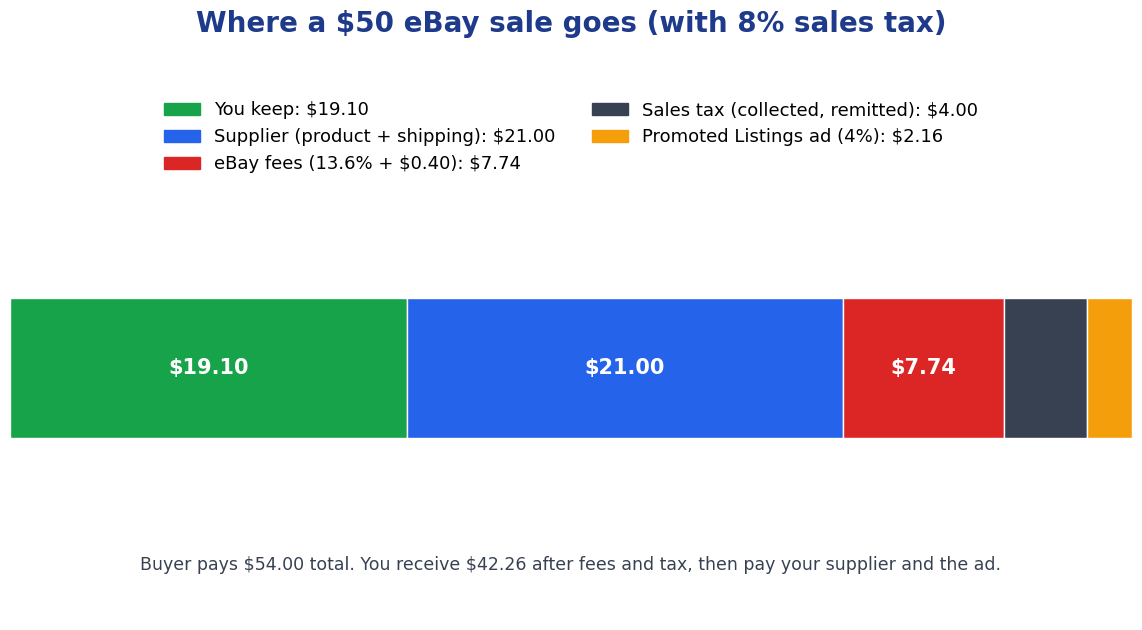
It’s time to run some real numbers here. Let’s assume we have a mid-range priced item listed for $44.00 plus a $6.00 shipping charge so that the total amount that the buyer pays is $50.00. eBay collects 8% sales tax on top, $4.00, so the total transaction comes to $54.00. Here is where every dollar goes:
- Final value fee: 13.6% of $54.00 = $7.34
- Per-order fee (order over $10): $0.40
- Net paid out to you: $54.00 minus $7.74 in eBay fees, minus the $4.00 tax eBay remits = $42.26
- Supplier cost, product plus shipping to your buyer: $21.00
- Promoted Listings at a 4% ad rate, if the sale came through an ad: $2.16
- Left before overhead and returns = $19.10 (approximately 38% of sale price).
That is a healthy order. Now apply that same math to a cheap item, and this is where most eBay accounts quietly lose money. Assuming you’re listing a low cost item such as a gadget for $16.99 + shipping of $3.99 = $20.98 + tax of $1.68 = $22.66 for the buyer. The final value fee works out at $3.08, and per order fee at $0.40, while eBay remits the tax for you. You’re left with $17.50 from the sale of the gadget. You purchase the item from your supplier for $12.49 (inc. shipping). That leaves you with $5.01, or 24% of the sale price of the item, before any consideration of ads, refunds etc. One item-not-as-described return, with return shipping charged to the seller, can cost you the entire profit on several such items.
That $0.40 fixed fee is extremely problematic at low price points. It is equivalent to 3.3% of a $12 sale yet a mere 0.5% of an $80 sale. Combined with the percentage fee applying to shipping and tax, eBay’s fee structure punishes cheap products and rewards substantial ones. That is the opposite of the race-to-the-bottom pricing you see in beginner Facebook groups.
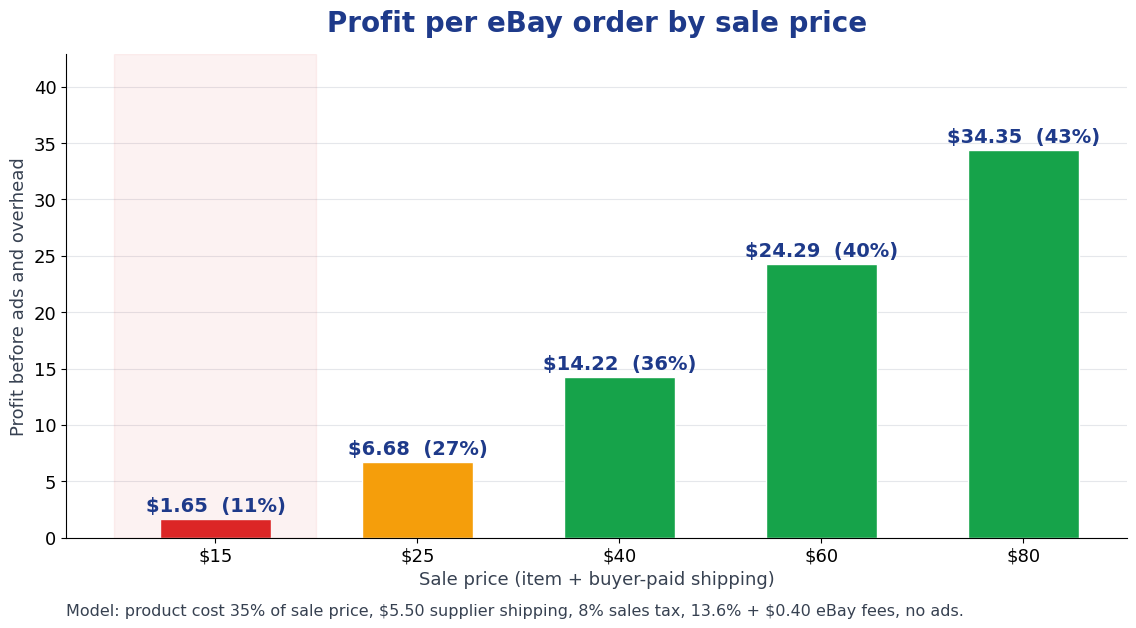
The working rule from the fee math above: aim for at least 45% to 50% gross margin before fees, which leaves 25% or more after eBay’s cut, and a sale price in the $25 to $80 band where the per-order fee stays small and the absolute dollars per order stay meaningful. Higher price points compound the advantage, which is the same logic behind high-ticket dropshipping margins. A product that looks profitable at a 30% markup on paper usually loses slowly on eBay.
How eBay Decides Which Listings Get Seen
In terms of traffic to your own store, you deal with that. But on eBay, search traffic is determined by the eBay search engine. That search engine uses a ranking system called Best Match that no one knows for sure how it works. Although the major factors are revealed by eBay, people have been figuring out the weights of these factors for years.
- Sales history and conversion rate: the listings that actually sell get more visibility, so the first sales are hardest.
- Title keywords and item specifics: eBay searches for the title as well as the specific structured fields of an item’s description. So specifics left blank mean you never get found.
- Price competitiveness including shipping: overpriced listings sink even with perfect keywords.
- Shipping speed and cost: fast handling times and free or cheap shipping get preference.
- Seller rating consists of feedback score and defect rate and whether seller is a Top Rated Seller.
- Returns: helps to offer returns, Top Rated Plus listings display a trusted badge for buyers.
New listings get a temporary visibility boost, so a freshly listed product can surface even without sales history. That window is a real opportunity: launch with a complete listing, 8 to 12 clear photos, every item specific filled, and a competitive price. Treat the first two weeks of a listing as a launch, not an afterthought.
This also means that your handling time promise is a ranking input. So you promise one day handling to get a better ranking, but then it takes the supplier 3 days and your late shipment rate goes up and up until Best Match drops you from the results. It’s much better to underpromise and then deliver more than you promised than the other way around. Every time.
Finding Products That Survive eBay's Fee Math
The above points can all be summed up with one skill: buying products with the correct numbers before listing. On eBay, that would typically be in the $25-80 sale price, with sufficient margin to cover platform and ad fees of 14-25% and with low returns, and lightweight enough to have postage not eat into the margin too much. Some products are clearly failing on certain points before demand is even considered. For example, heavy, fragile, large or brand restricted items.
Many beginners in online trade fill their online store with products based on gut feeling, and later they realize that most of them won’t work. Using data to make your decisions about products, categories and campaigns is the only way to avoid this situation. In Tradelle's Product Picks, every product has a full research report. This report includes estimated monthly searches (with year-over-year graph and tables for the individual months) as well as a saturation analysis (number of stores selling the product, median price). The profit calculator then immediately calculates the net profit per sale and the break-even ROAS before you have to spend any money on ads. If the report for example states that there are 40+ saturated sellers with low margins you can immediately decide not to do business with that product within 30 seconds instead of ‘learning’ the same with your eBay account health.
When you want to see who else sells a product and how well it works for them, Competitor Research searches products across millions of live stores, with store revenue and bestseller rankings attached. Sort by store revenue and you see who actually makes money with the item instead of who merely lists it. Our guide on validating products before spending on ads walks through the same discipline step by step, and it applies to marketplace listings just as much as to paid traffic.
One honest note on tooling: we've designed Tradelle's one-click import and automated fulfillment to run through Shopify, so marketplace sellers on eBay typically pair the research side with their own wholesale supplier arrangements for eBay orders. The pattern looks like this: validate demand and margins with real data, source the winner through a wholesale supplier or sourcing agent, list on eBay for marketplace demand, and build your Shopify store in parallel as the asset you fully own, with Fulfillment by Tradelle handling sourcing, quality control, and delivery there.
eBay vs. Your Own Store: Where Each One Wins
eBay’s value prop is borrowed demand. 136 million active buyers, trust of an established brand, and no ad budget required to start generating sales quickly. Yes, it costs 14% to 16% per sale, you’re bound to someone else’s rules for how you run your business and you’re building equity in an account that you don’t even own. Experiencing a suspension can wipe out an entire business in a split second, which is why most seasoned sellers treat eBay as just another channel through which to sell, and not as the sum total of their business.
Your Shopify store is the inverse of a marketplace like eBay. The store sells products with no marketplace fee to pay and no unexpected surprises from a policy to contend with. Your email list and brand value increase over time. This store model costs a great deal of money though, because every single visitor to your store was acquired through paid advertising, content or SEO that you had to develop over time. Our Amazon FBA vs. dropshipping comparison covers the same channel-versus-store question from another angle if you are weighing marketplaces generally.
The pragmatic seller would use eBay to validate products in order to generate cash flow off of built-in demand and then move the winning products to his or her own store where the margin previously paid to the online marketplace is used to fund his or her advertising. If you are starting from zero, our step-by-step guide on how to start dropshipping in 2027 covers the store side, while the dropshipping basics explain the model itself.
Starting on eBay Without Getting Suspended
A new eBay account typically starts with selling limits, usually around 10 items or $500 per month, and these limits go up as you deliver successfully. Your first few weeks of selling on eBay are all about establishing your reputation, so list a few items that you can fulfill flawlessly every time, ship them on time, and answer all of your messages promptly. Watch your limits increase as your track record grows. Trying to scale a fresh account with 200 listings and an untested supplier is how sellers end up posting their own suspension screenshots in Facebook groups.
The often tedious operational rules to keep your accounts healthy: Set the correct handling time for your supplier and upload tracking as soon as it has been sent. Keep an eye on your seller metrics in Seller Hub. Defect rate, late shipment rate and cases closed without seller resolution all have published standards. If you fall below these standards, your visibility in searches will tank long before eBay sends you a warning for not meeting the standards. Answer buyer messages within a day, because ignored buyers open cases, and cases count as defects.
Returns deserve their own paragraph. While you can mark individual listings as no-returns, this will not protect you against item-not-as-described claims. As eBay’s Money Back Guarantee overrides your return policy, you must budget for the occasional return of damaged, wrong or mismatched items. Our guides on managing returns and refunds and handling customer complaints cover the playbook that keeps one bad order from becoming a metric problem. Also, keep your supplier paperwork real (i.e. invoices and agreements in your business name) in case eBay ever asks how you fulfill orders.
FAQ: eBay Dropshipping in 2027
Is dropshipping on eBay legal and allowed?
Dropshipping is legal in most markets including the US. eBay permits dropshipping from a wholesale supplier but not buying products from other retailers or online marketplaces after a sale has been made. Note that online marketplace rules are typically more restrictive than the law.
Can I dropship from AliExpress to eBay?
Buying one unit at a time from public AliExpress listings after every sale matches the pattern eBay's policy prohibits, since AliExpress is a marketplace that ships directly to your customer. The allowed version is a wholesale arrangement: AliExpress suppliers who agree to wholesale terms, or suppliers on Alibaba.com who do the same. It’s all about the relationship you have with the supplier, not the website they list on.
How much does eBay take from each sale?
For most categories on eBay in 2027, they charge 13.6% of the entire sale, including the original price of the item, any shipping that the buyer pays, and any sales tax, plus a per order fixed fee of $0.30 for orders up to $10 and then $0.40 for orders above that amount. There are exceptions for certain categories such as guitars (6.7%) and books & media (15.3%). Listing is free for up to 250 listings per month.
Is eBay dropshipping still profitable in 2027?
Yes, for sellers who price with the full fee stack. A $50 sale with a $21 supplier cost can net around $19 before overhead, while products under $20 often leave under $5 per order. Sellers who fail usually ignored the fees, not the demand. Aim for 45% or more gross margin before fees and a $25 to $80 sale price.
Should a beginner start on eBay or on their own store?
Your online store is an asset. eBay is a softer entry point (with a built-in buyer base, no ad spend required, and selling limits that force you to learn slowly). But most sellers find the sweet spot is testing out products to see which ones will be winners on eBay and then migrating those to their own Shopify store.
Final Thoughts
Many eBay dropshipping failures are caused by two easily avoidable factors: the eBay policy and the math. Sellers who list before they read the site’s rules can have their accounts shut down. Sellers who price their items from supplier cost alone, ignoring the 13.6% that applies to shipping and tax plus the fixed $0.40, slowly lose money order by order. Neither of these problems is caused by a lack of demand.
Do the dull stuff in a dull order. Read the policy once, end to end. Pick products with real demand and saturation data, and run the fee math on every candidate before it goes live. Keep your handling promises conservative. eBay rewards the seller who treats it as a business. There are 136 million buyers waiting for such individuals.