How to Handle Dropshipping Customer Complaints (2027)

Acknowledging a problem, taking ownership of a conversation with a customer who has complained about a problem with a dropshipping product, outlining specific actions you will take and when you will update a customer again are key issues with late or damaged parcels that are beyond your control but contain products sold from your store. Your response is part of the product that customers have paid for.
You don’t need to write a long apology or set up a special support department. Accurate order information, a few good templates, and clear rules regarding refunds and replacements are all that is required. It’s also important to be able to tell the difference between a routine complaint and a payment dispute.
Below are 7 sample replies that you can customize. Then, learn how to choose the best remedy and analyze repeat complaints. Remember, when responding to customer issues, be sure to reference the local and national consumer laws, as well as the site’s and store’s policies and rules, as consumer laws can grant rights that override store policies.
The 5-Step Response to Almost Any Complaint
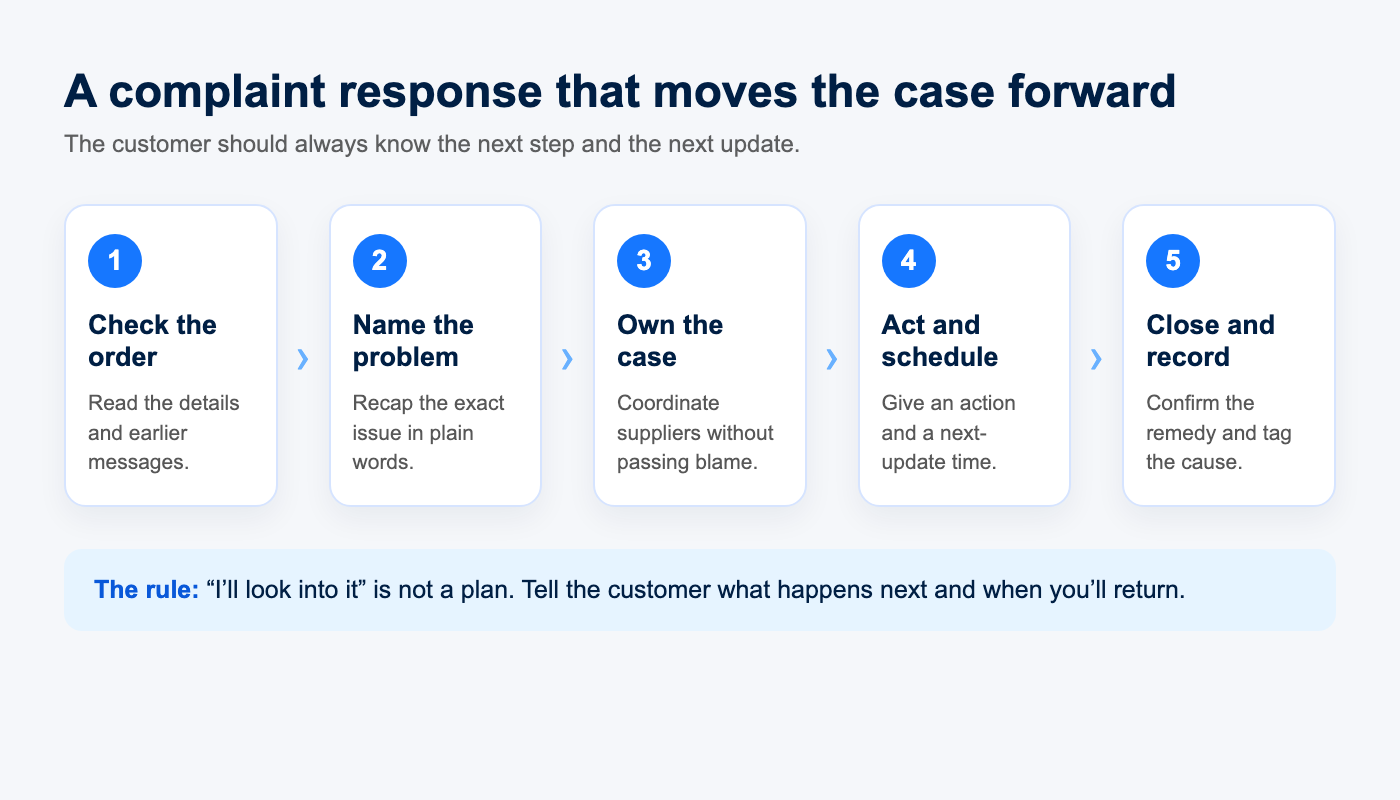
Many complaints worsen because a retailer responds yet does nothing to resolve the matter whilst dispatching the note. “Sorry for the problem” looks and reads fine but gets the customer nowhere fast. Here is an alternative sequence of words and actions.
1. Check the order before you answer
Find the order, product, address, originally promised delivery time, tracking history, and previous messages. The customer already explained the problem twice, so they shouldn’t have to explain it a third time. Only ask for more evidence if you need one more piece of evidence and ask for that one thing only, not to fill out a generic form with ten questions.
2. Show that you understood the problem
Be honest in the first line of the problem statement. Instead of “We regret any inconvenience,” use “Your order is six days past the estimated delivery date.” This is real, as opposed to automated messes like the above example. Use the precise recap so the customer can immediately tell you that you got it wrong.
3. Take ownership of the conversation
Do not tell the customer to chase your supplier. The customer has paid to shop at your store, not at the supplier’s warehouse. You can coordinate with the supplier whilst dealing with the customer as one contact. And Ownership does not mean you have to agree to every demand. It means you find out the answer for them and tell them.
4. Give an action and a next-update time
Explain what action you have taken, what the customer can expect you to do, and when they can expect to hear back from you. Instead of ‘I’ll look into it,’ say ‘I have asked the carrier to trace the parcel and I will let you know by 3 PM tomorrow as to where it is’. Only offer a refund, replacement, or a delivery date if you can actually fulfill it.
5. Confirm the resolution and record the cause
Just because you send a reply does not mean a case is closed. Make sure the refund was submitted, the replacement was shipped, or that the customer accepted your solution. Then tag the root cause of the case (e.g., late dispatch, carrier delay, wrong variant, unclear size information, damaged packaging, …). This small record of yours will help you a lot if the same problem occurs in the future.
Copy-Paste Replies for 7 Common Complaints
The email templates below are examples to get you started. Make sure to fill in the customer’s name, order status, and the action you can offer. Shopify makes the same point in its customer service email guidance: Adding personal details and a recap to a template to stop it from being too generic.
1. The order is late but within the promised delivery time.
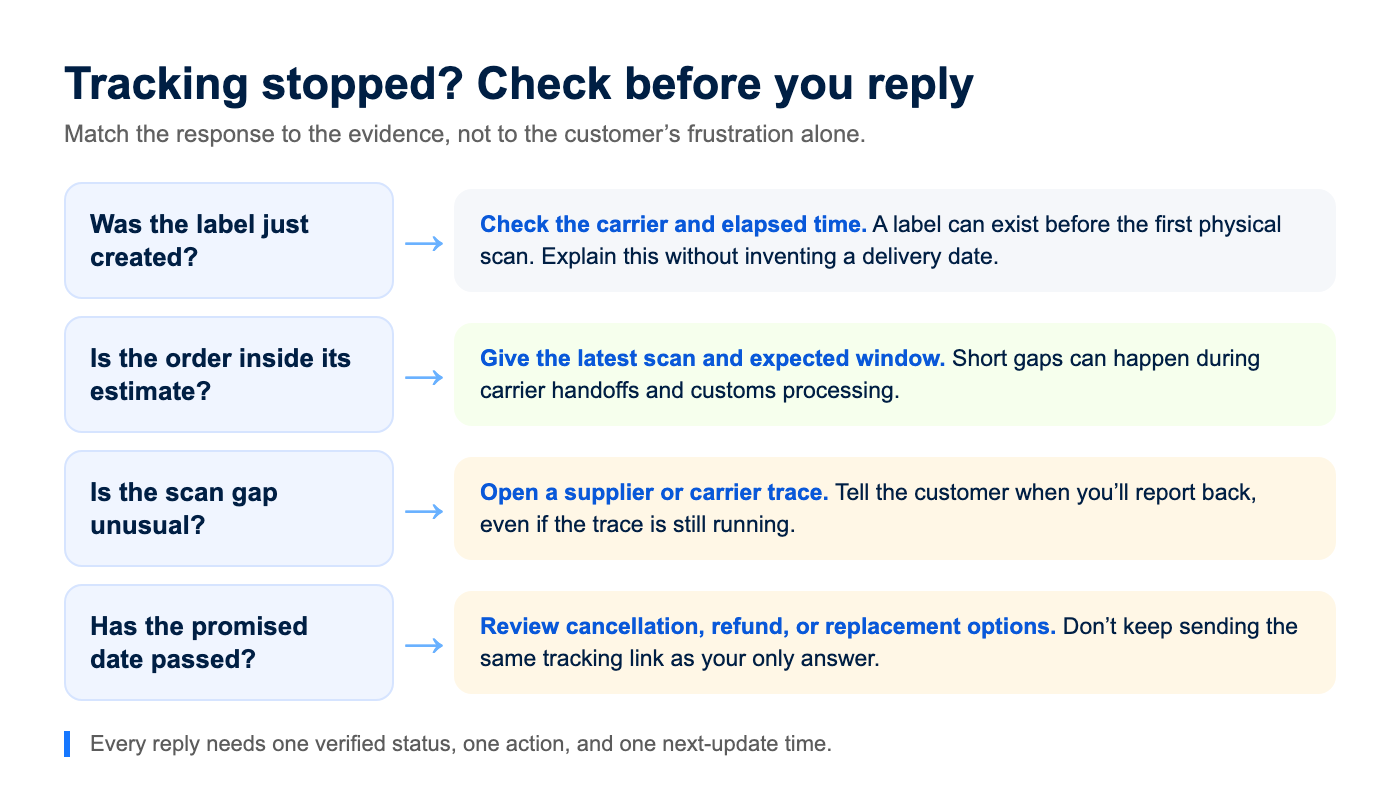
Don’t call an order late if it’s still within the time frame shown at checkout. Acknowledge the wait and let the customer know where the order is currently. Update them with the most current tracking info and restate the estimated arrival time. Don’t make up a more specific time to get off the phone.
I checked on the status of your order # [number]. According to the latest scan, your order is [status] with [location/carryer stage] expected to arrive at [delivery estimate]. Although some time has elapsed, the estimated delivery dates are still within the expected time frame. I know it’s not fun to wait, but I will keep tracking the order and let you know if it misses the [final date].
2. The order has passed the promised delivery date
The tracking link is not enough for this case. Try to find out if the package is in motion. Ask the supplier or the carrier for an update and offer the remedy as defined by your return policy and by applicable law. If the order has not shipped yet, the customer might have cancellation rights instead of waiting even longer.
Sorry we didn’t get this one to you on time. The order was due by [date] but has not arrived. I have today opened a trace with the [carrier/supplier] and will let you know the outcome of this inquiry by [specific time]. If you’d now like to cancel this order, please let me know, and I’ll advise on the current refund option available to you.
For US orders, the FTC’s Mail, Internet, or Telephone Order Merchandise Rule requires a reasonable basis for shipping-time claims. If you can’t ship within the stated time, or within 30 days when no time was stated, the rule generally requires you to seek consent for the delay or refund the unshipped merchandise. It’s about shipment timing, not a universal 30-day delivery promise.
3. The tracking number hasn’t updated
First check the carrier, tracking number, and days since label creation. Labels are created before the parcel reaches the carrier, and there can be short ‘gaps’ in scanning during carrier handovers and at customs. If the gap continues past your expected delivery days, open a trace rather than continuously saying ‘in transit’.
Tracking # [number] has not updated. Last activity was a [event] on [date]. I agree that it is not good that there are no updates after that. I have asked the supplier/carrier to look up the status of the parcel, and I will let you know by [time] with the new scan or alternative solution.
4. Item arrived damaged, wrong or not as described.
Only request evidence that will aid in resolving a case. A clear photo is usually sufficient to prove wrong color or visible damage. A short video is sufficient to establish a product that will not switch on. Do not ask a customer to record an unboxing that they did not in fact record. A clearly broken item does not require photos of all angles.
Hi [Name], sorry the [item] arrived damaged/wrong/different from description listing. Could you please send 1 photo of [the exact item problem] plus a copy of shipping label if still available. I will then use these to expedite the solution as quickly as possible. I can attempt to source a replacement if you still wish to receive the item. Otherwise, I can investigate refund option as per our policy.
Also address the listing itself. In addition to correcting the order, add a sizing chart, a close-up shot of all labels, or notes on compatibility to avoid the next complaint. Our guide to writing product descriptions that set accurate expectations is a useful place to start.
5. Tracking states delivery, but the customer cannot find his parcel.
Investigate claim seriously. Assume neither claim of fraud nor fault on part of carrier. Determine the address for delivery in question as well as the exact time of delivery. Confirm where mail was left in safe place. Find out who staffed mailroom on day in question. Get a list of all other people in household. If customer has provided a delivery photo, then investigate. Ask carrier for information that is not publicly available. Inform customer of all information that is investigated and complete investigation within reasonable time frame.
Template: Sorry that parcel has not arrived. Carrier advised that it was delivered on [date] at [time]. I have requested carrier to supply delivery proof, such as photo and location of where left. Could you please check any relevant safe places / mailroom and also confirm if anyone else at address has received parcel. I will try to get carrier to reply to myself by [time].
6. The customer wants a refund
Start with the reason for a return. Is it late? Does the item not work? Did the customer just change their mind? These can have different answers. Read your return and refund policy. You can make a note of supplier terms, but don’t let the supplier’s slow reply be the reason it takes you ages to reply to your customer.
Template: Hi [Name], I understand that you would like a refund for [reason], and I have checked the order and our policy. The available option is [option]. The next step in this process would be [action]. Once the refund is approved, I will then send on confirmation of refund and advise you when it will arrive with your payment provider.
7. The customer is angry or complaining in public
Reply to the issue, not the insult. You acknowledge the problem and then move the details of the order to a private message. Don’t put your customers’ full order history in a comment to address a problem with their order. Even if they’re being abusive, you can still be helpful and set a boundary.
Hi [Name], I’m sorry [specific issue] is going on with your order. I need to investigate this further and provide a clear solution to you. Please forward your order number to [support email or private message], and I’ll investigate personally and reply to you there by [time].
6 Phrases That Make a Complaint Worse
Even a weak reply looks reasonable when you’ve written it. What it implies to the customer about you is that: you haven’t checked. You don’t believe them. You’re trying to bring the conversation to a close. So replace these with something more useful.
1. ‘Your order is on its way’
From a tracking link alone, it is not clear whether a package is actually moving. If the last scan is from a while ago, then it can sound like you haven’t read the case. State what the latest scan actually says and then state what action will be taken regarding the gap / delay.
2. ‘We’re waiting for our supplier’
The customer did not agree to run your supply chain. This is fine to disclose, but include a next update time. Do not make your customer run around to get information from a company that they do not have a relationship with.
3. ‘As per our policy’
Turning a policy into a conversation stopper: quote the relevant extract in plain English and apply to the order in hand. Set out both of the options available under the policy where there are two. The policy wording cannot supersede the consumer’s additional rights under consumer law.
4. ‘You should have read the description’
It’s possible that the customer failed to notice something, or that your description of the product failed to draw attention to something. But scolding them is unlikely to be helpful. Instead, specify the information in question, and then decide whether, on the basis of that information, the product would have been what a buyer would reasonably have expected from your listing.
5. ‘Calm down’
Typically, telling someone who is angry with you to calm down will just give them a reason to hate you even more. That doesn’t mean you have to talk to them in exactly the same tone, or agree with everything they say. You can acknowledge their anger and move on to dealing with their problem. For example: “I can see that the order you placed a week ago has not arrived. I am investigating this matter.”
6. ‘We’ll get back to you soon’
“Soon” to you may be an hour, but to your customer it may be 5 minutes. Set a deadline you can keep. If you fail to reply by that time, make sure you do send the update you promised. Silently failing to meet a routine delay with your customer makes him feel scammed.
A discount code isn’t a universal apology
Future discounts ask unhappy customers to spend more money with you. After a small problem, this can work. Missing parcels, unsafe products, and legitimate refund requests need to be solved first. Goodwill gestures only and they need to fit the circumstance and your margins too.
Refund, Replacement or Store Credit?
Consider what your ultimate solution is to the customer’s problems. If they still want the original product, then a replacement would be the best solution, if stock is confirmed and new delivery is acceptable. However, a refund may be the more sensible solution if the item is out of stock, order has been placed but not due to be delivered for a long time, or customer has a right to cancel order. Store credit should be a choice, not a disguise for a required refund.
Compare the full cost, not just the product cost
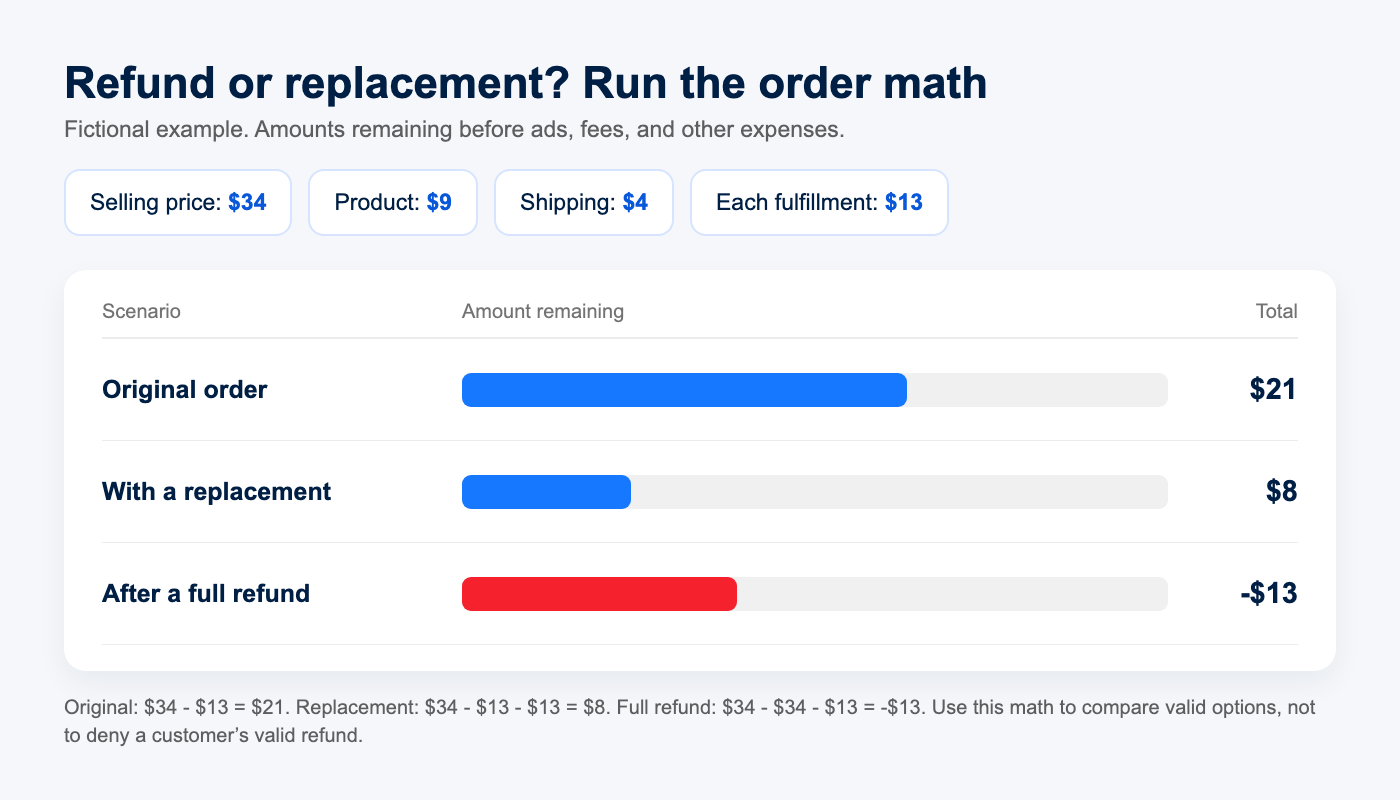
The following example calculates the return on a $34.00 order. In this case, the product cost was $9.00, and the cost for shipping was $4.00 for a total of $13.00 in original fulfillment cost. The remaining amount before ads, fees, etc. would be $34.00 - $13.00 = $21.00. An additional $13.00 is added to send the replacement order, leaving $8.00. The full refund of $34.00 is then subtracted from the remaining amount, leaving a negative amount of $13.00 before accounting for additional expenses.
Math helps us make a choice between two ‘correct’ options. The math should not force customers into accepting a replacement they do not wish to accept or that they are not required to accept. Be sure to include the cost of return shipping for the damaged item. For very low value items, the item may cost more to ship back than the item is worth to your company.
Make the remedy easy to understand
Put the practical details in the same message as the decision. Our guide to managing dropshipping returns and refunds covers the operational side. For any remedy, confirm:
- Whether the original item(s) need to be returned to you.
- Who provides and pays for the return label.
- When the refund or replacement will be initiated.
- What tracking or refund confirmation the customer will receive.
When a Complaint Becomes a Chargeback
A chargeback is not just another angry email from a customer. The payment provider has a formal case with a set of evidence requirements and a strict deadline. First, read the dispute reason for the chargeback. Then, write down the response deadline for the case. To defend a chargeback, you will need the order confirmation, the product description on the site, the shipping promise on the site, the tracking record for the shipment, the delivery evidence for the shipment, the policy shown to the customer at the time of purchase, and all subsequent customer emails.
Stripe says its usual response window is 7 to 21 days, depending on the card network, and evidence should address the customer’s specific claim. The tracking screenshot provided as evidence does not address the claim that the received product is broken. The refund policy provided as evidence does not prove that the parcel was delivered to the provided address. Match the provided documents to the appropriate claims.
We expect you to maintain a record of any communication with the customer and to complete the payment provider’s formal process to resolve the dispute. Note that the payment of a separate refund does not automatically mean that the dispute has been closed. Our dropshipping chargeback guide goes into more detail about how to prevent and respond to chargebacks.
How to Prevent the Next Complaint
One customer problem = one complaint. Ten similar complaints = a store problem. Track these in a spreadsheet with fields for Order #, Product #, Supplier, Problem, Time to First Response, Solution, Cost to Fix, and Root Cause. Review this list every week. You don’t need fancy support analytics to notice that the same lamp keeps arriving with a cracked shade.
Use what you find to make a specific change:
- Recurring complaints about size of clothing: Update size chart with accurate information and add images that show actual body measurements.
- Repeated damage complaints: Check packaging and pause the product if necessary.
- Repeated wrong variants. Audit the current mapping of variants before loading more orders.
- Late orders repeatedly: Change the delivery promise or check supplier / shipping route.
- Customers repeatedly asking “where is my order?”: improve tracking information and delay notifications.
Prevention starts before checkout. Make your shipping policy visible, distinguish processing time from delivery time on your site, and only promise dates that you are able to honor. Be sure that your product photos and descriptions are accurate. After a purchase, send the tracking number as soon as possible and follow up with the buyer if the order will not arrive on time as promised by your site. Reliable Tracking Number Updates can remove some manual work. Your customers will still need to speak to a human being to have their problems sorted out.
FAQ: Dropshipping Customer Complaints
How quickly do you have to respond to a customer complaint?
Answer within one business day, even if it is just an initial answer. The response should confirm that you understand the issue at hand, indicate what you are checking, and provide a specific next-update time. While fast acknowledgment of a problem is important, it is not a substitute for a complete resolution of the problem.
Should I apologize when the customer is wrong?
Acknowledging the frustration in a charge does not mean you have to agree with an incorrect charge: “I understand why you were surprised by this charge” etc. and then provide correct information in a calm manner. Do not apologize for something that did not happen. Keep reply out of courtroom.
Wait to refund customer's payment until supplier's account has been paid?
Not automatically. Your customer’s refund rights and your supplier’s reimbursement process are separate questions. Check your policy, marketplace rules, and local law, then give the customer a clear timeline. A slow supplier shouldn’t become an indefinite delay for the buyer.
A customer has threatened a chargeback, what can you do?
Staying calm and addressing the root cause of problems is crucial. You must offer a solution you can actually provide and keep a record of all correspondence. Organize your order and delivery information and respond with the specific evidence required for each claim to a dispute filed through the payment method within the time frame specified.
Can I refuse to help an abusive customer?
Setting a boundary does not mean you can’t deal with a legitimate complaint about an order. Deal with the issue at hand, keep the conversation in writing, and ask for respectful communication. End the conversation and seek help as needed if the customer threatens or harasses you. That does not mean you get to return insults to the customer.
How do I make a complaint template sound human?
Use the customer’s name, refer to the product and problem they described, and verify all the rest of the bracketed information. State one action step and a return date for the next update. Remove any unnecessary statements regarding the case.
Final Thoughts
Complaint handling does not have to end in victory for either side. Most complaints can be solved by providing a clear explanation and fulfilling a promise. Check facts, take ownership, offer solution, and ensure that issue is closed.
After that, look for the pattern in your complaints. Often it are the same issues with a product description, supplier, delivery promise, or support process that are bothering you.