Amazon FBA vs Dropshipping: Real Cost Breakdown (2027)
Amazon FBA costs roughly $3,000 to $5,000 to launch properly in 2027, while a dropshipping store can make its first sale for under $500. That single gap explains most of the decision, but it is not the whole story. Once you run the per-unit math on the same product, FBA roughly doubles your profit margin on every sale, as long as the product actually sells.
Which model is better matters less than which model matches your budget, your risk tolerance, and the stage your business is in right now. I have seen sellers burn $4,000 on inventory that never moved, and I have seen dropshippers quit a working product because thin margins frustrated them. Both mistakes come from the same place: choosing a model before understanding its cost structure.
This guide details the start-up costs for both models itemized, the up-to-date Amazon fee schedule as of the January 2026 changes, and runs a sample $24.99 product through each system to detail all of the corresponding costs in each.
How the Two Models Actually Work
A quick review of the basic mechanics before we get to the numbers. So much confusion exists in this debate because the two models are often compared on the wrong things.
Amazon FBA in one paragraph
With Fulfillment by Amazon, you buy inventory upfront, usually 300 to 500 units from a manufacturer, and ship it into Amazon's warehouses. Amazon stores it, packs it, ships it, and handles returns and customer service. Your listings qualify for Prime, which is the single biggest conversion advantage on the platform. In exchange, Amazon takes a cut of every sale and charges you for almost everything it touches: fulfillment, storage, inbound placement, and removal.
Dropshipping in one paragraph
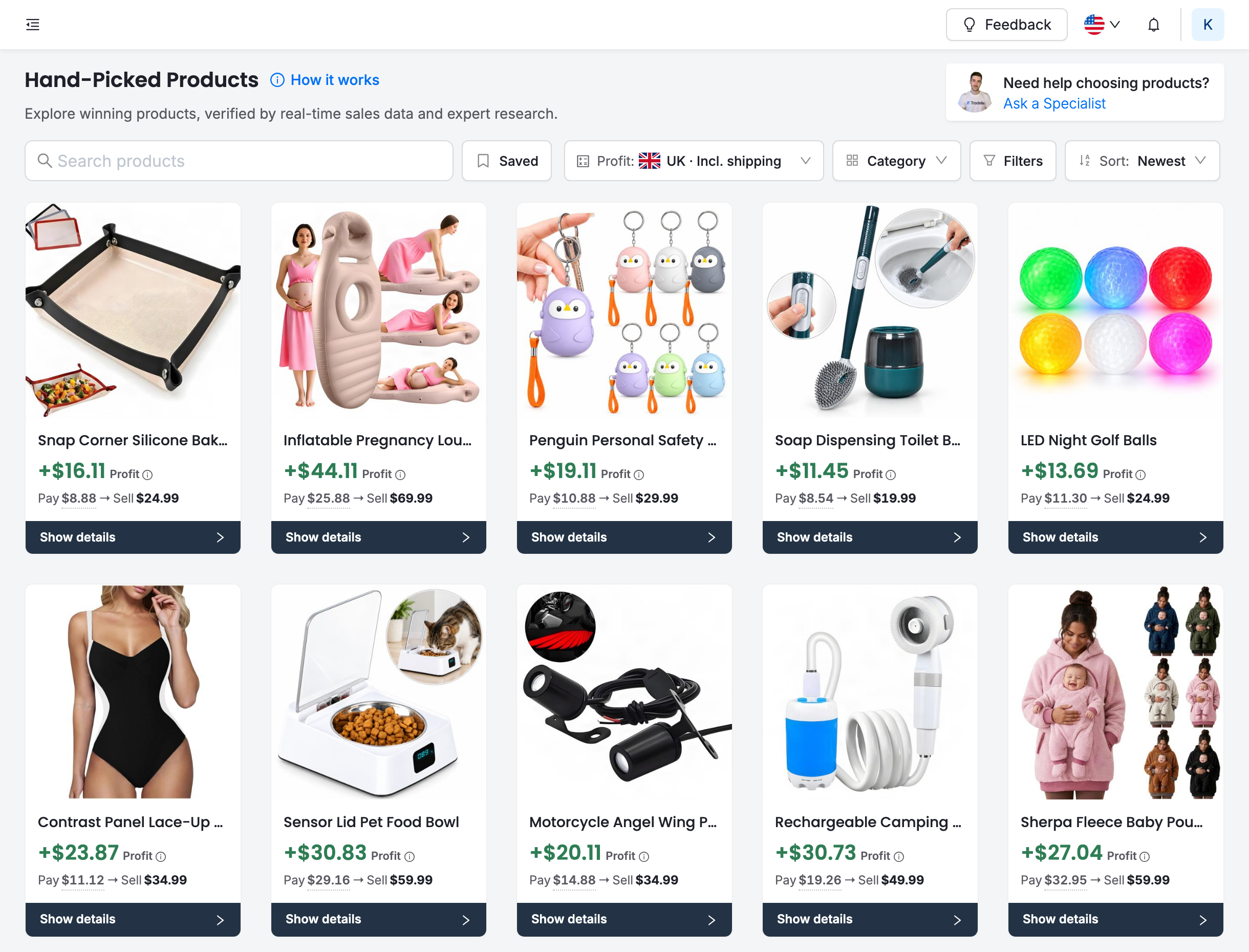
The dropshipping model allows you to list products from suppliers in your own store, and have them sent to your customers as you make sales. You don't need to hold any stock, and your main efforts are selecting products, building out a great store, and buying traffic. You only pay for what you sell, not for entire pallets of stock. Tradelle's fulfillment layer even removes the need for you to place the order with suppliers in the first place, since a sale automatically triggers the supplier order, with tracked shipping included. Your store continues to earn money while you sleep.
Startup Costs, Line by Line
Where philosophy ends, arithmetic begins. I will use realistic 2026 numbers throughout, not the mostly-positive best-case figures you see in YouTube thumbnails.
What FBA costs before your first sale
The biggest line item on the list is for your initial inventory. Based on our estimates for initial private label orders, a conservative starting point would be 400 units at $5 per unit, so $2,000 for initial stock. Then there's the cost to ship the goods to the Amazon warehouse. For a small ocean shipment this could be around $400, divided across the units in the shipment. You'll also need to pay for a GS1 barcode ($30) and for product images ($150 to $400 if you hire someone to do them for you). Some manufacturers won't prep and label products for Amazon sale, so this could add another $0.20 to $0.50 per unit to the cost of the goods. Your monthly Amazon Professional selling plan fee is $39.99 from day one of selling on Amazon in 2026. People often forget that you'll need to pay for visibility on Amazon during the launch period of your new product. For Sponsored Products ads during a launch, expect to spend $300 to $800 in the first month before your product starts to rank organically.
The totals for a careful, lean FBA launch come in at $3,000 to $3,700. These numbers are consistent with quotes found online from established sellers in various niches for a comfortable launch price of $2,500 to $10,000 or so. Starting small with retail arbitrage or a very tiny initial run to test out FBA and see how the product prep works is cheaper, yes, but then you aren't testing out FBA. You're testing out whether or not you'll like the work.
What dropshipping costs to launch
Starting a dropshipping business is almost embarrassingly cheap by comparison. The Shopify Basic plan starts at $39 per month, or $29 per month when you pay annually. Domain names run $10 to $15 per year. Samples of products that you sell online typically cost between $30 and $60 per sample. This is something you want to invest in, because if you start selling a product online without ever physically holding it in your hands, you're asking for a high refund rate. A test ad budget, enough to learn anything at all, is around $200 to $300. That's the whole list. The total is roughly $300 to $450 to get started, and the majority of that is your ad spend, which you can pause at any time.
One line you will not find in that budget is supplier vetting, because it costs time rather than money. It is also where most beginners cut the wrong corner. Ordering samples from five suppliers and comparing what arrives is the traditional route. The faster route is starting from a catalog where someone already did that work. Tradelle's product catalog only lists items from suppliers that passed quality and shipping checks, which turns a week of sample roulette into an afternoon of comparing margin data.
| Startup item | Amazon FBA | Dropshipping |
|---|---|---|
| Inventory / first stock | $2,000 (400 units) | $0 (supplier holds stock) |
| Platform subscription | $39.99/mo Professional | $29-$39/mo Shopify Basic |
| Freight and inbound | $400 + $0.20/unit placement | $0 |
| Barcode, photography, prep | $200-$450 | $0 |
| Samples and supplier vetting | $0 (already ordered stock) | $30-$60, or done for you in a vetted catalog |
| Launch advertising | $300-$800 | $200-$300 |
| Total to first sale | about $3,000-$3,700 | about $300-$450 |
The Amazon Fee Stack After the 2026 Changes
Amazon's fee architecture did not get simpler this year. It got more granular. If you are planning a 2027 launch, these are the numbers that matter, all from Amazon's published fee pages and the 2026 adjustment announcements.
Note that the referral fee for 2026 Amazon items is the same as prior years, 15% in most categories of product with a minimum of $0.30 per item. For some categories of items there are rates ranging from 5% to 45%. So for a $24.99 item, for example, you would budget $3.75 in referral fee.
The FBA fulfillment fee covers picking, packing, and shipping for each order. Amazon increased the average FBA fulfillment fee by $0.08 per unit as of January 15, 2026, and then in April 2026 added a 3.5% surcharge on top of this new fee. A typical 12 oz large standard-size item selling at $24.99 now pays about $4.35 per unit to FBA, compared with $4.15 per unit in 2025. Finer size and price bands mean packaging that pushes your product into the next tier costs real money, so design your box before you order 500 units of anything.
Storage is where slow sellers bleed. Standard-size monthly storage runs $0.78 per cubic foot from January through September and $2.40 per cubic foot from October through December, right when everyone stocks up for Q4. On top of that sit the newer structural fees: inbound placement charges for sending stock to fewer warehouses, and the low-inventory-level fee that punishes you for keeping too little stock relative to sales. Amazon now prices every operational habit individually, and sellers running 2023 playbooks feel it in every statement.
Two of the other changes to 2026 fees are relevant to sellers doing business outside of Amazon. Amazon's Multi-Channel Fulfillment fees increased by $0.30 per unit, and the Buy with Prime fees increased by $0.24 per unit. Neither touches a pure FBA listing, but both change the math for sellers who use Amazon's warehouses as their whole logistics network. The practical habit for 2027 is checking Amazon's fee pages every January and again before Q4, because the schedule now moves in small steps several times a year rather than in one annual jump.
The Dropshipping Cost Stack
Dropshipping stores have no fulfillment fee schedule as they have no warehouse. Their per-sale costs are very simple, but one of them will surprise a lot of new online retailers.
First, the supplier cost. Typically, a product that you sell for $24.99 will cost you between $7 and $9 from a good quality dropshipping supplier, shipping included. Second, payment processing will cost around 2.9% plus $0.30 per transaction, so for a $24.99 transaction this would cost you around $1.02. Third, your Shopify subscription and a couple of apps will cost around $50 to $70 per month. But again this is negligible once you start to get transaction volume.
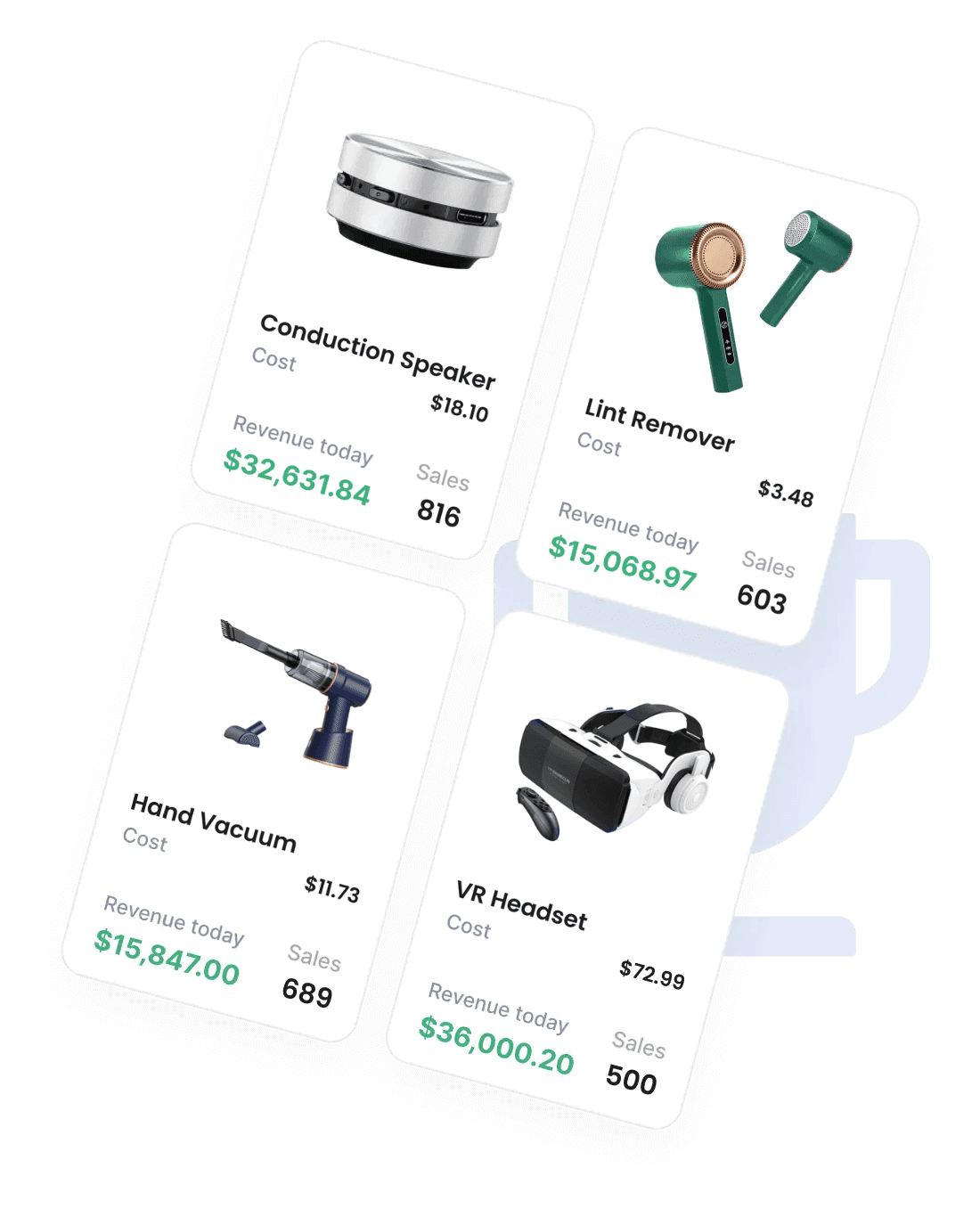
Then there is the cost that actually decides whether dropshipping works for you: customer acquisition. Nobody owes your store traffic. On cold audiences, expect to pay $8 to $12 in ads per purchase for a decent product with a decent page, and more while you are still testing. This is the dropshipping equivalent of FBA's inventory risk. Instead of betting $2,000 on stock upfront, you feed the ad platforms $30 a day until you know what converts. That guessing phase is where most dropshipping budgets die, and it is exactly the phase Tradelle's Product Picks was built to shorten: you see the supplier cost, the realistic selling price, the margin, and a saturation score before you spend a single dollar on ads, so the products you test start from evidence instead of hope.
Worked Example: One $24.99 Product Through Both Models
Enough abstractions. Take a stainless steel insulated water bottle selling at $24.99, a 12 oz large standard-size item, and run it through both systems. For FBA, assume a $5 unit cost from the manufacturer and a 400-unit first order. For dropshipping, assume an $8.50 supplier cost with shipping included and a $10 ad cost per sale, which is mid-range for cold traffic.
| Per sale | Amazon FBA | Dropshipping |
|---|---|---|
| Sale price | $24.99 | $24.99 |
| Product cost | -$5.00 (plus $0.80 freight) | -$8.50 (shipping included) |
| Marketplace / platform fee | -$3.75 referral (15%) | -$1.02 payment processing |
| Fulfillment | -$4.35 FBA fee | $0 (supplier ships) |
| Advertising | -$3.00 PPC per sale (typical launch) | -$10.00 cold traffic |
| Profit per unit | about $8.09 (32%) | about $5.47 (22%) |
| Capital at risk if it flops | about $3,000+ | the ad spend you stop today |
Read that table twice, because it contains the entire FBA vs dropshipping debate. FBA pays you $8.09 per unit instead of $5.47, a 48% raise on every sale. But to earn that raise, you prepaid $3,000 for the privilege of being wrong about a product. The dropshipper who picked the same loser lost maybe $150 in test ads and moved on before lunch. If you want to play with your own numbers, my guide on calculating dropshipping profit margins walks through the formula in detail.
One honest caveat on the FBA column: that 32% margin assumes the product is selling through at a steady pace. If it doesn't, storage fees start to erode your margin, and Q4 storage at $2.40 per cubic foot eats it three times faster. Dropshipping has zero inventory risk because you are not holding any inventory, but you pay for that safety in thinner margins and slower, supplier-dependent shipping. The shipping part, at least, is solvable: Tradelle fulfills from vetted suppliers with tracking on every parcel, so the delivery experience stays closer to what 2027 buyers expect instead of the six-week mystery mail that gave dropshipping its old reputation.
The Costs That Never Appear in Fee Tables
Both models hide expenses that only show up once you are running. For FBA, there are removal and disposal costs for inventory that does not sell, returns processing for categories where Amazon refunds first and asks questions later, and Amazon's two-week payout cycle, which keeps cash locked in Amazon's accounts right when the business needs to reorder inventory. None of these are large individually. Together, they routinely shave three to five points off the margin you calculated on a spreadsheet.
On the dropshipping side of things, the hidden costs are refunds, chargebacks, and support tickets. A supplier that ships the wrong color to a customer can result in a refund plus the loss of that customer. A dispute that escalates can cost you the full value of the order plus the chargeback fee. Enough of these and you may even end up losing your payment processor. I wrote a separate guide on handling dropshipping chargebacks because they deserve their own numbers. Happily, most of these costs stem from one root cause: unreliable suppliers, which is a selection problem. Work from a vetted supplier base with real tracking, and the refund-and-dispute tax shrinks to background noise.
Which Model Fits Which Seller
FBA is suitable for you if you have $3,000 to $5,000 you can genuinely afford to lose, if you already have proof that a product sells (your own sales data, not a hunch), and if you want to build a brand that you can sell later. The Amazon customer base, Prime conversion rates, and hands-off logistics are a big advantage. Once a listing starts ranking, the machine mostly feeds itself. A seller with $8,000 saved, a full-time job, and one validated product idea is the textbook FBA candidate.
Dropshipping fits you if your budget is in the hundreds rather than the thousands, if you are new to selling online and don't yet know what is going to sell well, or if you value speed over margin. For the cost of one FBA sample order, you can test five different products this month. With this model you have full control of your online store, your customer data, and your pricing, none of which Amazon lets you have. If you are starting from zero, my 2027 guide to starting a dropshipping store covers the setup step by step.
There is also a margin ceiling worth knowing about: typical dropshipping margins of 10% to 20% at commodity price points climb sharply as you move upmarket. Sellers working the $100 to $500 range see very different math, which I broke down in the high-ticket dropshipping margin analysis.
The Hybrid Path Most Successful Sellers Actually Take
Here is what the loudest voices on both sides leave out: the FBA vs dropshipping question has an expiration date. The sellers who do this well treat the models as phases, not religions. They test products with dropshipping, because failing there costs $50 in ads instead of $3,000 in dead stock. When a product proves itself with real orders over real weeks, they negotiate a bulk order, put a logo on it, and send 500 units to FBA to capture the better margin and the Prime badge.
That sequence removes the two worst outcomes in ecommerce: going all-in on an unproven product, and staying stuck on dropshipping margins with a product that clearly deserves better economics. If tariffs and import costs are part of your landed-cost math for the FBA phase, read the de minimis and landed-cost guide before you wire money to a factory, because the 2027 import rules can change what that bulk order really costs.
The primary goal of the testing phase is to test as fast as possible and this is where Tradelle really performs. You browse hand-picked products with verified supplier costs, import them to your store in a click, and then watch orders process automatically with tracked shipping and no manual supplier emails to manage. You're able to test more products per month because the operational work is not eating your evenings, and every test teaches you something the next one cashes in on. Your future FBA candidates are the winners you find through this process, validated with other people's money before you risk your own.
FAQ: Amazon FBA vs Dropshipping
How much money do I need to start Amazon FBA in 2027?
Plan for $3,000 to $5,000 for a proper private label launch: roughly $2,000 of inventory, $400 of freight, a few hundred for photography, barcodes, and prep, the $39.99 monthly Professional plan, and $300 to $800 of launch advertising. Smaller test batches or retail arbitrage can start under $1,000, but they do not test the real FBA economics.
Is dropshipping still profitable in 2027?
Yes, but the margin comes from product selection, not the model itself. Commodity products at $20 to $30 typically net 10% to 20% after ads. Sellers who research saturation and margin data before listing, and who move into higher price points, do considerably better than that average. The gap between guessing and researching is usually the gap between quitting and scaling.
Can I do Amazon FBA and dropshipping at the same time?
Yes, and many sellers do. A common setup is dropshipping new product tests on a Shopify store while running FBA for one or two proven winners. The models share suppliers and research skills, so running both mostly costs you time, not extra infrastructure.
Is dropshipping allowed on Amazon?
Amazon permits dropshipping only if you are the seller of record, your name appears on all packing slips and invoices, and you handle returns yourself. Having a retailer like Walmart ship orders to Amazon customers in their packaging violates the policy and gets accounts suspended. This merchant-fulfilled dropshipping is a different game from FBA, with no Prime badge and stricter metrics.
Which model is better for beginners with no experience?
Dropshipping, for one simple reason: the tuition is cheaper. Every beginner makes product-selection mistakes, and with dropshipping those mistakes cost ad spend you can stop today. FBA magnifies both good and bad decisions, so it rewards experience and punishes guessing with four-figure losses.
How long until each model turns a profit?
A dropshipping store can have its first profitable week within a month, as long as the first or second product takes off. FBA runs slower: sourcing, freight, and launch ranking typically mean three to six months before a listing pays back its startup costs. Both timelines assume consistent effort. The difference is that dropshipping lets you restart cheaply when a timeline slips.
Final Thoughts
Amazon FBA vs dropshipping is not a morality play between patient builders and lazy hustlers. It is a capital decision. FBA buys you roughly double the per-unit margin in exchange for thousands of dollars of upfront risk. Dropshipping sells you speed, flexibility, and cheap lessons in exchange for thinner margins and ad costs that never fully go away.
If you have the capital and the data, FBA economics win. If you have neither yet, dropshipping is how you earn both. Start lean, test products with real margin data behind them, and let sales tell you when it is time to send that first pallet to Amazon. Your first product does not need to be your forever product. It needs to teach you something true. And if you want the testing phase to run on evidence instead of guesswork, that is precisely the problem Tradelle exists to solve.