High-Ticket Dropshipping Profit Margins: The Real Math for 2027
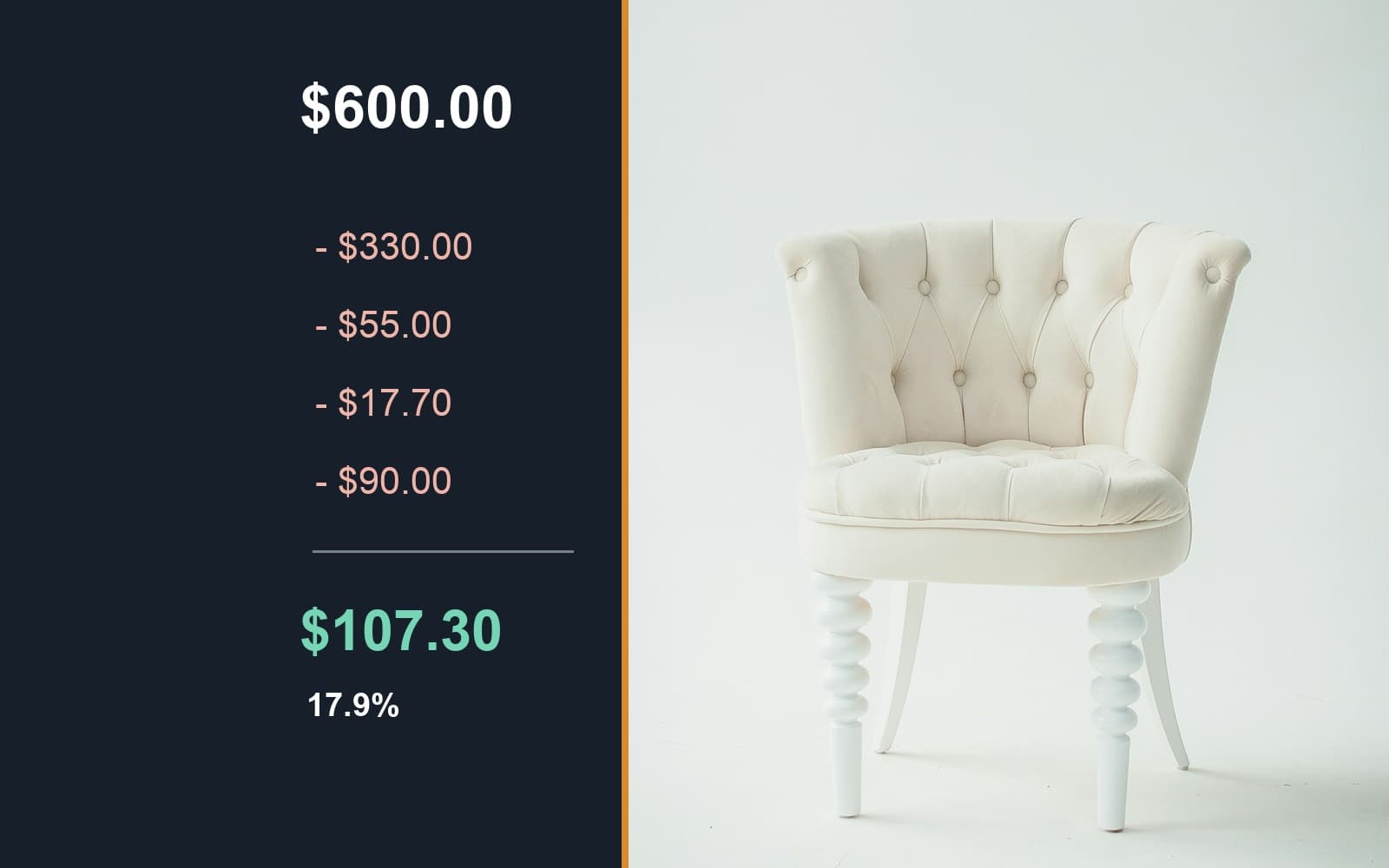
A high-ticket dropshipping profit margin is your share of the sale’s revenue after all costs have been paid, including product, shipping, payment processing, advertising, and all after-sale follow-up costs. Even though a product may have a huge-looking sale price of $600 on your website, after you calculate in all the real costs of the order, you may be surprised at how little real profit you actually ended up with after the order has been processed and put into your books.
Margin for a high-ticket item is not fixed. It depends on the price of the item, the shipping route, the return costs, and your customer acquisition costs. Therefore, a simple % margin that another retailer is working on is not very helpful. You need to do the maths for your own order.
We use fictional numbers to illustrate a point. Let’s look at a $600 order compared to 15 sales of a $40 product. We see the effect of 1 return or lost dispute on a batch of 10 orders. The numbers used here are illustrative, and you can use your own quote and campaign numbers to get an accurate idea of what to expect. We don’t make any income promises and we don’t use unknown industry averages.
What Counts as High-Ticket Dropshipping?
In the dropshipping world, “high-ticket” is a term often thrown around. By high-ticket, we mean that we sell relatively expensive products and have the supplier ship. There’s no real set price for what high-ticket would be, and it varies from seller to seller. One guy may consider products that cost $200 or more to be high-ticket, while another considers anything over $1,000 to be high-ticket. It’s a term and not really a category, and whether or not higher order value provides enough wiggle room to cover additional costs to service is really the main thing to consider.
Those costs can include freight, delivery appointments, pre-sale questions, warranty coordination, and a much larger refund when something goes wrong. A treadmill and a phone case don't create the same workload just because both arrive in a box. For the examples below, high-ticket simply means a $600 product. It's a worked example, not a definition you need to adopt.
If you're still choosing a model, our guide to finding products with high profit margins covers the product-selection side. This article stays with the numbers after you've found a candidate.
The Margin You Actually Keep
Start with three different views of the same sale. Gross margin looks at revenue minus the direct product and fulfillment cost. Contribution margin goes further and subtracts variable selling costs such as payment processing and advertising. Net profit also accounts for overhead, taxes, and other business expenses. Mixing these up is how a healthy-looking product margin becomes a disappointing bank balance.
For product research, contribution per order is often the most useful number. It tells you what each completed sale contributes toward overhead and profit after the costs that change with that sale. The formula is simple:
- Revenue minus product cost
- Minus outbound shipping and fulfillment charges
- Minus payment processing fees
- Minus advertising cost per acquired order
- Minus expected returns, disputes, replacements, and support costs
Use your own definitions within Accounting. Our general guide to calculating dropshipping profit margin explains the underlying formulas. The important part here is to stop before a cost disappears into a spreadsheet row called other.
Worked Example: What a $600 Order Leaves
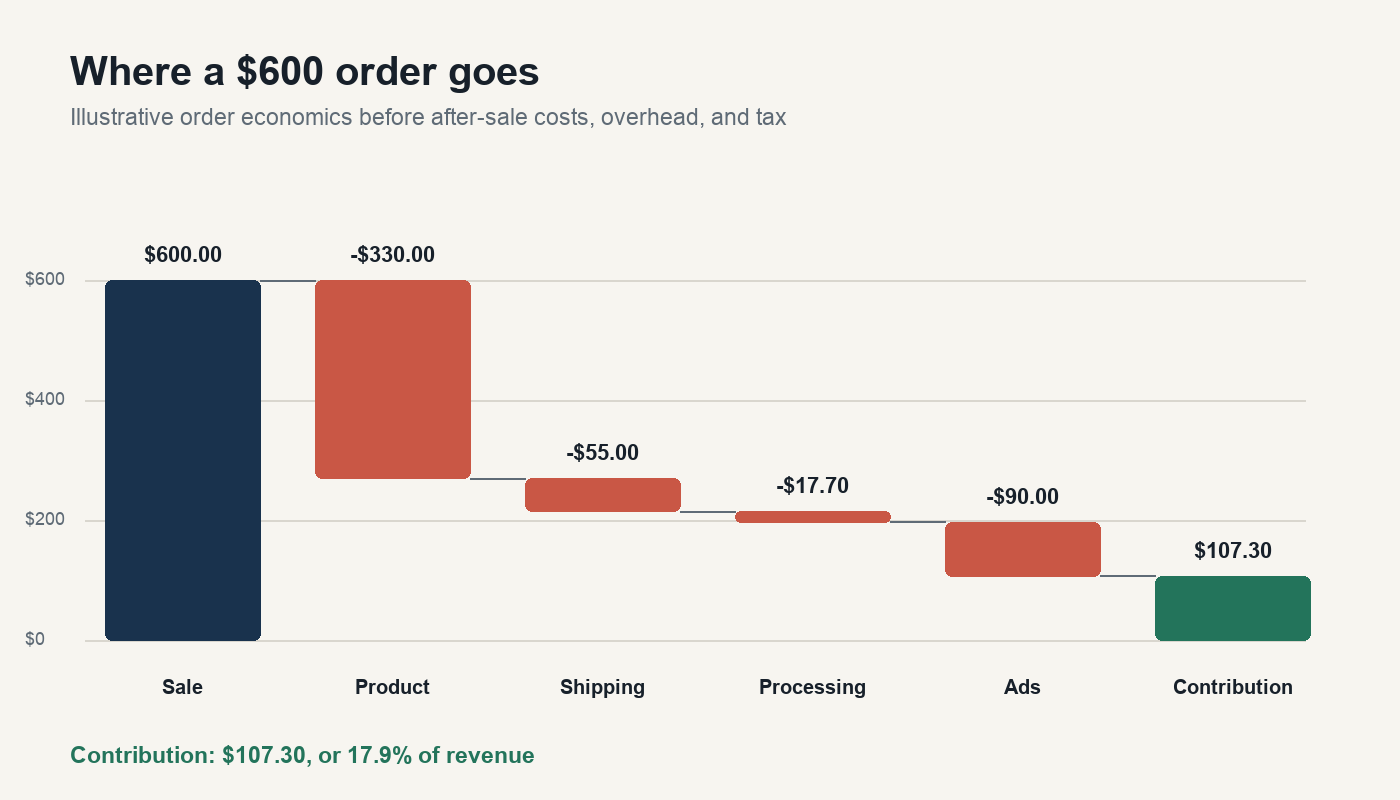
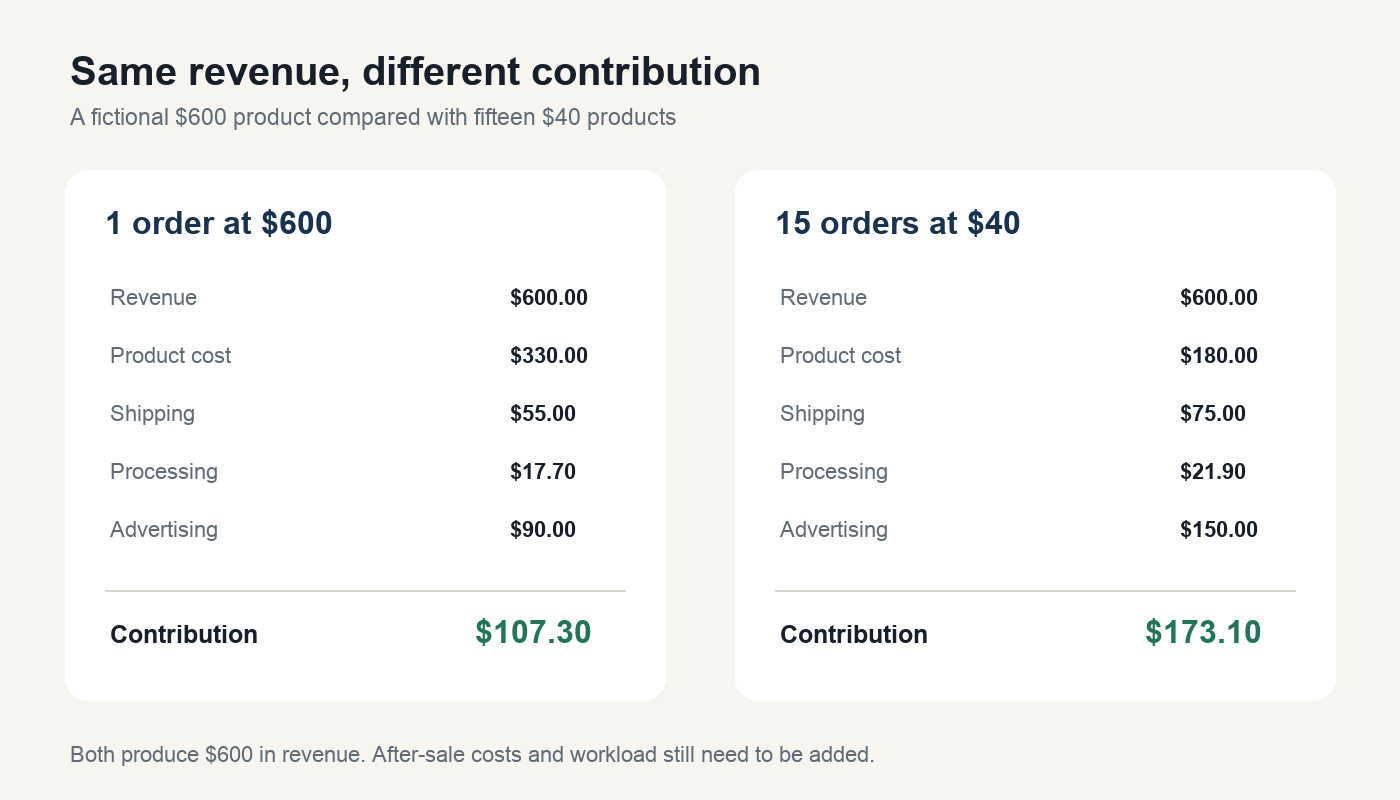
Imagine you sell a product for $600. The supplier charges $330, and outbound shipping costs $55. Your payment cost uses Stripe's published US domestic-card rate of 2.9% plus $0.30 as an example, which produces a $17.70 fee on this order. Advertising costs $90 per acquired order. Your actual processor, card mix, and campaign will differ.
- Selling price: $600.00
- Product cost: $330.00
- Outbound shipping: $55.00
- Payment processing: $17.70
- Advertising: $90.00
That leaves $107.30 in contribution before returns, disputes, overhead, and tax. Divide it by $600 and you get a 17.9% contribution margin. The gap between product cost and selling price was $270, but only $107.30 remains after shipping, processing, and ads. Neither figure is fake. They just answer different questions.
The example uses Stripe's current public pricing only to make the processing calculation concrete. Check the rate for your own provider and country instead of copying 2.9% into every product estimate.
One $600 sale or 15 sales at $40?
Now compare that order with a fictional $40 product. It costs $12 to buy and $5 to ship. Using the same illustrative processing rate gives a $1.46 fee, and advertising costs $10 per order. Each sale leaves $11.54. Fifteen sales produce $173.10 in contribution before after-sale costs, compared with $107.30 from the single high-ticket order.
The low-ticket product wins this particular comparison despite generating the same $600 in revenue. It also means 15 parcels, 15 customers, and more chances for routine support. The high-ticket order involves one buyer but concentrates much more financial risk in that buyer. There's no universal winner. You're choosing a cost structure and an operating workload, not just a price tag.
Six Costs That Make High-Ticket Margins Look Better Than They Are
1. The shipping quote you didn't request
The price quoted by a supplier for a product is not the delivered cost to you. You need to ask for a shipping quote to be provided for the country and postcode region that you intend to serve. Typically there will be a change for remote locations, oversize packages, appointment delivery, and for delivery to residential locations. Products that are shipped in multiple boxes need to have the quote confirmed for all boxes.
Package dimensions matter too. FedEx explains that its dimensional-weight pricing uses package size as part of the shipping calculation. A large but relatively light product can therefore cost more than a beginner expects. Get the packaged dimensions, not just the dimensions shown on the product page.
2. Payment fees on a larger transaction
Percentage-based processing fees grow with the order value. In our example, $17.70 is manageable, but it still belongs in the calculation. International cards, currency conversion, installments, and alternative payment methods can change the cost. A financing option may help a customer afford the purchase, but you should check its merchant fee before treating it as free conversion help.
3. Customer acquisition before the first sale
When you are selling to high-ticket buyers, they typically have a lot of questions and compare many alternatives before buying. Thus, it is not wise to make any assumptions as to the number of visits or days it will take for these buyers to purchase. In your financial analysis, simply note the ad cost per order and remember that this cost also belongs beside the cost of the product and not in some separate account. And be sure to include the cost of creative production and product samples in your launch budget even though you are keeping them out of the contribution per order.
If you are going to run Shopping or search campaigns, it’s best to do a cost test before scaling. Our guide to running Google Ads for dropshipping covers the campaign side. Your maximum affordable acquisition cost should come from the order math, not from whatever budget feels comfortable on launch day.
4. Returns with heavy shipping in both directions
A return isn't simply a refunded product price. You may pay the original outbound shipping, a return label, inspection, repacking, and any loss in resale value. Some items can't be resold as new. Others cost more to transport back than their recoverable value justifies. Your policy still needs to honor applicable customer rights, so this is a planning exercise rather than an excuse to obstruct a valid return.
Ask the supplier where the item goes, who arranges collection, and what condition it must be in for credit. Then compare that with the customer-facing policy in our guide to managing dropshipping returns and refunds. A supplier credit note and your obligation to the customer are separate questions.
5. Disputes on orders with more to lose
A dispute can reverse the payment while the product and outbound shipping are already gone. Stripe's public US pricing lists a $15 dispute-received fee, with separate fees possible when you counter or appeal. Its dispute documentation explains that the issuer reverses the payment and Stripe debits the payment amount and dispute fee. Use your provider's current fee schedule for your own model.
Good records matter more when it is for a case worth hundreds of dollars. So keep all the order confirmation, product details, delivery promise, tracking, delivery proof, and customer communications together. Our dropshipping chargeback guide walks through prevention and evidence in more detail.
6. Support, warranty work, and replacements
Who answers a compatibility question before purchase? Who diagnoses a fault after delivery, arranges a replacement part, or pays for a technician? Time has a cost even when you don't send yourself an invoice. A replacement component also has a picking and shipping cost. Put a realistic allowance in your product test, then replace that estimate with observed data as orders come in.
What One Return or Dispute Does to 10 Orders
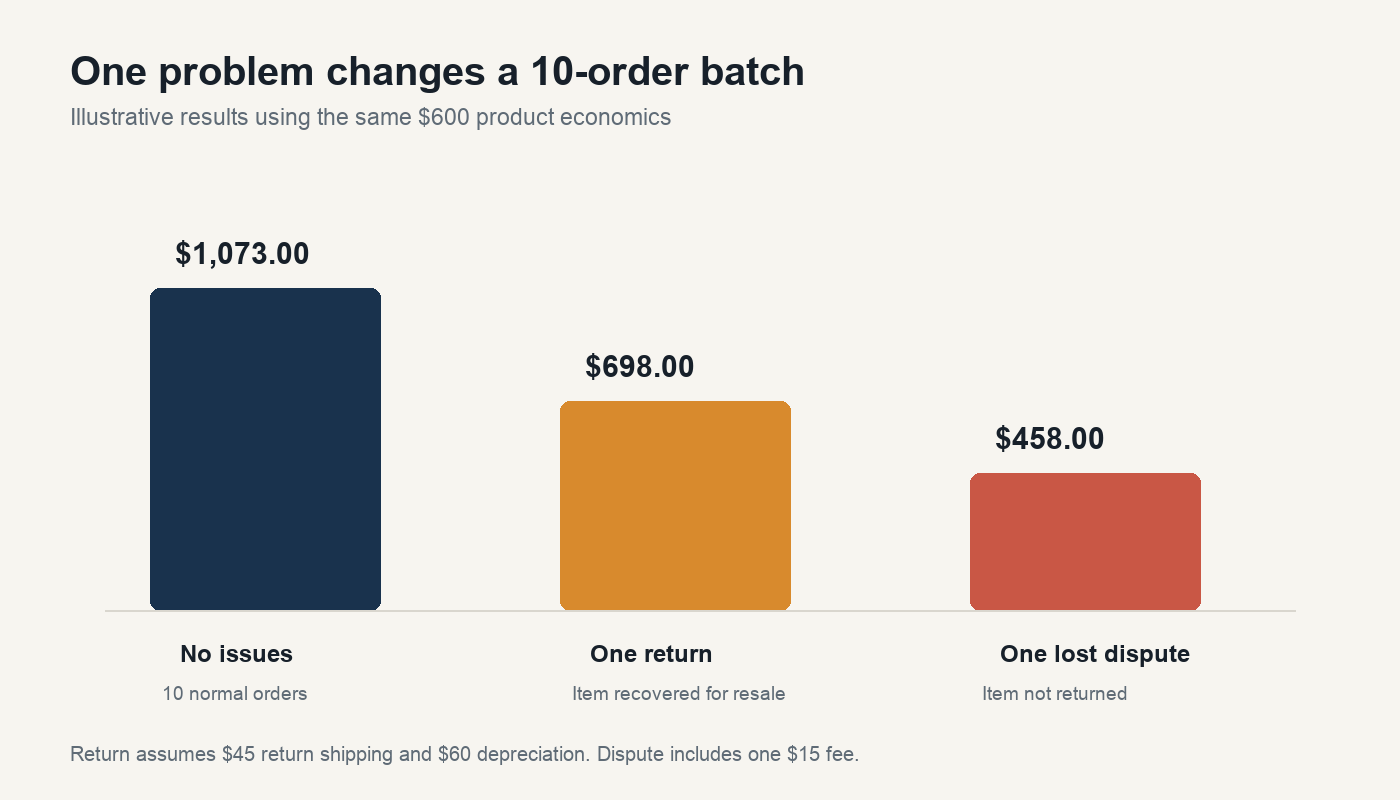
Let's stay with the $600 example and imagine 10 orders. With no after-sale problems, they produce $1,073 in contribution. Now suppose one customer returns an item. The other nine orders still contribute $965.70. For the returned order, assume you refund $600, pay $45 for return shipping, and record $60 for inspection, repacking, and depreciation. The product comes back in resalable condition, so its $330 cost is recovered as inventory rather than treated as a total loss.
That returned order finishes at a $267.70 loss after its original shipping, processing, advertising, return shipping, and depreciation. The batch total falls from $1,073 to $698. One return therefore reduces the batch result by $375.30 compared with a normal order. This is illustrative math, not a benchmark return rate. Your supplier credit, product condition, and shipping contract can change every part of it.
Now replace the return with one lost dispute where the item isn't returned. The other nine orders still contribute $965.70. The disputed order loses $507.70 after product cost, outbound shipping, processing, advertising, and one $15 dispute-received fee. The batch finishes at $458. Compared with a normal order, that single case reduces the total by $615. The model excludes any additional countering fee, network fee, tax effect, or recovery.
There's no need to worry too much about every sale. What you need to stop doing is treating your best-case scenario batch as your expected average. Use your real order history to calculate your after-sale cost per dispatched order and apply that to future product decisions. Then test out a few of the more believable ‘what-ifs’ before deciding whether you can afford the worst-case scenario to happen.
Set Your Advertising Ceiling Before You Launch
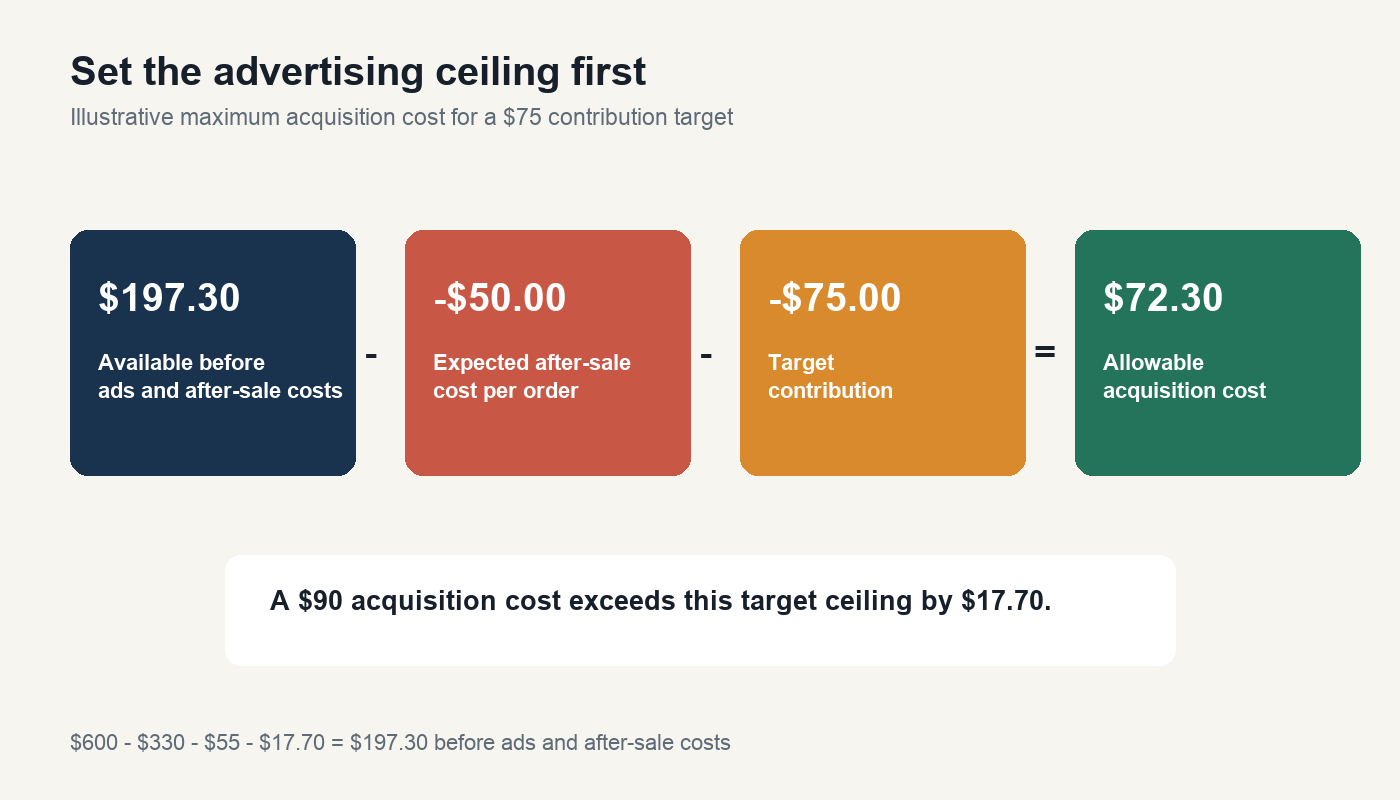
Your break-even acquisition cost is the most you can spend to acquire one order before the order stops contributing. Start with revenue, subtract every non-advertising variable cost, then subtract your expected after-sale cost per order. The remainder is the theoretical advertising ceiling. If you want a specific contribution left over, subtract that target too.
For our $600 product, subtracting the $330 product cost, $55 shipping, and $17.70 processing leaves $197.30. Suppose you assign $50 per dispatched order for expected after-sale costs and want $75 in contribution. Your allowable acquisition cost is $72.30. The $90 campaign in the original example contributes before after-sale costs, but it doesn't meet this particular $75 target.
To get your way out of this mess, you have three options: to improve the conversion on your acquisition so that it becomes cheaper, to cut another variable cost, or to dump the product. Raising the price is another option but then you have to check whether your customers are prepared to pay that higher price. And no lowering of your desired profit in the spreadsheet because you have already spent the money on the ads.
A High-Ticket Product Checklist That Uses Real Inputs
While you can’t know your actual return rate or acquisition cost before running the test, a lot of the guesswork can be removed by working through this checklist for each candidate and recording the source of the number against each point.
- Demand: What evidence can you bring to bear to prove that customers specifically desire exactly this product, not just this product category?
- Selling price: What do comparable stores charge for the same service and product specifications?
- Delivered cost: Is the quote you were given for your target market a price to deliver a product and for shipping?
- Package: Do you know the boxed dimensions, weight, and number of parcels?
- Returns: Who pays transport, where does the item go, and when does the supplier issue credit?
- Warranty: Who supplies parts, answers technical questions, and pays for another shipment?
- Acquisition: What cost per order can the product support after your after-sale allowance?
- Cash: Can you fund supplier payments, refunds, and disputes while payment balances are unsettled?
Order a sample once the product economics look good. Check the packaging, the instructions, the actual dimensions, and the service once it has arrived. A sample can reveal problems with a supplier’s products that the supplier has failed to mention in messages. For bulky or technical products test out the supplier’s support on a few very ordinary pre-sale and warranty questions.
Where Product Research Helps and Where It Stops
Product research can also help build a shortlist of potential products by comparing demand signals with competing stores’ offerings, the cost of the product, and potential selling price. Tradelle's Product Picks is one place to start that shortlist, while Competitor Research can help you inspect the stores already serving the market.
No research tool can ever accurately project your actual return rate, card mix, support required, and ad performance before you have started selling. Profit at the product level should always be treated as an estimate that requires your actual shipping quote and payment fees, as well as the specifics of the individual campaigns that you are running. A supplier should answer operational questions clearly as well. Our guide to choosing dropshipping suppliers can help with that part of the review.
Keep conversations around fulfillment support specific to what you need. Ask for the destination, expected delivery window, how packages are handled, how tracking works, and what returns are like for the product you are looking to sell. Fulfillment by Tradelle is relevant only after those details fit your product and market. A logo on a checkout page doesn't improve a weak order calculation.
FAQ: High-Ticket Dropshipping Profit Margins
What is a good high-ticket dropshipping profit margin?
A margin is considered good if it covers all variable costs and also covers overhead and tax to reach the desired profit. Such a margin does not have to be the same percentage for all orders. It is expressed in both percentage and dollar terms and, for example, a lower percentage than normal can still translate into more money on very high value orders.
Are high-ticket products more profitable than low-ticket products?
No. High-ticket items can have more contribution per order but also more cost in shipping, customer acquisition, returns, and disputes. So in our example a single $600 order would generate $107.30 while 15 orders of $40 each would generate $173.10. It all depends on the numbers you put in.
How do you calculate high-ticket dropshipping profit?
Start with the selling price. Subtract product cost, the outbound shipping, the fulfillment charges, the payment processing, the advertising per acquired order, and all other after-sale costs and divide the resulting estimated contribution per order by the revenue to get the contribution-margin percentage. Then deduct the overhead and tax in calculating the business’s net profit.
Should payment processing be included in product margin?
Include it when you calculate contribution because the fee changes with the sale. A percentage-based fee becomes a larger dollar amount on a more expensive order. Use your actual provider, country, card mix, and payment methods. A worked example using a public rate is useful only until your real processing data is available.
How much should you spend on ads for a high-ticket product?
Set the ceiling from your order economics. Subtract non-advertising variable costs, expected after-sale costs, and your desired contribution from the selling price. What remains is the maximum acquisition cost for that target. Start with a capped test, measure actual acquisition cost, and don't raise the budget merely because the product has a high retail price.
Why should you model returns before choosing a product?
Returns can add transport, inspection, repacking, and depreciation while removing the revenue you expected to keep. The impact is especially clear on bulky or expensive products. Model a return using your supplier's actual credit terms and return route. The exercise doesn't reduce a customer's rights. It tells you whether the business can handle them.
Final Thoughts
High-ticket dropshipping is not necessarily more profitable in terms of margin, but rather a different set of trade-offs. The fact that you need fewer sales to hit the same amount of money in revenue is great, but each individual sale has much greater cost in terms of acquisition, in terms of shipping, in terms of after-sale service. If it works with the product and supplier, great. But one wrong assumption can cost you a fortune.
Before you commit, write down the complete order. Use a real delivered quote, your payment rate, an advertising ceiling, and a return scenario you can afford. If the product still meets your target after that, you've got something worth testing. If it only works when every customer keeps the parcel and every click is cheap, keep researching.