Dropshipping Trends 2027: 7 Shifts Worth Planning Around
Predictions for the main dropshipping trends for 2027 include increased landed cost, AI on both sides of the transaction, faster delivery promises, creative-led advertising, social checkout and much deeper product research. Some of these trends increase costs for retailers while others open up new opportunities for demand. The main thing is that they will reward retailers who have planned for 2027 in December as opposed to coming up with strategies in February.
Unlike most predictions posts, which are written from intuition, every trend in this article is already visible in 2026 data: customs rules that took effect this year, ad platforms that automate targeting for you, social commerce passing $100 billion in US sales, and product reports that show exactly why most stores in a saturated niche never get an order.
Each section ends with what to actually do about it, and one section walks through a full live product report so you can see the new research standard. Know your numbers before the year starts.
1. De Minimis Is Gone for Good, and Landed Cost Sets the Price
The US de minimis rule for years allowed goods up to $800 in value to enter the country duty-free. That all changed on August 29, 2025, when duty-free treatment was suspended for all countries. As of June 24, 2026, US Customs and Border Protection made the suspension indefinite, moving every low-value parcel into a formal or informal entry with duties attached.
What the new entry rules changed in practice
A $4 gadget that used to slip through tax-free now picks up duty, brokerage, and entry processing on top, and fixed charges like these hit cheap products hardest. A $6 item can absorb a few extra dollars only by raising its price, and raising the price of an impulse buy is how conversion rates die.
Run the arithmetic on a typical cart to feel it. Say your product costs $6.20 and shipping is $4.10. Add a few dollars of duty and fixed entry cost, and your real landed cost lands near $12 instead of the $10.30 in your spreadsheet. Sell at $24.99 and your contribution before ads just dropped by a fifth, with no warning anywhere in the checkout. Scale that across 1,000 orders and the difference decides whether the year was profitable.
Which products survive the new math
- Items selling at $30 and above, where a few dollars of entry cost is a rounding error.
- Light products that ship cheap, because weight now stacks on top of duty.
- Bundles and multipacks that spread one entry cost across more revenue.
- Anything you can describe as a gift, since gift buyers tolerate healthier prices.
The flip side is what to drop: ultra-cheap trinkets whose entire appeal was a $9.99 price tag. That model depended on duty-free entry, and duty-free entry is over.
Reprice the whole catalog, including older listings
Two defenses work. First, price from landed cost: product, shipping, duties, and fees in one number, then set your selling price above it. Our dropshipping pricing strategy guide walks the full math, including where ad spend fits. Second, pick a supplier whose price already includes customs handling. With Fulfillment by Tradelle, customs and applicable import duties are handled for you, so the dashboard total is the final supplier cost, shown excl. VAT. No surprise line items after checkout.
Apply this to your current listings, and treat the older ones as the priority. Even a winner from 2025 can quietly turn into a loser under 2027 costs while its ads keep spending. The full de minimis breakdown covers country-by-country detail. The trend is simple: landed-cost discipline stops being an accounting habit and becomes a survival skill.
2. AI Sits on Both Sides of the Sale
Shoppers increasingly start product searches inside AI assistants instead of search engines, and the assistants answer with specific products and stores. If your catalog is invisible to them, you miss a demand channel that charges nothing per click. We tested this directly and wrote up how to get Shopify products recommended by ChatGPT: clean product data, honest specs, and crawlable pages decide whether an assistant can quote you.
Make your store quotable
- Your product descriptions have to answer the real questions of your customers: dimensions, materials, delivery time, what you send in the box.
- Keep specs consistent for title, description and structured data on the page.
- Collect reviews that mention concrete use cases, because assistants quote specifics, not adjectives.
- Cover the adjacent questions buyers ask: margins, shipping cutoffs, returns, and warranty, so varied prompts still match your page.
These things convert human visitors as well. Thus, optimizing for best AI answers and for buyers becomes the same task.
Let AI run the routine
On your side of the sale, AI moved from toy to coworker. Listing drafts, price tests, stock checks, and order routing run automatically once you set the rules, and our guide on what to automate first puts them in the right order. Tradelle goes one step further with its MCP server: external AI assistants like ChatGPT or Claude can operate a Tradelle account directly, researching products, searching the catalog, and managing fulfillment through conversation. In practice that means you can ask an assistant to find rising products in a niche, check their saturation, and prepare an import, all in one session.
In 2027, your store needs to be readable by machines and your operations need to be runnable by them. AI needs to be more than a gimmick for sellers, otherwise they will be competing against others with lower structural weekly costs.
3. Delivery Speed Turns Into an Advertising Claim
With de minimis gone, every cross-border parcel carries paperwork. That makes delivery time the next battleground, because the stores that ship fast and predictably can say so in their ads, and the rest cannot. 'Arrives before Friday' converts better than any discount code.
The baseline moved up. Fulfillment by Tradelle averages 6 to 10 business days worldwide with real-time tracking, and tracking numbers sync to your store and your customer automatically. The fulfillment guide shows the complete flow from paid order to delivered parcel.
Put the window in writing
- Show it on the product page, next to the price: the real delivery window for the buyer's country.
- In the ad, when the window is a strength: 'ships in 24 hours' or 'arrives in about a week' beats a generic shop-now, for example.
- In the confirmation email, with live tracking, because the silence after payment is where refund requests are born.
That last point pays for itself. Automatic tracking number updates keep customers informed without support tickets, and every ‘where is my order’ email you never receive is margin you keep.
The returns half of the promise
Fast delivery only works as a claim when the refund path is just as clean. Returns through US, EU, and UK return centers matter twice: customers buy more confidently when a return is local, and you stop losing the full item value every time something comes back. On the Pro plan, Fast-Track Refund Handling shortens that loop even further.
Shipping in 2027 will no longer be a function of logistics but a part of the product offer itself. A slow window is a product selection signal. Don't bury it in the footer.
4. Ad Platforms Reward Creative Volume, Not Targeting Tricks
Meta's delivery system now finds buyers from your creative more than from your interest stack, and Advantage+ shopping campaigns automate most of what remains. The lever you still own is the ad itself: the hook, the demo, the offer.
What to test in every creative batch
- Present 3-5 significantly different views of a product instead of a single video with 3 thumbnails.
- Every cut gets to start with a different first two seconds. That’s how the hook gets to decide whether or not you get to see the rest of the demo.
- Single creative aimed at the gift buyer not the user for November/December period.
Determine your kill rule before you spend money. My simple rule: pause ads that spend twice the acquisition cost to convert a single sale and increase your spending on ads that are already beating your break-even ROAS. In 2027, discipline will trump the algorithm that happily expends your entire ad budget to learn what you could have programmed it to do.
No need to guess which concepts will work well. In Ad Explorer within Tradelle, you can see which competitor ads are currently scaling, with reach, estimated spend, and how long each ad has been running. Based on this, you can launch the next batch of ads with facts instead of just trying things out. Create a free account and watch your niche for a week before you brief anyone.
One timing gift survives every automation change: the Q5 window after Christmas, when CPMs drop while gift-card money and New Year motivation arrive. Sellers who prepared creatives in December enter that window at full speed instead of storyboarding through it.
5. Social Commerce Becomes a Real Sales Channel
Social checkout has gone from being an experiment with customers to being another shopping channel. EMARKETER's December 2025 forecast, collected in this social commerce statistics roundup, puts US social commerce sales at $87.02 billion for 2025, up 21.5%, and above $100 billion for 2026. TikTok Shop alone is forecast at $23.41 billion in US sales for 2026, up 48% on the year.
The five-second product filter
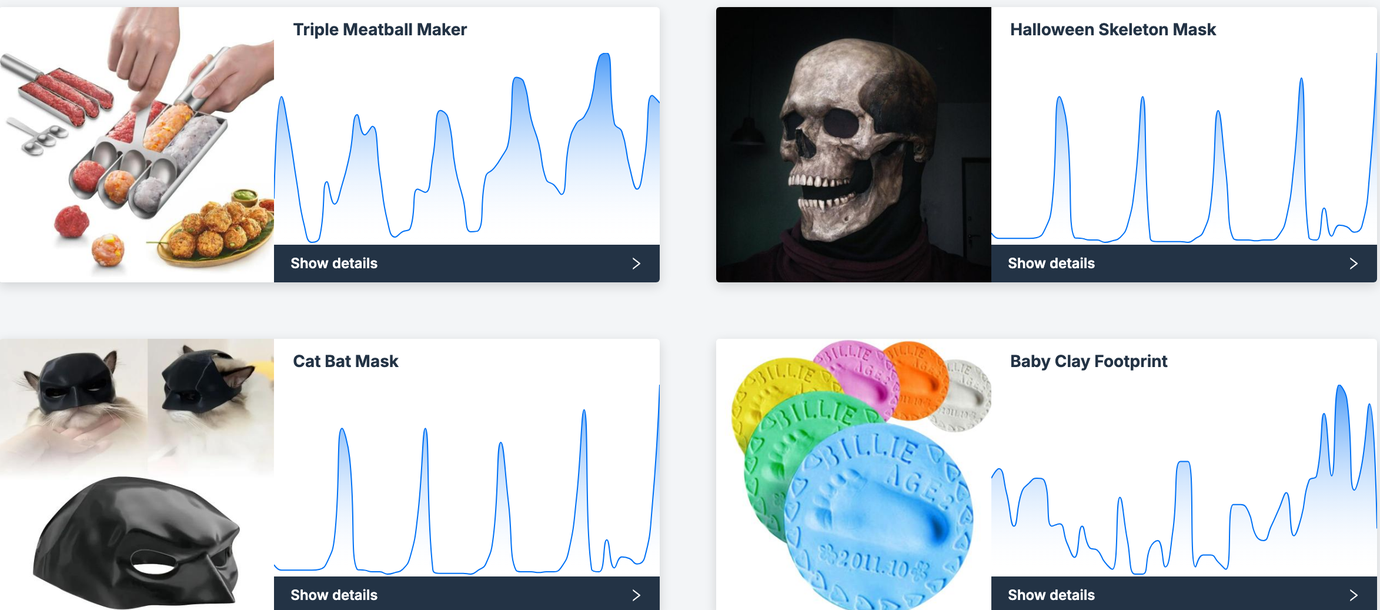
For product selection, this flips a filter. A good 2027 product demos well in five seconds of video: the problem is visible, the fix is satisfying, and a stranger understands it without sound. Product Picks tags exactly these items with its TikTok Friendly trait, and Current Trends shows which of them are rising right now, each backed by up to 5 years of demand history.
Which products pass the filter
- A problem you can see on camera: tangled cords, wet shoes, cluttered counters.
- A fix that looks satisfying in one take, with no explanation needed.
- A price in the impulse band, roughly $20 to $60, where a viewer can buy before the feeling fades.
- Low sizing or compatibility risk, because social buyers do not read size charts.
You do not need to become a social platform expert to benefit. You need products that survive the five-second test, and a fulfillment partner that keeps delivery promises when a video suddenly works.
6. Product Research Gets Deeper, and the Gap Shows
Here is what deep research looks like in practice. The Electric Travel Clothes Dryer is a warm-air drying cover aimed at parents on sports trips and small-space households. Its Tradelle product report, checked on November 26, 2026, shows about 30,000 searches a month, up 2% on the year before, with demand busiest from October to December.
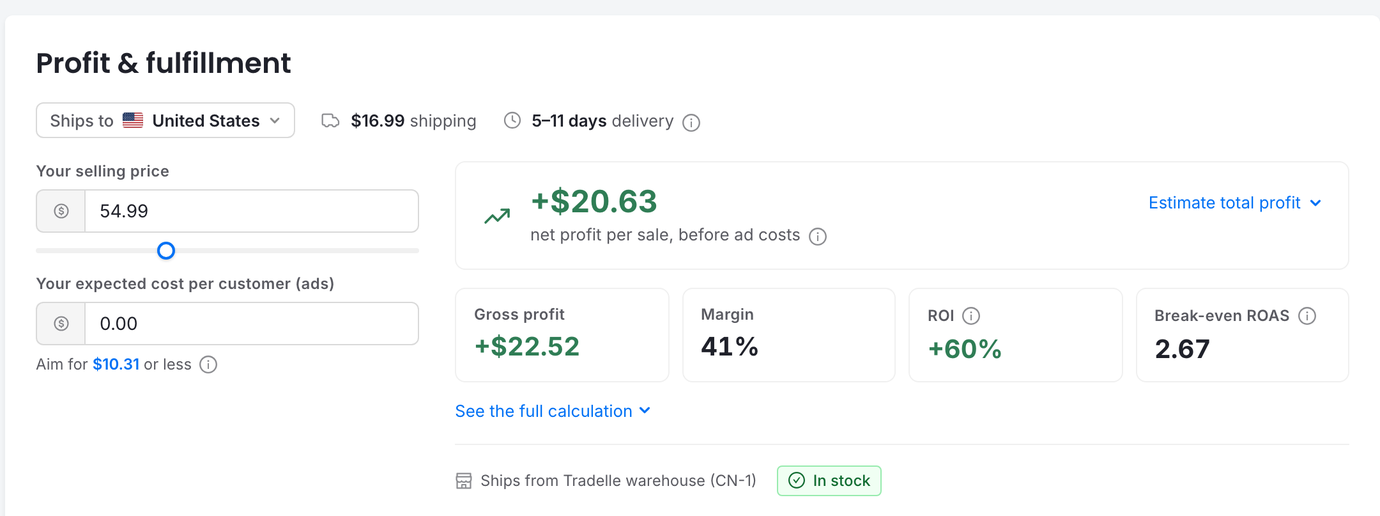
This product's economics look good at first glance: $15.48 product cost, $16.99 shipping with a 5-11 day window, and a $54.99 suggested selling price, for a gross profit of $22.52 before ads. Using the built-in calculator at the suggested price, you get $20.63 net profit per sale before ad costs, a 41% margin, and a break-even ROAS of 2.67, with a recommended customer acquisition cost of $10.31 or less.
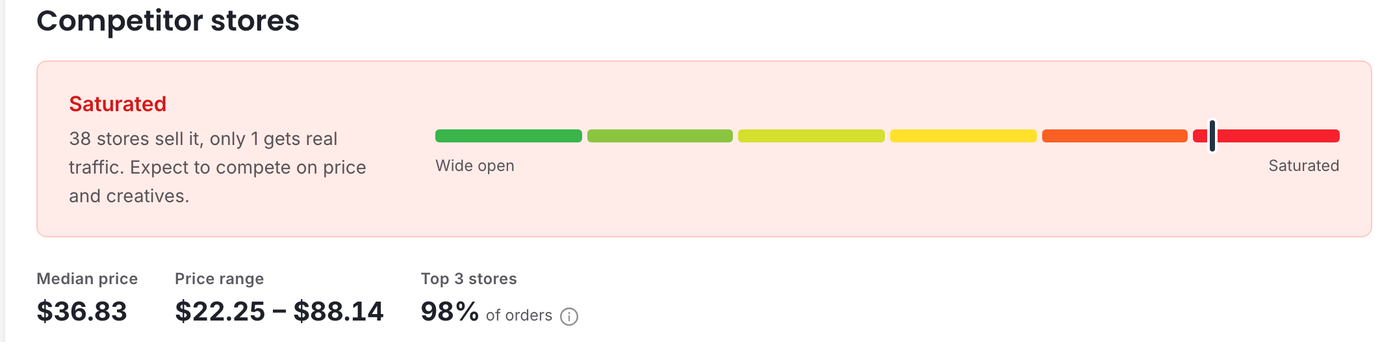
Then the saturation data tells the real story. The report flags this product as Saturated: 38 stores sell it, only 1 gets real traffic, and the top 3 stores hold 98% of orders. The median competitor price sits at $36.83, well under the $54.99 suggestion.
The entry options, priced honestly
Strong demand plus brutal concentration leaves three honest paths. Attack a segment the leaders ignore: RV travelers, team managers buying ten units at once, or ski-season households, each with its own creative and landing page. Out-create the incumbents: if their ads are all static images, a five-second demo of wet shoes drying in a hotel room is a real advantage. Or take the answer the data gives you and pick a different product, which is exactly what the saturation gauge exists for.
What you cannot do is enter with the same product, the same angle, and a higher price than the median. One store wins this one. The other 37 are decoration.
The five numbers to check on every report
Before any product gets your ad budget, read the same five lines: monthly searches and their direction, the busiest months against your calendar, gross profit after product and shipping, the break-even ROAS against what your account actually delivers, and the saturation summary with its store count. The dryer passes four of the five and fails the fifth decisively. Most products fail one or two, and knowing which line failed tells you whether to fix the price, the timing, or the product choice itself.
Where this research depth lives
Product Picks runs this same analysis across tens of thousands of hand-picked products, each with demand history, saturation, and profit math, each fulfillable through Tradelle in one click. Store Explorer adds the other half: any Shopify store's estimated revenue and traffic sources, so you can study what the two winning stores actually do differently before you spend a dollar.
Read the traffic sources on a winning store like a verdict. Mostly paid social means that the store lives and dies with the creative of individual ads and a better ad can knock the current leader off the perch. Mostly organic means someone has built a content moat and you are likely to engage in a slower battle for store dominance. That one distinction dictates how much budget a sensible entrant should bring.
7. Owned Channels Decide Your Q1 Profit
Each of these trends increases the cost to acquire customers. The counterweight is selling twice to the customer you already paid for. Email and SMS flows, post-purchase offers, and a reason to come back in January all convert Q4's expensive traffic into cheaper Q1 revenue.
Set up four flows before the year turns: a welcome series for new subscribers, an abandoned-cart reminder within two hours, a post-purchase cross-sell around day ten, and a win-back campaign for Q4 buyers in late January. The email marketing guide covers each flow in detail, and the average order value breakdown shows the cart math behind them. Neither is glamorous. Both compound week after week.
Give January a reason to exist in the inbox. New Year buyers shop with fresh motivation and gift cards, and a store that follows up with a genuine offer in the first week of January converts them while competitors are still recovering from the holidays.
FAQ: Dropshipping Trends in 2027
Is dropshipping still profitable in 2027?
Yes, for sellers who price from landed cost and research products deeply. The de minimis change killed the race-to-the-bottom model, not the model itself. Stores with real margins, fast delivery, and differentiated creatives continue to profit. Stores selling the same saturated product at the same price as 37 competitors do not.
What is the biggest dropshipping trend for 2027?
The end of duty-free de minimis shipping affects every number in your business: prices, suppliers, promises to deliver, and products that simply don’t make any money to send. The second biggest change is to shopping via AI, since it creates a demand channel for online stores with good product data.
Are saturated niches off-limits in 2027?
No, but the entry price changed. A saturated label means demand is proven and a few stores capture nearly all of it, so you enter with a different segment, a different creative angle, or a bundle the leaders do not offer. Entering with a copy of the leader's listing is what the data warns against.
How much will it cost to start a dropshipping business in 2027?
For a few hundred dollars you can set up a store, do a few product tests at $50-$150 each for ad spend or seeding, and then have enough to cover a few orders until the payment shows up. The big shift in how you spend money is from spending it on inventory to spending it to test creative and to validate.
Will AI replace dropshippers?
No, but it replaces the manual parts of dropshipping. Product research, listing drafts, and order routing already run themselves inside platforms like Tradelle, and AI assistants can now operate an account directly. The seller's job moves to judgment: which product, which angle, which margin.
When should I start preparing for 2027?
December. Lock your landed-cost pricing, shortlist products with Q1 demand curves, prepare three to five creatives per product, and set up post-purchase email flows before the Q5 ad window opens right after Christmas.
Final Thoughts
None of these seven shifts is waiting for January. Customs rules, ad automation, AI shopping, and social checkout are already running, and the sellers who planned around them in December will spend 2027 executing instead of catching up.
Start with the numbers. Pick a niche with room (our 2027 niche breakdown has ten with real data), read one full product report this week, and price your next product from landed cost. The year rewards the prepared.