De Minimis 2027: Ecommerce Landed-Cost Guide
The de minimis exemption for commercial imports into the US has already been suspended and will cease to exist as a matter of statute on July 1, 2027. For online sellers, the key task of dealing with this change is to factor in import duties, the cost of clearance, and other aspects of fulfillment into the price of the goods they sell online.
The date for the suspension of duty-free treatment by the Executive action was 2025, followed by implementation of Customs and Border Protection regulations in 2026. Congress repealed the commercial-shipment exception in separate legislation with an effective date of July 1, 2027. It is important to note that these different actions could cause confusion as to when items need to be priced.
In this guide we focus on commercial ecommerce imports into the USA. It covers current timelines for such shipments. It includes a worked example of a landed cost calculation as well as an explanation of the terms DDP and DAP. There is also a break-even formula for consolidated domestic fulfillment as well as a look at where a supplier with final prices and customs handling can add most value by removing administrative effort from the equation.
What De Minimis Means for Ecommerce in 2027
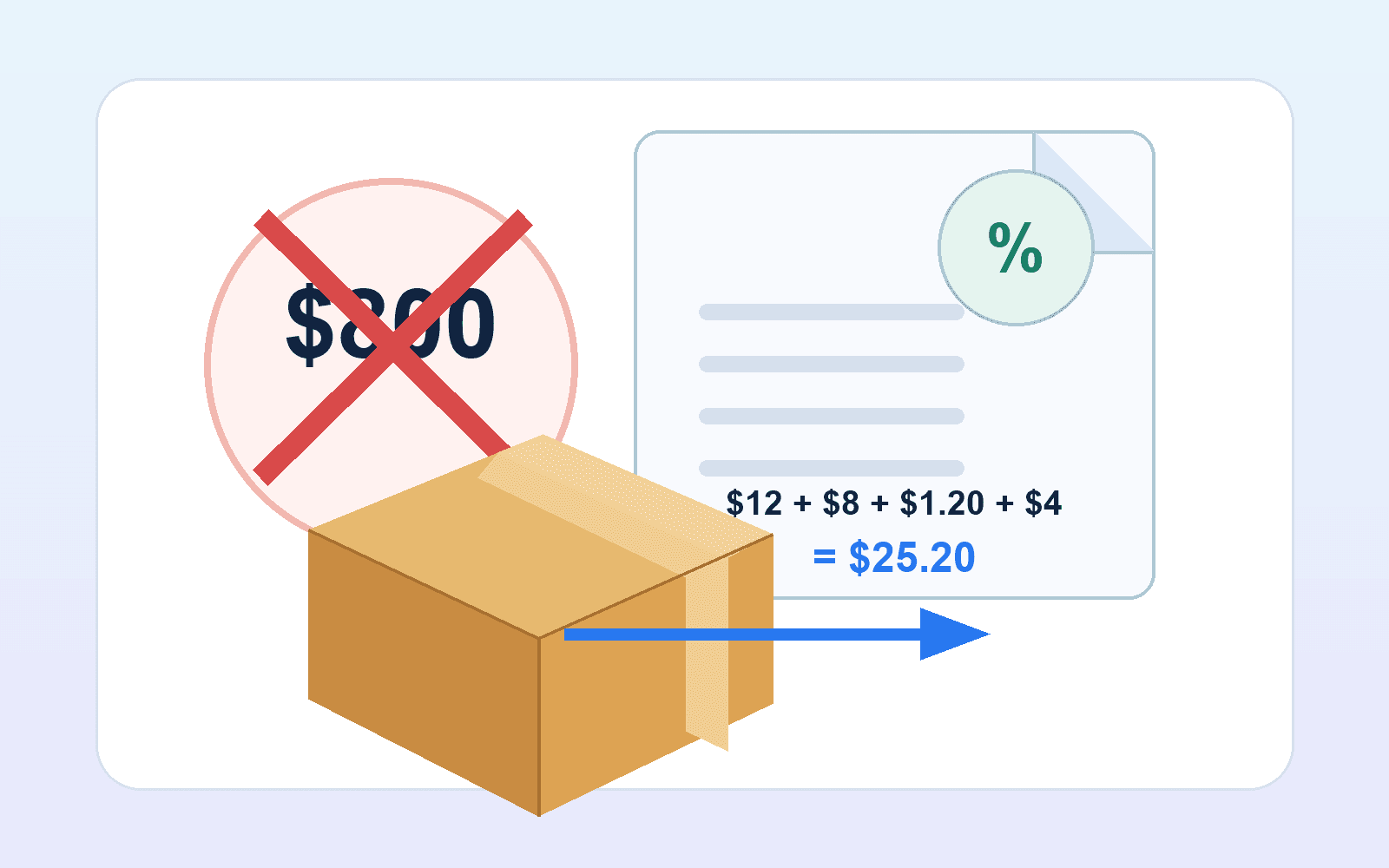
De minimis is the common name for an administrative exemption in section 321 of the Tariff Act of 1930. For qualifying commercial shipments under 19 U.S.C. 1321(a)(2)(C), it allowed articles valued at $800 or less, imported by one person on one day, to enter without duties or taxes imposed because of importation. It did not make every tax disappear, and it did not exempt products from safety or other admissibility rules.
The separate provisions for bona fide gifts and certain personal or household articles traveling with a person are outside this article. Our subject is the commercial-shipment exemption that shaped cross-border ecommerce and dropshipping.
The dates that actually matter
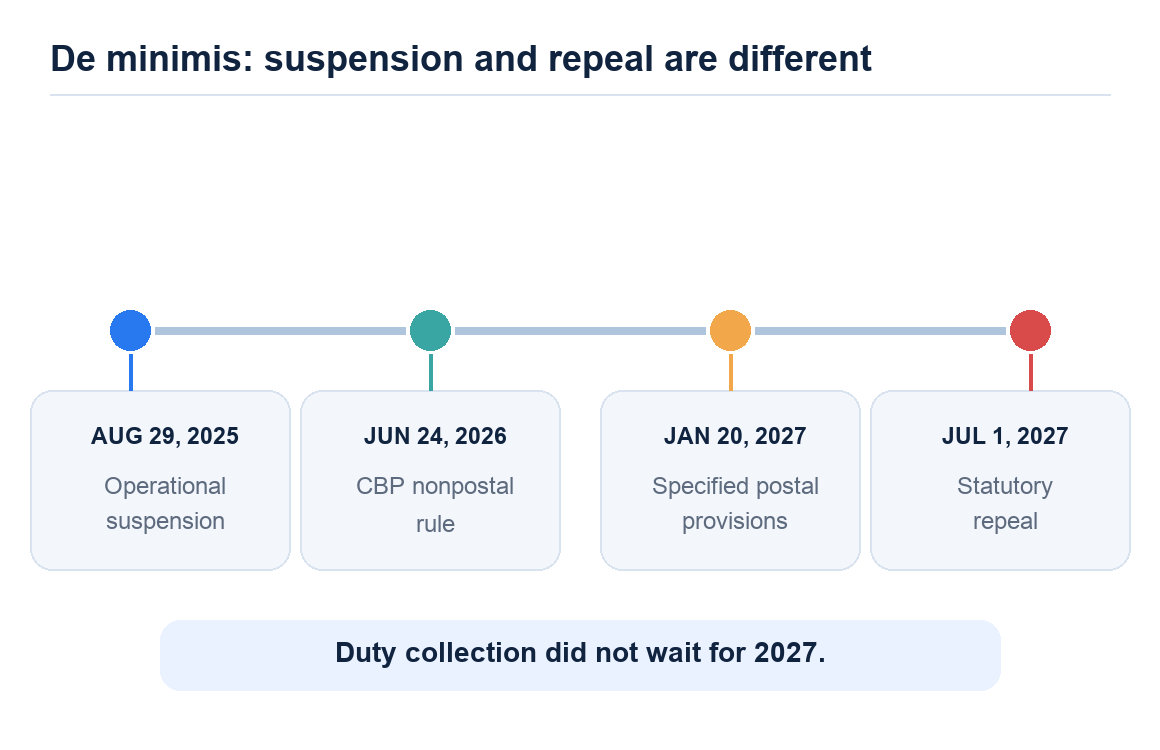
Duty-free de minimis treatment for covered commercial imports ended on August 29, 2025. CBP’s June 2026 rule later implemented an indefinite suspension for merchandise valued at $800 or less arriving by modes other than international post. Those shipments need an appropriate formal or informal entry and are subject to applicable duties, taxes, and fees. The old Entry Type 86 route is no longer available.
International post has its own procedures. Its regulatory suspension took effect June 24, 2026. A new informal process for qualifying postal merchandise valued at $2,500 or less followed on July 24, and the voluntary Entry Type 13 test began September 22. Entry Type 13 gives eligible filers another option, but it does not cover shipments subject to antidumping or countervailing duties, or to quotas. Those still require formal entry.
A Federal Register notice published on October 22, 2026 then set January 20, 2027 as the compliance date for two specified postal regulations, 19 CFR 145.12(a)(2)(v) and (vi). That notice covers merchandise with particular agency requirements, certain Chapter 98 or 99 duties, and certain duty-free claims. It is not a general postponement of duty collection for every postal parcel, and it does not remove the postal informal process for ordinary eligible merchandise.
Then comes the statutory date. Public Law 119-21, section 70531 repeals the commercial-shipment exception effective July 1, 2027. This is the point when the legal basis for the old exemption disappears rather than remaining suspended.
What changes on July 1, and what does not
July 1 changes durability. Before that date, sellers operate under a suspension implemented through executive and regulatory action. After it, the commercial exception has been repealed by statute. Planning for a permanent return of the old $800 rule is not a useful 2027 sourcing strategy.
July 1 does not mark the beginning of duty collection on low-value parcels. Applicable duties already apply under the suspension. The repeal also does not create one universal percentage for every product. Your exposure still depends on the item’s classification, country of origin, customs value, and any additional measures that apply when you import.
A small parcel can still enter the country. The difference is that its low value no longer gives it the old duty-free treatment or simplified de minimis entry. Your product price, shipping promise, and supplier process need to reflect that reality now.
Build the Landed Cost Before You Set the Price
Landed cost is the amount required to get one unit to its destination, cleared for import and ready for the buyer. A product-cost figure alone cannot tell you whether the order works. The necessary lines depend on the route, but the worksheet usually starts with product cost, international transport, duties, customs clearance, brokerage, import taxes where applicable, insurance, and final delivery.
Start with the SKU, not a generic tariff headline
Begin with the product’s Harmonized System code and its destination-specific tariff classification. In the US, that means checking the current Harmonized Tariff Schedule. Confirm the country of origin, which generally comes from manufacture or substantial transformation rather than the location of a warehouse. Then check whether additional duties or product-specific measures apply.
A few key points to note: Customs value and landed cost are not necessarily equal. Transaction value is typically equal to the price at which the article was sold for export to the US (with certain statutory additions to the price as required). Cost of international transport and insurance are examples of items that remain as landed cost items even though they are not included in the customs value. Verify the correct shipment is being valued and record all fees from supplier’s quote exactly as they appear. Also be aware that a quote that is delivered price may already include the cost of transport and/or clearance and thus should not be relisted.
For the calculations below, imagine a fictional SKU selling for $39. Its product cost is $12, and we will assume that $12 is the accepted customs value in both routes, purely to keep the comparison stable. We will also assume a 10% duty rate and a $4 clearance charge. Those are illustrative assumptions, not valuation rules or rates for a real product. Advertising, payment fees, returns, store taxes, and other business expenses are excluded until later.
A direct cross-border DDP order
Delivered Duty Paid, or DDP, puts import clearance and the payment of import duties and taxes on the seller. A carrier or broker can perform the work, but the seller carries the commercial responsibility. For a consumer, the important result is that the agreed checkout total does not get followed by another import bill.
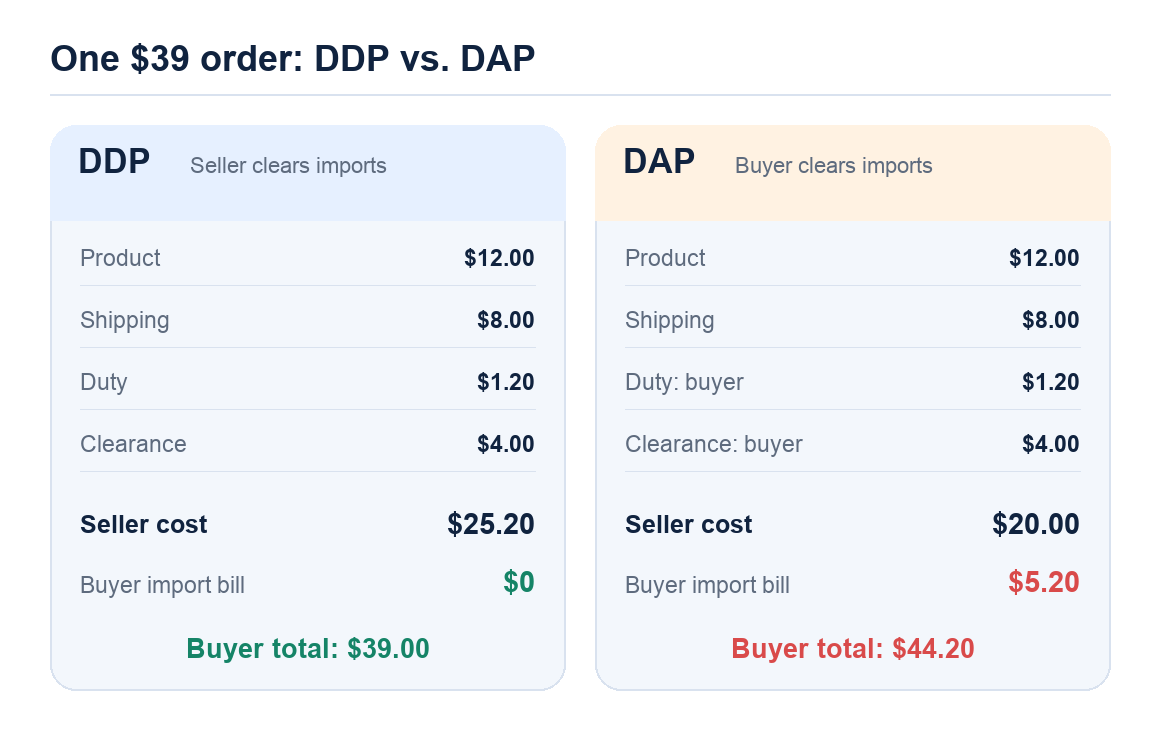
Our example order has $12 of product cost, $8 of international shipping, $1.20 of assumed duty, and $4 of assumed clearance cost. The landed fulfillment cost is $12 + $8 + $1.20 + $4 = $25.20. At a $39 selling price, $13.80 remains before advertising, payment fees, returns, store taxes, and other business expenses.
That remainder is not net profit. You still need to subtract the rest of your costs. Our guides to calculating dropshipping profit margin and high-ticket order economics show how acquisition and after-sale costs change the picture.
DDP vs. DAP: Who Deals With the Import Bill?
Delivered at Place, or DAP, keeps transport to the named destination with the seller but moves import clearance, duties, and taxes to the buyer. A courier may still process the customs entry for convenience, then collect the charges and its service fee from the recipient. That can make a DAP quote look cheaper on the seller’s worksheet while creating a worse delivery experience.
The same order under DAP
Using the same fictional order, the seller pays $12 for the product and $8 for shipping, or $20. The buyer separately faces our assumed $1.20 duty and $4 clearance charge. A $39 checkout price therefore becomes a $44.20 effective cost for the buyer before any other applicable charges.
If the seller keeps the full $39 and contributes nothing toward those import costs, $19 remains before other business expenses. That is $5.20 more than under DDP. But the customer also has $5.20 more to pay and may need to respond to the carrier before the parcel moves.
If the customer’s effective total is to equal $39.00, then the check-out price can be decreased by $5.20 to $33.80. Using $20 for product and shipping, the seller would have $13.80 left, the same remainder as in the DDP example. Simply moving the bill around does not make its economics disappear.
Why the customer experience can differ
With DDP, the seller has to know the import costs and arrange payment correctly. With DAP, the buyer can face a payment request, a request for information, or a delayed release. If the buyer refuses the charge, the parcel can be returned and the seller can still carry the commercial fallout.
DAP can make sense when the recipient is a business with its own broker and import process. For an ordinary consumer buying a $39 item, an unexpected collection request is usually a harder proposition. Your returns process also needs to account for a refused cross-border delivery, not only a customer who changes their mind after opening the parcel. Our guide to managing dropshipping returns and refunds covers the operational side.
The real comparison between DDP seller cost of $25.20 and DAP seller cost of $20 is between the seller’s remainder, the buyer’s total payment, and the work created by each option.
When Does Consolidated Domestic Fulfillment Pay Off?
Consolidation means importing a batch, clearing it through customs, and then sending individual orders domestically. It does not eliminate import duty. The batch still has to be classified and entered correctly, and the duty has to be paid. Your customer’s domestic order simply no longer needs its own international customs event.
The possible saving comes from spreading inbound freight and entry expenses across units and replacing repeated international parcels with domestic fulfillment. In return, you commit cash to stock, pay domestic storage and fulfillment costs, and accept the risk that some units do not sell.
A 100-unit and 300-unit comparison
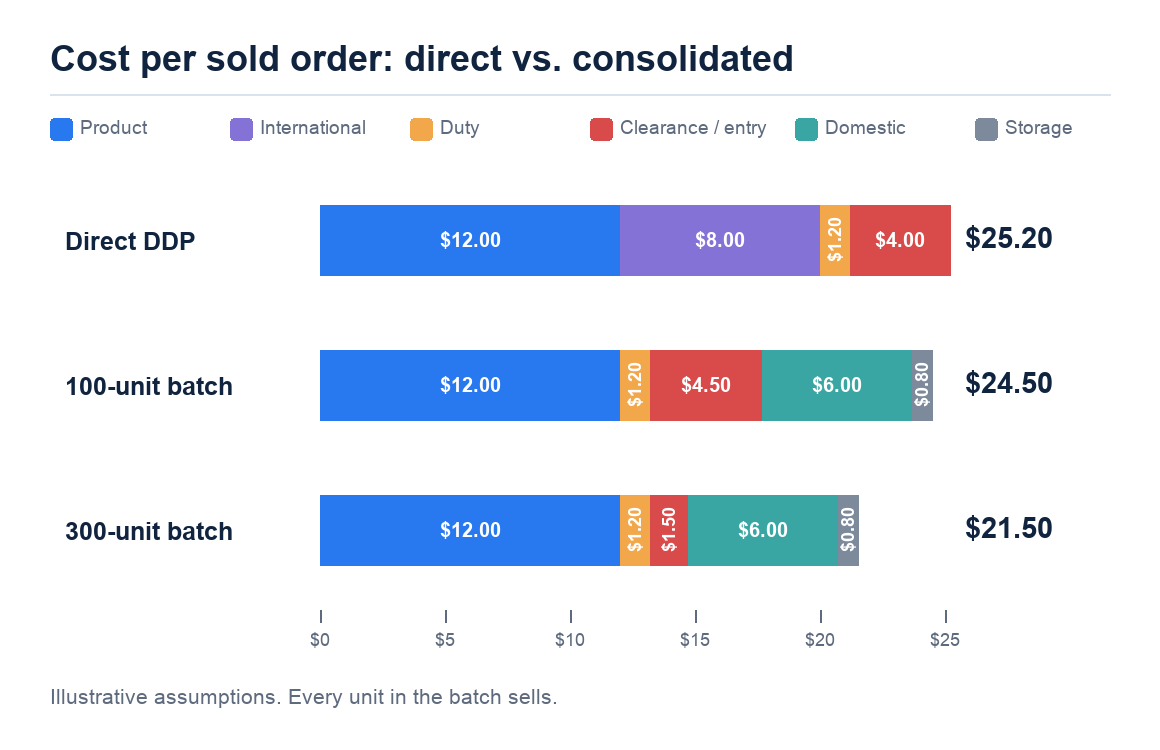
Keep the $12 product cost and 10% duty that we assumed in the example above. Then Domestic Fulfillment costs $6 per product and storage and carrying costs $0.80 per product. The total variable cost to sell this product in market would be $20 ($1.20 duty included) and, in addition to the variable costs, there is a fixed cost of inbound freight and entry for each batch of $450. Every figure remains an explicit planning assumption.
The batch formula for this product is $450 + $20 * units. Then $20 + $450 / units sold is the per-unit cost to sell. For 100 units in the batch, that would be $2,450 and $24.50 per unit sold. For 300 units in the batch, that would be $6,450 and $21.50 per unit sold.
Against the direct DDP cost of $25.20, the 100-unit route saves $0.70 per order. At $39, $14.50 remains before other business costs. The 300-unit route saves $3.70 per order, leaving $17.50. Notice that the assumed duty stays at $1.20 per unit in both routes. Consolidation is not a duty dodge. The difference comes from the freight and entry structure.
Find your break-even batch size
In this case, F is the fixed cost for the consolidated batch, and V is the variable cost to consolidate each order. Direct DDP costs for the order would be C. So consolidated shipping would win when V + F / N < C. Rearranging the inequality, F / (C - V) is the break-even point for this type of shipping.
Here, $450 ÷ ($25.20 - $20) = approximately 86.54 units. You would need to sell at least 87 whole units for this example to beat direct DDP on cost. At 86 units, the cost is $25.23 per unit after rounding. At 87, it is $25.17. The crossover is 86.538461..., so round up when planning a whole batch.
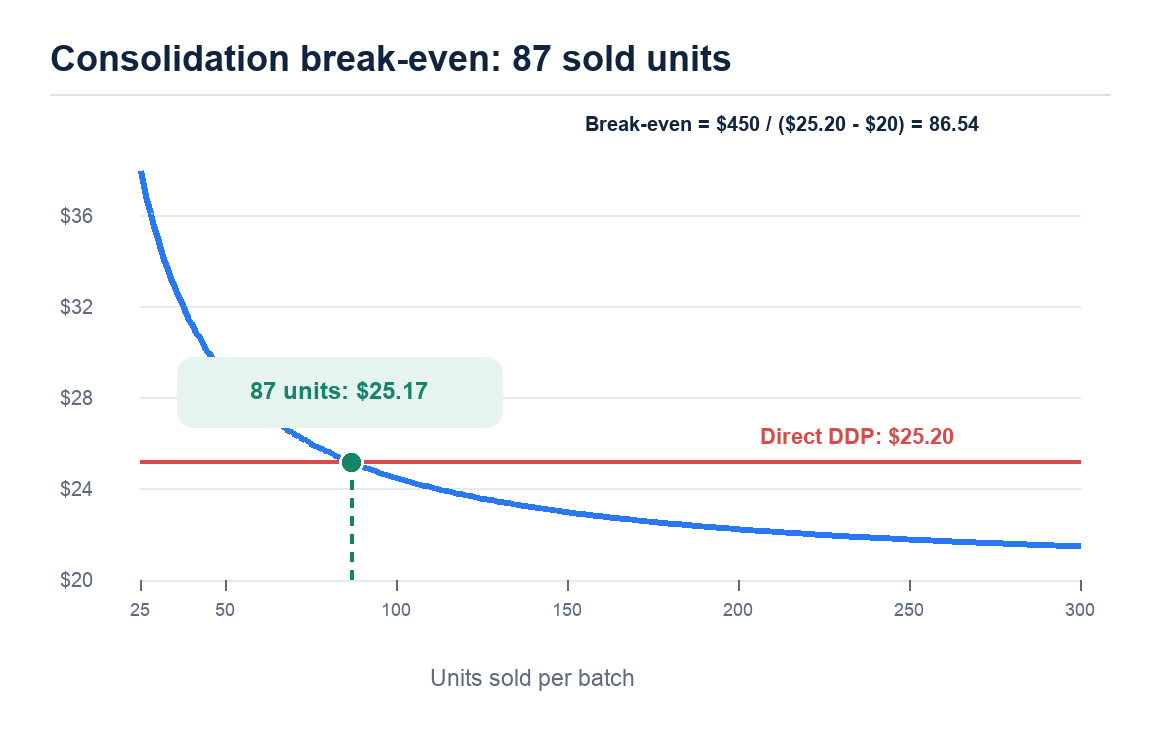
This route can’t win at the stated cost if C is equal to or below V. Spreading the fixed cost of a warehouse over a larger batch does nothing to the equal or higher variable cost. Don’t choose the warehouse option because it sounds more adult-like. Choose the numbers.
The sell-through assumption can break the result
Our examples assume every unit sells. Buy 100 and sell only 60, and the fixed cost is spread across fewer orders while 40 units still tie up cash. You may also pay for storage longer or discount the remainder. Seasonal products add another constraint because a cheap unit in the warehouse is not useful after its demand window closes.
When you consolidate stock, check the demand history, current sales, supplier lead time, and the date by which you need to sell the stock. Our product-validation workflow is a useful way to decide whether a SKU deserves inventory in the first place. A proven product can justify a batch. A hunch usually cannot.
A Practical Worksheet for Each SKU
Run the same route comparison for every product and destination combination. A SKU that works DDP to the US may have different economics to Germany or Australia. Likewise, a product that deserves a US batch after stable sales may still need direct fulfillment in a smaller market.
Use this checklist before choosing the route:
- Classification and origin: The current tariff number, country of manufacture, customs value, and any special measures applied to the actual SKU to be traded.
- Complete direct quotes: ask whether product, freight, duty, brokerage, disbursement, import taxes, and last-mile delivery are included. Keep DDP and DAP quotes on separate lines.
- Please provide complete consolidated quotes that separate out fixed charges for inbound transportation and entry fees from per-unit charges for warehouse storage, pick, pack, and domestic transportation. Also, please make sure to include any receiving charges that may apply.
- Demand and sell-through: estimate how many units can realistically sell before the next reorder or seasonal deadline. Use orders you can support with evidence, not an optimistic annual total.
- Customer promise: decide whether the shopper will see one final total or an import charge later. Put the delivery window beside that choice.
- Include in the Cash and downside section the batch deposit, the money tied up in unsold stock, possible returns, and the cost of slow sales.
For product research, Product Picks gives you a report that summarizes product costs, suggested selling prices, shipping to destination, market demand, and competitor pricing. The worksheet can be used as a starting point and then completed with actual customer-acquisition costs as well as assumptions regarding after-sale activities.
Direct DDP is generally a cleaner test than consolidation when ordering unknown quantities. As demand becomes more certain and your sell-through numbers are above your estimated break-even point, then Consolidation would likely be the better option. DAP is typically used with a recipient who can take and assume full import responsibilities. None of the above methods are necessarily cheapest.
How Fulfillment by Tradelle Simplifies the Import Side
There is another way to reduce the worksheet: choose a supplier whose product and destination-shipping prices are final and who handles customs for you. Fulfillment by Tradelle sources directly from manufacturers, manages international shipping and customs, processes orders automatically, and sends tracking updates. You do not need to calculate de minimis or arrange import-duty payment for each Tradelle order.
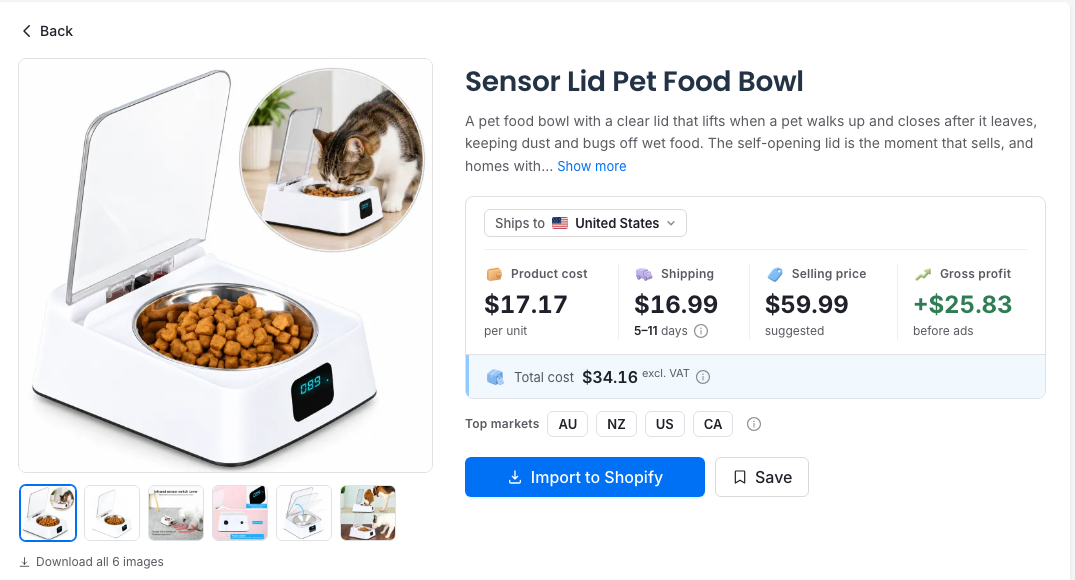
Take the Sensor Lid Pet Food Bowl as a fresh dashboard example checked on November 4, 2026. For delivery to the United States, it shows a $17.17 product cost and $16.99 shipping, with a stated 5-11 day delivery window. The total supplier cost is $34.16 excluding VAT. The suggested selling price is $59.99, leaving $25.83 in gross profit before ads and your other business expenses.
Those product and shipping figures are the final supplier prices. Tradelle handles customs and applicable import duties, so you do not have to classify the bowl yourself, calculate a separate de minimis charge, or manage customs for the order. The dashboard’s VAT label refers to your business VAT, which stays separate just as it would with any supplier.
This does not change US law. It changes who handles the operational work. Instead of comparing brokers and hoping a customer will pay an unexpected bill, you can see the supplier cost before importing the product and let Tradelle handle the cross-border process. That makes Tradelle the easiest supplier for sellers who want customs off their task list.
Automatic Tracking Number Updates sends dispatch details to Shopify and notifies the customer. The same platform also handles returns through US, EU, and UK return centers. You can evaluate the product with real cost and demand data, then move into fulfillment without adding a separate customs workflow.
If you are comparing supplier models, our guide to dropshipping suppliers that ship worldwide explains the wider selection criteria. For a current view of US dropshipping conditions, see Dropshipping in the United States After 2025.
Your 2027 Action Plan
Start with the products you already sell. Export the SKU list, destination countries, current supplier prices, and shipping terms. Mark any quote that says only “shipping included” without explaining duty and clearance. Those are the quotes that need questions now, not after a customer receives a collection notice.
Ask the 4 supplier questions to write down beside the SKU (product code) for that item: 1) Who clears import on this item? 2) Who pays for duties / taxes on this item? 3) What brokerage/disbursement fees will be charged by supplier (or other third parties) and by whom will they be paid? 4) Will customer ever be asked for payment or for information by supplier or 3rd parties before item is delivered?
You can now recalculate your direct and consolidated routes using the above formulas. Make sure to keep fixed costs and variable costs separate and use a realistic sell-through number. If you are a Tradelle user, simply record the final product and destination-shipping prices in your dashboard and let the fulfillment team handle customs for you. You can then use the remaining worksheet to calculate the selling price, acquisition cost, fees, returns, and taxes that you need to pay.
Mark two review dates on your calendar: January 20, 2027 (the compliance date for the specified international-post provisions) and July 1, 2027 (when you need to review your legal and supplier assumptions again). A separate low-value-shipment proposal by CBP (posted on October 8, 2026) is still waiting for comments, so don’t consider the proposed filing, data, and bond requirements as settled yet. Product classifications, additional duties and carrier charges can change independently from the statutory repeal.
FAQ: De Minimis 2027 for Ecommerce
Is de minimis still available for US ecommerce in 2026?
No, not for the commercial shipments covered by the former $800 exemption. Duty-free treatment is suspended and applicable duties, taxes, and fees apply. CBP’s June 2026 rule covers non-postal modes, while international post has separate procedures. Bona fide gifts and certain travelers’ articles fall under different provisions.
Does de minimis end on July 1, 2027?
Note that while the statutory repeal of the commercial-shipment exception takes effect on July 1, 2027, the exception has already been suspended. So, do not wait until July to update your landed costs to reflect supplier charges for duties or to ask your supplier how they handle duties.
Does the new policy still allow under $800 shipments to go to the US?
A low shipment value does not mean that the item cannot be imported. It no longer receives the old duty-free commercial treatment. A shipment of this type still requires proper entry and it could be subject to duties, taxes, and fees that are applicable to the imported article based on current laws and regulations.
Does DDP mean there are no import duties?
No. DDP means the seller arranges import clearance and pays the applicable duties and import taxes. Those costs still exist and need to be included in pricing. DAP assigns the corresponding import responsibilities to the buyer instead.
Does holding US inventory eliminate import duty?
No, the consolidated batch would still be imported and assessed under the appropriate import regulations. While having inventory for Domestic fulfillment can mitigate many of the international freight and clearance issues, it adds several layers of cost including storage and Domestic delivery cost. Compare the complete economics of the entire route.
How do I find the duty rate for my product?
Start with the product’s tariff classification and country of origin, then check the current US Harmonized Tariff Schedule and any additional measures. Confirm the customs value and which fees your supplier or carrier already includes. Do not apply the illustrative 10% rate in this article to a real SKU.
What does Tradelle charge for customs handling?
The product cost and destination-shipping price for the product shown on the dashboard are the final supplier prices. Tradelle handles the customs and any import duties that are applicable as part of the order fulfillment process. Business VAT, advertising, payment fees, returns, and other store costs remain separate. You do not need a separate de minimis calculation or customs workflow for the order.
Final Thoughts
De minimis planning for 2027 starts with a simple fact: the old commercial exemption is suspended now, and its statutory repeal arrives on July 1. Build duties and clearance into today’s order economics. Compare DDP and DAP by seller remainder, buyer total, and delivery friction. If you are considering a domestic batch, calculate the break-even sell-through before committing cash.
Or remove the customs work from your plate. Fulfillment by Tradelle combines final product and destination-shipping prices with sourcing, customs handling, automated orders, and tracking. That leaves you with the parts of the business you can actually grow: choosing products, setting a sustainable price, and winning customers.