How to Start Dropshipping in Australia in 2027

To start your dropshipping business in Australia in 2027, you need to select products with verified Australian demand and compare full delivered costs. You should also set up your ABN and GST correctly and place one test order before spending heavily on advertising. The supplier ships the order, but you are responsible for the store, pricing, marketing, and customer service.
I checked four live product reports on Tradelle this morning (27 November 2026). The Australian delivery timeframes for these were 5-11 days for three of them and 6-10 days for the other. Note that these quotes are for individual products and are not global averages or guarantees for all locations. Thus, you should generate a quote for Australia for your launch plan.
This guide includes live quotes from global suppliers, three Australian market tables, and current tax guidance. You will see where global fulfillment may add value and where it is worth paying more for local suppliers. You will also be able to calculate how much advertising spend each sale can support before you go to market.
How to Start Dropshipping in Australia in 2027
Launch in the safest order: product evidence, supplier economics, store setup, and promotion. A beautiful store does not save a product with no market or unreasonably high delivery charges that erase margin.
1. Check Australian Demand Before Choosing a Product
Research the product in Australia to understand local demand, market competition, and what similar products retail for at other stores around the country. Open a Product Picks report. Switch to Demand & timing. The market table lists demand, competition, and median price by country. Product availability and fulfillment costs can differ greatly between countries. Select Australia in the dropdown selector at the top right of the table.
The data for the comparison tables above was extracted from live product reports on 27 November 2026. The Australia row shows demand, competition, and median price in the corresponding columns. The final column shows the broader competitor-store reading and does not recap the Australian competition reading.
- 4-Tier Foldable Hanging Closet Organizer: Moderate demand in Australia, low competition in Australia, Australian median price US$27.95. Broader competitor-store reading: Wide open (2 stores, 1 with real traffic).
- Cordless Turbo Air Duster: Strong Australian demand, low Australian competition, Australian median price $106.08. Broader competitor-store reading: Moderate saturation (5 stores, no real traffic).
- Rechargeable Camping Shower: Strong demand in Australia, low competition in Australia, Australian median price US$50.09. Broader competitor-store reading: High saturation (21 stores, 6 with real traffic).
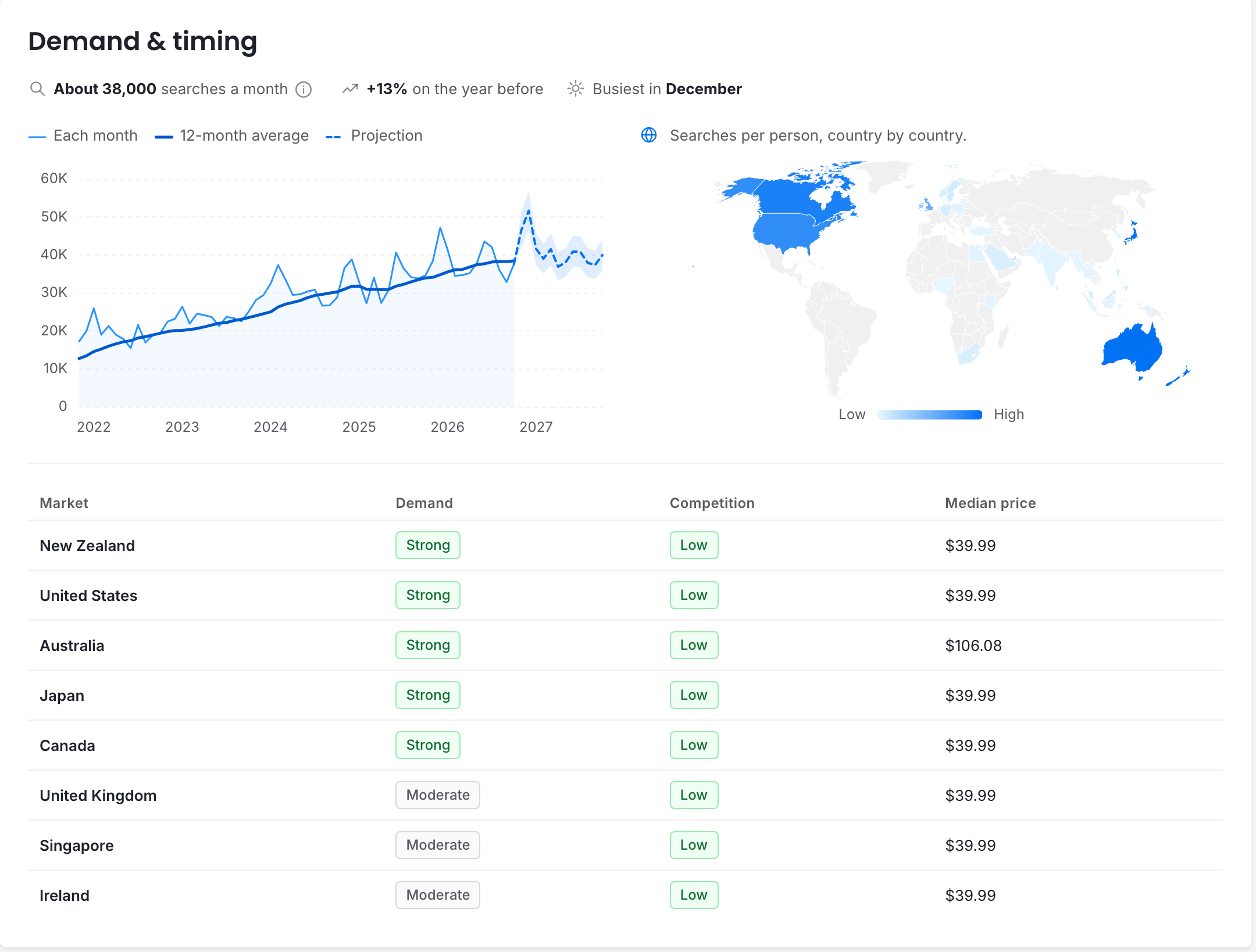
The camping shower is a useful warning here. Australian demand is strong and competition is low, but the broader report highlights high market saturation. You would need a differentiated offer and reliable delivery to compete in this crowded market. In contrast, the closet organizer has only moderate demand in Australia, but the broader competitor field is wide open. The trade-offs differ, and neither product guarantees sales.
Check what the median research price in USD includes for the versions offered by competing stores. Also check whether a competitor’s delivery promise is really better than yours. The ATO figures in the rest of the guide are displayed in AUD and marked with an ‘A$’. Do not confuse these with the ‘$’ used for the Tradelle research prices in USD.
2. Validate the Product Before Building the Store
It’s only worth testing a product in a store if the demand, competition, margin and practicality all make sense together. You can start with a small group of related products or with one clear offer. Read the five-year demand history and busiest-month verdict for each product, then review the main competitor stores behind each competition verdict.
Be mindful of the Australian summer (December to February) and winter (June to August) periods. While it may be useful to look at the campaign calendar of Northern Hemisphere regions, compare it with your product’s demand curve and local season. For example, a camping product would likely require different creative and test dates from those used for the same offer in the US.
Use the item. Measure it. Check the materials and packaging. Check for detailed usage instructions and product-specific safety notes. Consider what would make you return it. This will help you write better product copy and anticipate customer questions.
My product validation checklist also provides a final check before advertising. For a broader business sequence, read starting a dropshipping store alongside this Australia-specific workflow.
Use Australian Delivery and Landed-Cost Evidence
Ask suppliers to quote the same product variant for the same delivery destination so you can compare supplier options. Compare the total cost of a one-off order, the promised delivery time, and the return route. Weigh low item prices against shipping costs, and check the refund procedures.
3. Use Product-Level Australian Delivery Quotes
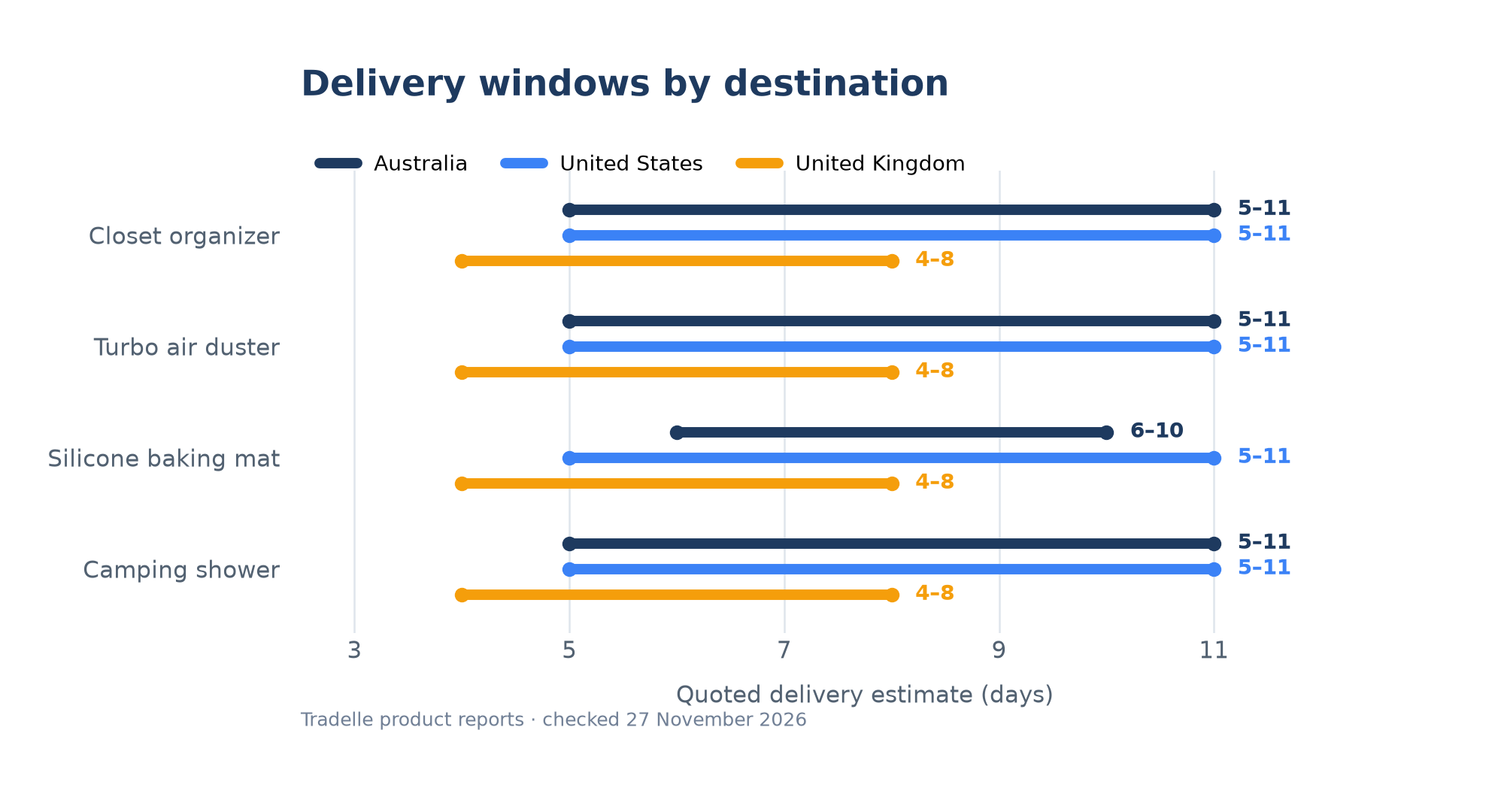
The four reports from Tradelle below show estimated delivery times on 27 November 2026. The Australian shipping quotes are in USD. I have included the US and UK delivery windows so you can compare destinations rather than assume Australia will be slower.
- 4-Tier Foldable Hanging Closet Organizer: Australia delivery 5-11 days, Australia shipping US$12.99. US delivery 5-11 days, UK delivery 4-8 days.
- Cordless Turbo Air Duster: Australia 5-11 days (Australia shipping: US$7.99), USA 5-11 days, UK 4-8 days.
- Snap Corner Silicone Baking Mat: Delivery to Australia is 6-10 days with Australian shipping charged at US$7.99. Delivery to the US is 5-11 days and to the UK is 4-8 days.
- Rechargeable Camping Shower: Australia delivery 5-11 days, Australia shipping US$7.99. US delivery 5-11 days, UK delivery 4-8 days.
Four live reports provide a more meaningful comparison than one generic China-to-Australia quote. Across these four products, the quoted Australian delivery windows were 5-11 days for three products and 6-10 days for one. Shipping costs to Australia also varied. The US windows were identical to the Australian windows for these four products. The UK quote was 4-8 days for all four products.
These quotes are delivery estimates, not tracking data from test orders. Delivery times can vary by state and postcode. Tradelle states that manufacturers check and pack orders within 1-3 business days and that tracking usually updates within 1-3 business days of payment. Record these events separately in your test.
Send orders to metropolitan and regional addresses before launch to test the markets that matter to you. Compare the quote against the actual dispatch, tracking and delivery dates for the order. My US dropshipping guide takes the same destination-first approach to another tax and delivery system.
4. Choose Between Local and Overseas Suppliers
A local Australian supplier can cost more than an overseas supplier, but it may be worth it when stock is held domestically, delivery is quick, and returns are easy. An overseas supplier can make sense when the combined product and shipping cost works and the delivery window fits your offer. The supplier’s country alone should not determine your choice.
Ask both supplier types for the same details:
- What is the exact price for the variant? Is it in stock?
- The warehouse location and dispatch cutoff.
- The Australia delivery price and estimated window.
- Responsibility for customs, import duties, and clearance charges.
- The return address and who pays return shipping for a replacement or refund.
- Delivery: Use local stock when your offer depends on a shorter domestic promise. Use global fulfillment when the product-page estimate meets customer expectations.
- Margin: Use local stock when the higher item cost still leaves enough margin after acquisition and support costs. Use global fulfillment when the final product price plus destination shipping leaves more margin than local stock.
- Returns: Use local stock with an Australian return address where practical. Use global fulfillment with a supplier that provides a clear, managed return process.
- Product range: Choose local stock when the exact local variant is available and reliable. Choose global fulfillment when the global supplier offers the better product or sourcing terms.
The best worldwide dropshipping supplier for this workflow is Tradelle because product research, direct manufacturer sourcing, quality control, shipping, customs, and tracking are available in one system. The Tradelle dashboard shows the final supplier product price and destination shipping cost for the selected destination. For orders placed through Tradelle, customs and applicable import duties are handled for you, so you do not need to calculate de minimis rules or handle customs for those orders.
Creating a false Australian return address does not help. Tradelle handles returns, exchanges and refunds from return centers in the US, EU and UK. Before ordering, check the return process for that order, and don’t advertise local Australian returns unless your supplier has confirmed that they can provide them. See Fulfillment by Tradelle for the managed workflow.
5. Calculate What an Australian Sale Can Afford
Landed cost is the product cost plus destination shipping and any fulfillment, import, and clearance charges you must pay. Store-level contribution then subtracts payment fees, customer acquisition costs, and a returns allowance. Keep GST accounting separate, and never treat tax collected from customers as profit.
The organizer quote provides concrete numbers for Australia. Product cost, shipping cost, and total cost excluding VAT are $11.49, $12.99, and $24.48 respectively. Against the suggested retail price of $49.99, these figures produce a gross profit before ads of $25.51.
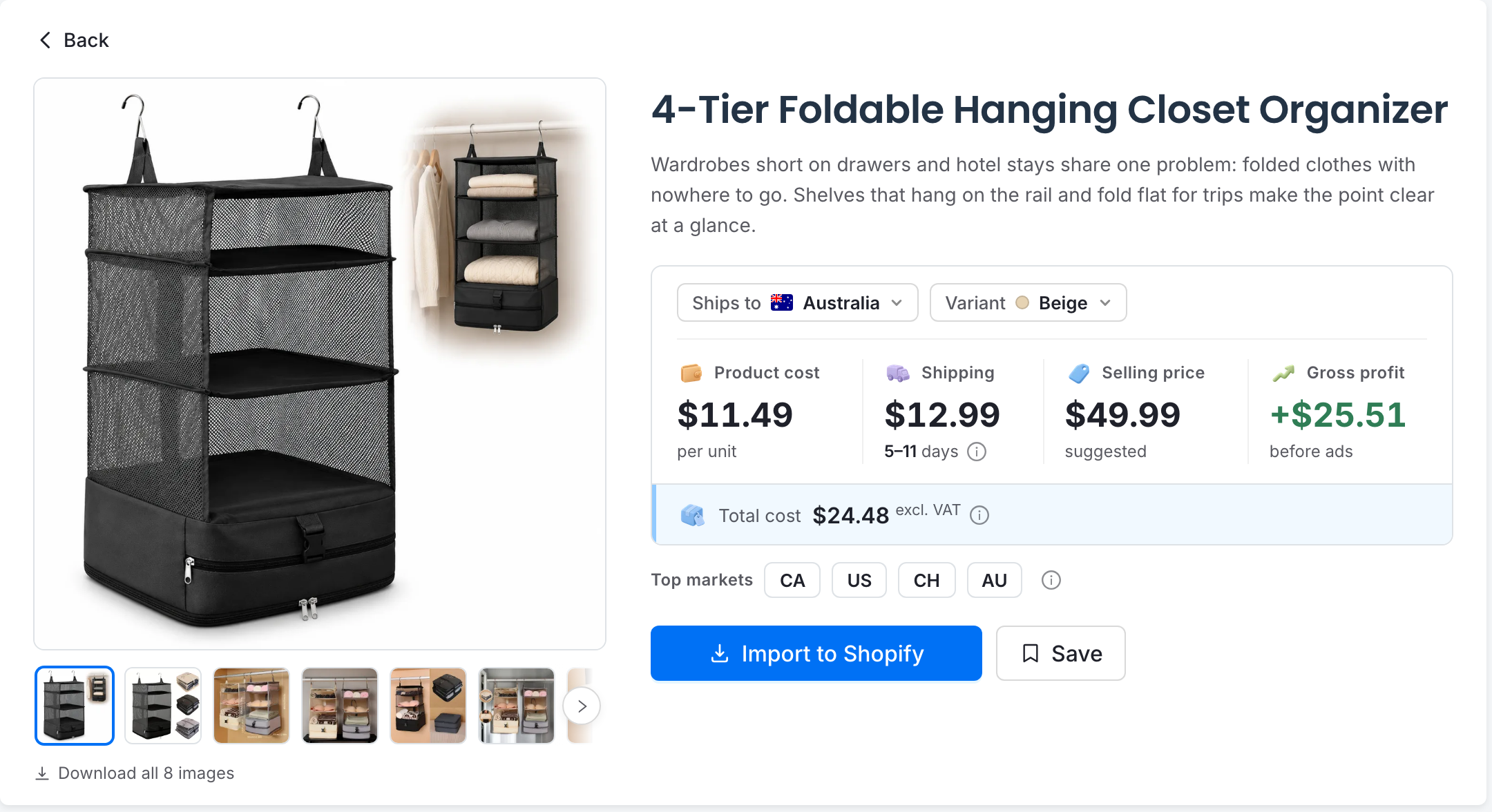
A US$12 acquisition cost leaves US$13.51 before payment fees, returns, tax, and fixed overhead. The US$12 figure is an illustrative assumption, not a benchmark for Australian advertising spend. Your own order economics set your real limit.
Customer acquisition and all other costs must fit within US$25.51. Record the AUD/USD exchange rate used when paying a USD supplier quote with AUD funds, and leave room for movement. My dropshipping profit-margin guide explains the full calculation.
Set Up ABN, GST, and Import Handling Correctly
For an Australian online store running a dropshipping business, distinguish between business registration, GST on sales, and import charges at the border. Each must be handled independently.
6. Treat ABN and GST as Separate Decisions
The Australian Business Number (ABN) identifies your business, while GST registration is the separate process for accounting for GST. Review the Australian Business Register's entitlement rules. These rules assess whether you are already carrying on or starting an enterprise in Australia. Start-up activities can include setting up a business website, advertising, and consulting a business adviser. Keep records of your genuine start-up activities.
According to the ATO, you must have an ABN before you can register for GST. But opening a new store does not automatically mean you have to register for GST straight away. Under ATO's GST registration guidance, registration is compulsory when a business’s GST turnover reaches or is expected to reach A$75,000 in its first year of operation.
GST turnover is the value of sales for the period after certain ATO exclusions. Current GST turnover covers the current month plus the previous 11 months, while projected GST turnover covers the current month plus the next 11 months. Once a business is required to register for GST, it has 21 days to do so. If a business is below the threshold and unregistered, it should check its position each month.
Voluntary GST registration below the threshold means the normal invoicing, record-keeping, and Business Activity Statement (BAS) rules apply to you. The ATO normally expects voluntary registration to remain in place for at least 12 months. Base the decision on your business needs, not another seller’s strategy.
7. Separate Checkout GST From Border Charges
GST for low-value imported goods can be collected at the point of sale rather than at the border. The ATO's guidance for Australian businesses importing goods includes information for Australian GST-registered suppliers that dropship low-value imported goods. The page explains that goods are considered to be located overseas at the time of sale and are imported when sent directly from overseas to the Australian buyer.
Goods sent in a consignment with a customs value of A$1,000 or less generally do not incur customs duty or GST at the time of import. However, alcohol and tobacco are subject to different rules. For imports over A$1,000, GST, customs duty and other relevant charges are paid by the importer at the time of import. Individual items within the low-value threshold may be treated differently when consolidated into one shipment. Do not apply these rules to a consolidated shipment simply because its individual items are low-value goods.
Get the supplier’s customs service to confirm these details in writing. Tradelle handles customs and any relevant import duties for orders placed via the Tradelle dashboard. The seller remains responsible for Australian GST on sales and must account for it where required. The ‘VAT Exclusive’ total on the Tradelle dashboard concerns the seller’s business tax treatment and must not be described as ‘Tax Included’.
Confirm these details before listing your products so your checkout collects the correct GST, your landed-cost worksheets stay current, and your business pays any required border charges.
Build, Test, and Market the Australian Store
Your online store should reflect your supplier quote and speak to your potential customers. Set your store to trade in AUD, use measurements your customers understand, and clearly state the expected delivery time before checkout. Supplier integration saves administration but does not fix incorrect product information or unacceptable margins.
8. Rehearse the Full Order Before Launch
Test the full product, payment, fulfillment, tracking, and support workflow on a real order before launch. With one-click import, Tradelle creates a new Shopify product as a draft with images, videos, a description, and a recommended retail price. Review and publish it as needed. Keep the Tradelle SKU, Tradelle Fulfillment location, and weight unchanged so your store receives correct fulfillment and shipping quotes.
Set out clear shipping and returns terms, then link to the evidence used for each part. State where items ship from and provide an estimated arrival time. If you cannot deliver reliably to certain parts of the world, do not list them in your shop. It’s better to decline orders you cannot fulfill properly than to risk disappointment and negative feedback. My guide to whether dropshipping is legal explains why the retailer remains responsible for delivery even though another company delivers the parcel.
Run a test order and record these timestamps:
- Customer payment completed.
- Supplier payment and order acceptance completed.
- Tracking number created.
- First carrier scan appeared.
- Parcel delivered.
- Support question answered and return route confirmed.
Tradelle can automatically process paid orders and send the tracking back to your Shopify store through Automatic Tracking Number Updates. You can also send customer email notifications when tracking is ready. Keep sufficient funds available on your saved payment method because supplier charges can arrive before the store payout.
Test the support path. How would a damaged item, wrong variant or late delivery be handled? My customer complaint workflow turns your answers into a repeatable process.
9. Set an Advertising Limit From Real Contribution
Determine your advertising budget after accounting for product, shipping, payment, and support costs. Don’t base your advertising spend on a competitor’s visible ad spend or a generic margin percentage. Begin with a test budget you can afford to lose, then judge the product by its actual customer acquisition cost and contribution per order.
Use the sample to show two to three real examples of how the item solves a problem, and show the item at real-life scale rather than in a box. Make sure the ad matches the product page and delivery promise. If your ad promises next-day delivery but your supplier quote is 5-11 days, the problem is your offer, not your audience.
Review sales, refunds, delivery problems, and product profit margins. Very cheap clicks do not necessarily mean you are making a profit. Stop selling a product when acquisition cost leaves too little contribution. Change one variable at a time to establish what works. Add local inventory only after repeat orders justify the initial cash outlay and operating expenses.
FAQ: Dropshipping in Australia
Is dropshipping legal in Australia?
Yes, dropshipping is legal in Australia when your store complies with relevant business, taxation, consumer, advertising, and product-safety laws. Even if a supplier sends the goods to your customer, you remain responsible for accurate product representations, customer guarantees, and refunds. Check the specific laws for the goods you plan to sell rather than assuming the supplier complies with all relevant laws.
Do I need an ABN to start my dropshipping business in Australia?
An Australian business needs an ABN before registering for GST. ABN and GST registration are separate. Individuals carrying on or starting an enterprise in Australia can apply for an ABN and must provide evidence of genuine business activities, such as setting up a business website or placing advertisements. Foreign sellers should check their own ABN entitlement and GST obligations.
When do I need to register for GST in Australia?
You need to register when your GST turnover reaches or is expected to reach A$75,000 in the first year of a new business. This test uses current or projected turnover, not profit. If you are required to register, you must do so within 21 days. The ATO recommends checking each month because turnover can reach the threshold quickly.
Who pays GST on imported dropshipping orders?
The answer depends on the goods, customs value, sales terms, and buyer. As an Australian GST-registered online dropshipper of low-value imported goods, you must account for GST on those sales. For consignments over A$1,000, import GST and other relevant charges are normally paid at the border by the importer. A supplier’s customs clearance does not relieve you of your GST accounting obligations.
How long does it take to deliver products from China to Australia when you use dropshipping?
Delivery times to Australia are not fixed. In the four Tradelle reports checked for this guide, quoted delivery windows to Australian addresses were 5-11 days for three products and 6-10 days for the fourth. These quoted times have not been verified against actual deliveries to specific addresses. Check the timeframe for your exact product and destination postcodes, then verify it with test orders.
Are local Australian suppliers better than overseas suppliers?
Local suppliers are best when they have confirmed Australian stock, fast delivery, and a local return route to protect your margin. However, overseas suppliers may offer better product choices and a lower delivered price if their quote works for you. Compare the exact variant, destination shipping cost, delivery window, customs responsibility, and return process before deciding.
Final Thoughts
Use evidence checks in sequence to start your Australian dropshipping store in 2027. Read the Australian market row. Use the fulfillment quote with Australia selected. Subtract every order cost from your selling price. Confirm your ABN, GST, and customs responsibilities before accepting payments.
The live product shipping quotes in this guide mean you do not have to rely on worldwide average delivery times. Use the product-level estimate and a test order to verify the timeframe and build your delivery promise from there. A small launch with ongoing measurement gives you stronger evidence than a large catalog and an unsustainable ad spend.