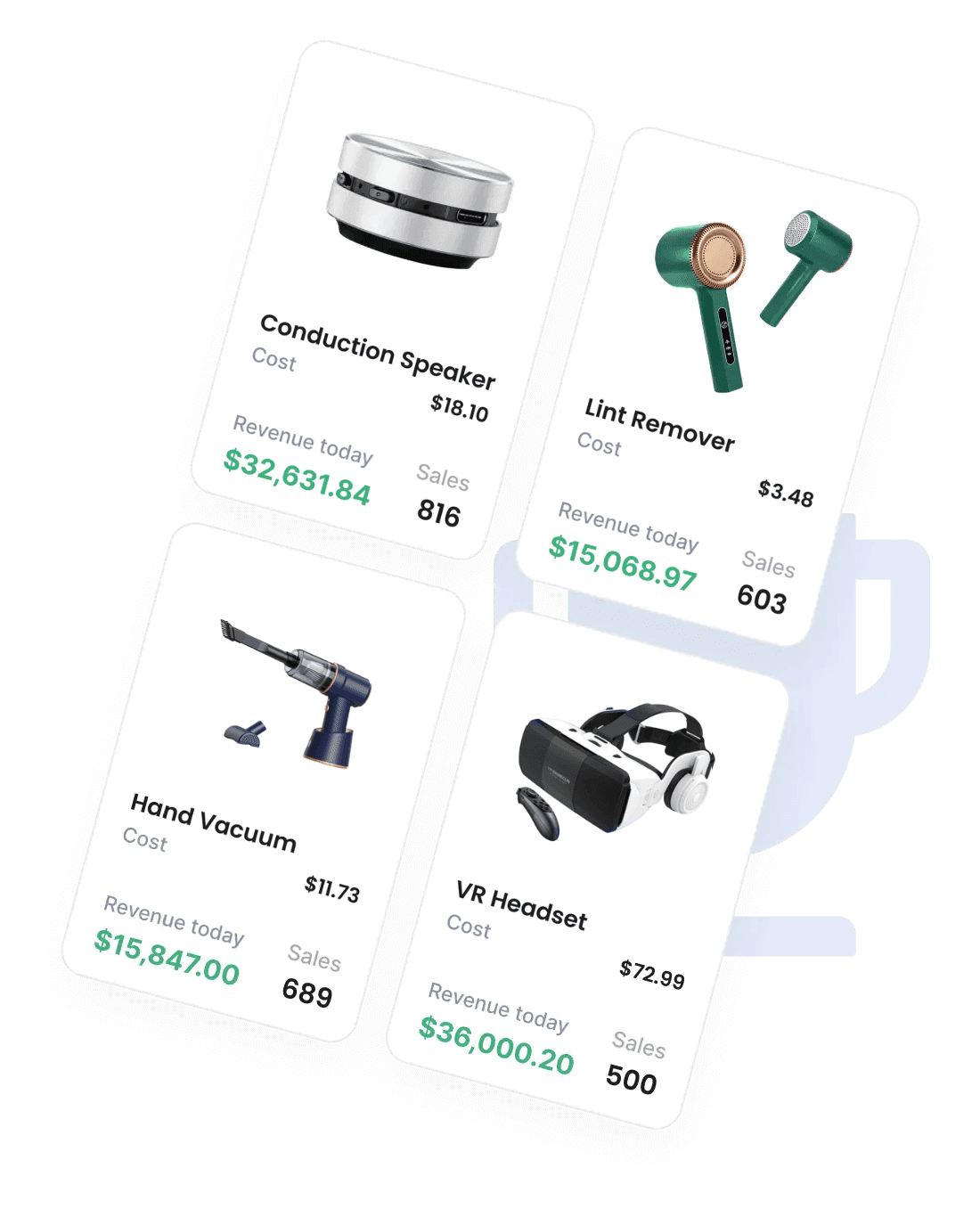
Home Decor Dropshipping in 2027: Margins, Trends, and Suppliers

Yes, home decor is one of the strongest dropshipping niches going into 2027. Buyers decide with their eyes in seconds, perceived value runs far ahead of product cost, and every room in every home refreshes itself on a schedule. The catch is physical: breakage and volumetric shipping quietly kill careless sellers, so the money goes to stores that pick light, tough products and let a proper supplier handle quality control. This guide gives you the real per-product math, the fragility ladder, demand and saturation readings, and the 2027 calendar worth building around.
The demand side is not in question. Grand View Research values the worldwide home decor market at $960.14 billion in 2024, with a projected climb to roughly $1.62 trillion by 2030. Online keeps taking share of that total, because a $50 lamp or a set of curtain lights is an easy impulse buy that nobody needs to touch first. The affordable end of the market, where dropshippers live, grows fastest.
Here is the plan. The basic economics of decor as a store, five real products with their landed cost and profit, which decor categories survive the parcel networks and which come back as refunds, how to read demand curves and saturation before you spend real money on ads, and how to source without stitching together three marketplace accounts.
Why Home Decor Economics Work
Decor converts the way jewelry does: fast, visual, emotional. Nobody compares table lamps for two weeks the way they compare coffee machines. They see a room that looks better than theirs and they buy. That impulse is why decor converts cold traffic, and cold traffic is where most dropshippers spend their budget. Our sister guide on jewelry dropshipping in 2027 shows the same buying behavior in accessories.
Perceived value does the heavy lifting. A plastic disc lamp that costs $8.79 photographs like a $50 design object, because buyers pay for the light effect and the look, not the materials. Home decor carries some of the widest gaps between cost and selling price in all of dropshipping, and the worked examples below prove it with real numbers.
The refresh cycle keeps customers coming back. People restyle a room every season, swap textiles in spring, add warm lighting in October, and buy gifts for other people's homes in December. One happy customer can buy from you three or four times a year without a single new ad. That is rare outside consumables.
A niche built for gifts
A large share of decor purchases are gifts, and gift buyers behave differently. They are willing to pay more than the product is worth because the wrapping is the point, they shop on a deadline, and they rarely return anything. Products that look giftable in a photo, a night light painting, a vase puzzle, LED curtain lights, sell themselves in November while you focus on traffic.
What this means for your store
First, invest time in photos before you invest dollars in ads. Price on perceived value, not cost-plus. And pick products that survive the mail, because none of the economics above survive a 10% refund rate. That last point deserves its own section, but first the math.
The Margin Math: Five Real Products, Real Numbers
All numbers in this section come from live Tradelle research reports, checked on November 22, 2026, with the profit picker set to include shipping and the destination set to the US. Totals exclude VAT, which is your business tax as the seller, while Tradelle handles customs and import duties. Margins are computed as gross profit divided by selling price.
You can pull the same numbers yourself. Every card in Product Picks shows the cost, the suggested selling price, and the profit before you even open the full report. Search a category, sort by profit, and you have a shortlist.
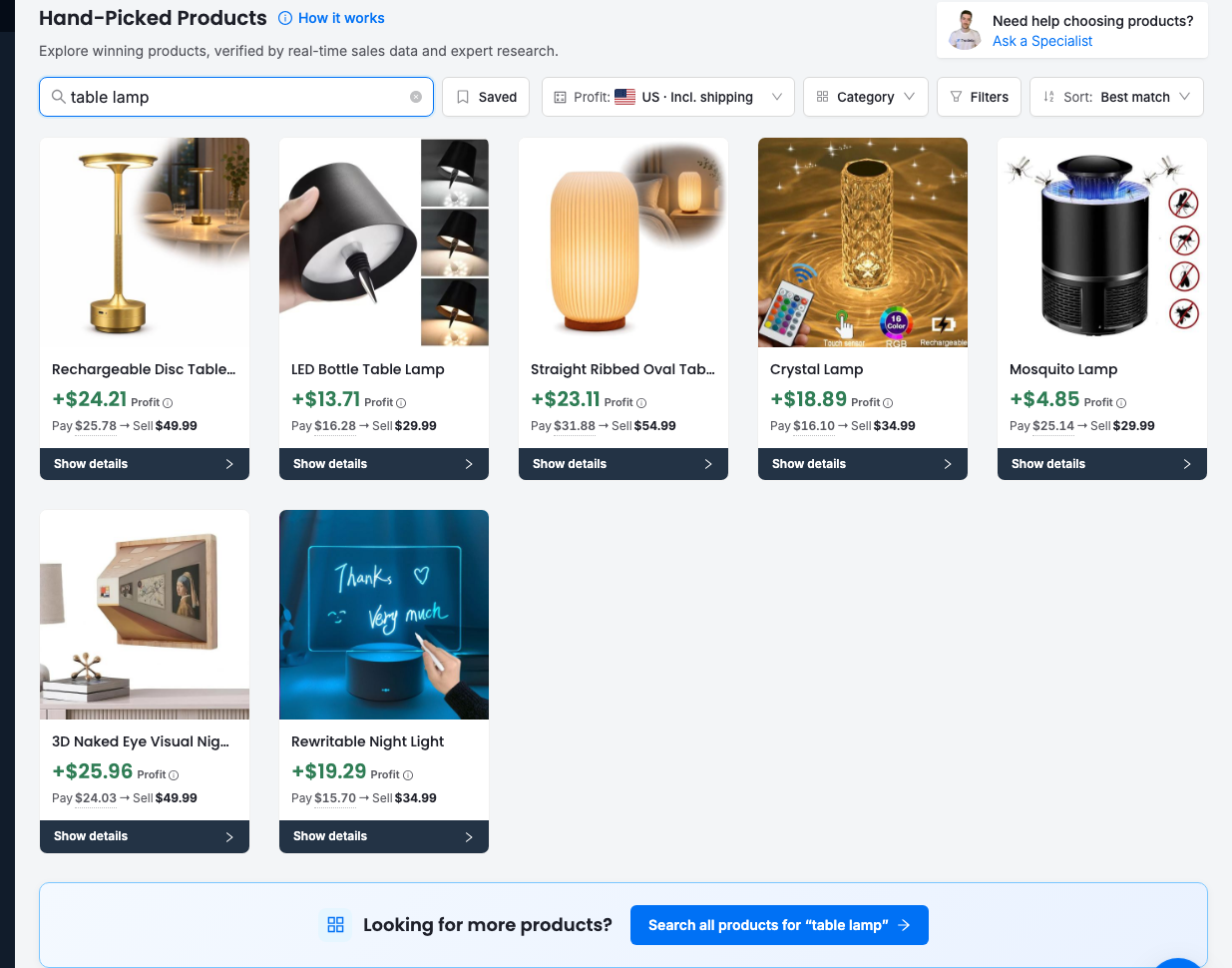
Worked example: the Rechargeable Disc Table Lamp
Here is a realistic order. The lamp costs you $8.79, shipping to the US runs $16.99, so your landed cost is $25.78. The suggested selling price is $49.99. Your gross profit before ads is $24.21, which works out to about 48%. Tradelle's report puts the break-even ROAS at 2.23, meaning every advertising dollar has to bring back about $2.23 in revenue before the order turns unprofitable.
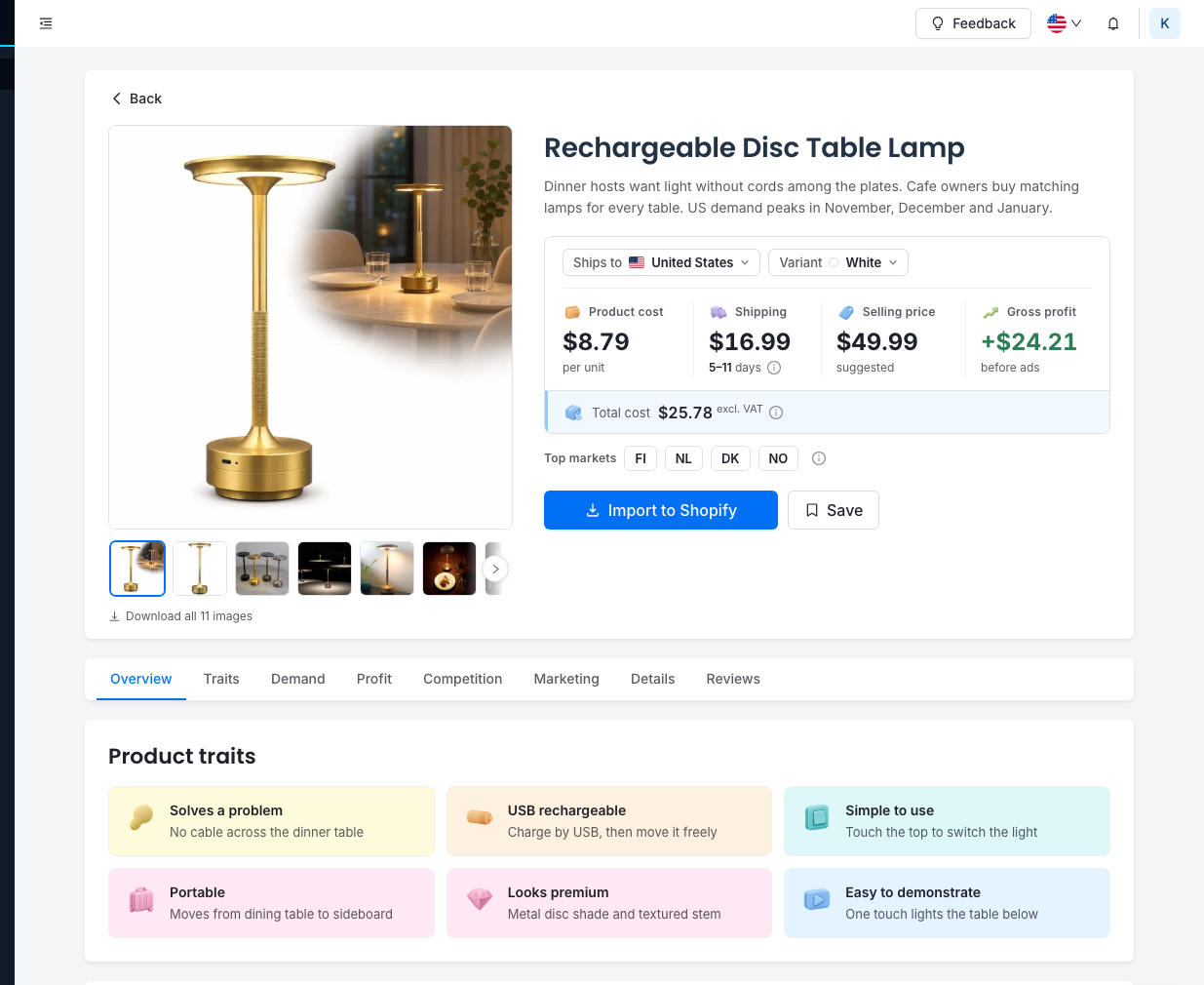
Who buys a cordless table lamp? The report's buyer angles are concrete: dinner hosts who want light on the table without cords between the plates, and cafe owners who buy matching lamps per table. Both are repeatable purchase patterns, not one-offs. The report also lists 5 variants shipping from Tradelle's CN-2 warehouse, so you can test styles without changing suppliers.
What pushes margin up or down
Compare two more products and the pattern appears. The 400 LED Curtain Lights cost $31.00 with $12.99 shipping, land at $43.99, sell for $69.99, and return $26.00 gross. That is about 37%, with a break-even ROAS of 2.96. The high product cost eats the margin even though the dollar profit per order is fine, and your ads have far less room to be average.
Now the LED Makeup Mirror: $7.17 cost, $6.99 shipping, $14.16 landed, $39.99 selling price, $25.83 gross. That is about 65%, and the break-even ROAS of 1.64 is the most forgiving of the five. Small, light, cheap to make, priced on what it does for a selfie. Three levers decide where a product lands in this range: how much of the price is product cost, how much space it takes in a box, and how high a price the photo can justify.
The high-ticket outlier
The Smart Curtain Opener shows what happens at a bigger price tag. Cost is $33.71, shipping $12.99, landed $46.70, and it sells for $129.99. Gross profit is $83.29 per order, about 64%, with a break-even ROAS of 1.64. Ten orders a day is roughly $833 in gross profit, enough room to buy traffic properly. Products at this level behave differently in ads and conversion, so if the bigger ticket tempts you, read our breakdown of high-ticket profit margins before committing.
The full set, gross profit and margin before ads:
- Rechargeable Disc Table Lamp: $24.21 profit on $49.99, about 48%.
- 3D Naked Eye Visual Night Light Painting: $25.96 profit on $49.99, about 52%.
- 400 LED Curtain Lights: $26.00 profit on $69.99, about 37%.
- LED Makeup Mirror: $25.83 profit on $39.99, about 65%.
- Smart Curtain Opener: $83.29 profit on $129.99, about 64%.
- 3D Vase Puzzle: $22.33 profit on $34.99, about 64%.
Fragility: The Risk Ladder
Plenty of catalog decor can arrive broken. Every broken parcel costs you three times: the refund or reshipment, the lost product, and the shipping you already paid. That hurts fast, so you assess the damage risk of every product before you list it.
- Safest: textiles and prints. Cushion covers, throws, wall prints, tapestries. They fold, they weigh little, and they cannot break.
- Middle: plastics, silicone, small electronics in housings. Lamps, LED mirrors, curtain lights, curtain openers. Generally fine in normal parcel service as long as the box is OK.
- Watch out: glass, ceramics, mirrors. Beautiful margins on paper, expensive in the returns pile. Vases, decorative ceramics, large mirrors.
Notice what the six worked examples have in common: none of them is glass or ceramic. That is not a coincidence. The best-selling decor in a dropshipping store is the decor that cannot arrive in pieces.
Model a bad month. Say 4 of 100 makeup mirrors arrive broken. You refund 4 orders at $39.99, you eat 4 landed units at $14.16, and you take the review damage on top. At the mirror's 65% margin that is a bad week, not a broken business. Fragile categories with thinner margins and higher prices run far worse. Breakage is a line item, so budget it like one.
Packaging checks before you list anything
Even for sturdy products, check the supplier's packaging before you commit. Will it ship in a double-wall carton, molded foam, bubble wrap, with corner protectors on anything with edges? Order a sample to your own address and shake the box before you open it. If it rattles, so will your customer's. Then read reviews for the words broken, cracked, and arrived damaged on the exact variant you plan to sell.
The volumetric weight trap
Carriers charge by actual weight or by the space your item takes up, whichever is greater. That is why the little disc lamp costs $16.99 to ship while the slim makeup mirror costs $6.99: the lamp needs the bigger box. Rugs and large mirrors get punished hardest, long and bulky and fragile at once. Products that fold, roll, or nest ship flat, and flat is profit.
Fulfillment structure matters more here than supplier promises. We source products directly from manufacturers, check them with in-house quality control before anything ships, and route returns to centers in the US, EU, and UK instead of a slow dispute across time zones. A broken item becomes a fast local refund, which is exactly how a one-star review never gets written. For a niche where the parcel journey is the whole risk, that setup is the difference between a store and a brand.
Demand and Seasonality: What Sells and When
The research report behind every product shows estimated monthly searches, the year-over-year direction, the busiest months, and a market table with per-country demand, competition, and median price. Read those four in order and you will never launch on a hunch again. For the bigger picture on any style, cross-check the five-year curve in Google Trends. Our guide on using Google Trends for product research shows how to read it: you want clean yearly spikes that repeat, not one viral bump that already collapsed. Keep in mind that Trends shows relative interest scaled from 0 to 100 rather than absolute search counts, as Google's own documentation explains. Always cross-reference the search estimates in the report.
Rising, peaked, and fading
Back to the six products from the math section. The volume leader is the LED Makeup Mirror at about 320,000 searches a month, though it is fading at 14% year over year and peaks in November and December. The table lamp holds steady at about 130,000 a month, down only 3%, with a four-year curve that flattens out and peaks October to January. The 400 LED Curtain Lights are the riser: only about 770 searches a month, but up 21% year over year and peaking in November and December. The 3D Vase Puzzle pulls about 6,400 a month and is down 19%, still giftable in December but clearly on the downward wave.
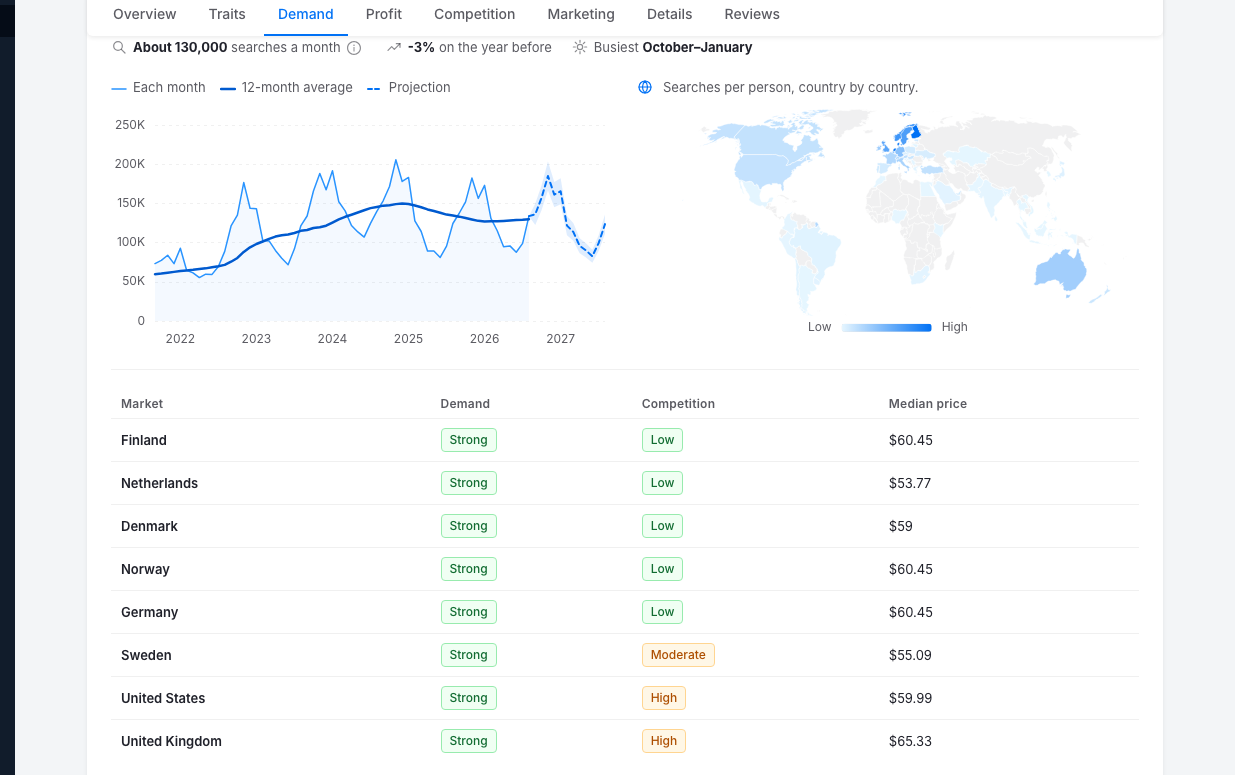
The entry rule is a rising curve plus low competition. A fading curve that falls from enormous numbers is not an automatic no, because enormous is still enormous in absolute terms. You enter those on price and creatives instead of chasing a trend at its peak.
Country pockets beat global averages
The money is in the market table. For the lamp, Finland, the Netherlands, Denmark, Norway, and Germany show Strong demand with Low competition at medians between $53.77 and $60.45, while the US shows Strong demand with High competition at $59.99. The mirror flips the map: Sweden, Norway, Finland, and Denmark read Strong and Low at $29, while the US reads Strong demand with Moderate competition at $24.99. The curtain lights flag Italy as Strong and Low at $58.95, and the Smart Curtain Opener flags the UAE, India, and Japan at $81.48. Same products, completely different difficulty by country. Selling into low competition is as good as free margin in this niche.
The 2027 decor calendar
Decor follows a predictable cadence, and the busiest-month data in the reports follows right along.
- October to January: lighting season. The disc lamp is busiest then, and the night light painting peaks November to December. Warm light sells while the days are short.
- November to December: gifting. The makeup mirror, the curtain lights, and the vase puzzle all peak here. Giftable decor carries the quarter.
- January: the refresh. A new year means a new room, and organization, textiles, and anything that photographs a restyle well get a second wind after the holiday lull.
- March to May: spring and wedding season. Light materials, table decor, and gifts for newlyweds setting up a home.
- All year: smart home. The curtain opener, about 24,000 searches a month and down only 4%, shows steady demand with no real off-season, which makes it a dependable baseline earner between peaks.
Timing follows from the calendar. With 5-11 day shipping there is no container lead time, but your pages need four to six weeks to rank and your ads two to three weeks to learn. Pick products eight weeks before the peak, build pages six weeks out, and scale spend in the final three. The stores that win December are built in October.
Saturation: How Crowded Is Too Crowded
The same reports grade competition, and the spread across our six products is the lesson. The table lamp reads Saturated, with about 100 stores selling it, which means you compete on price and creatives against established listings. The makeup mirror reads high saturation with 26 stores, the curtain opener high with 29, the vase puzzle crowded with 14. And then there is the outlier.
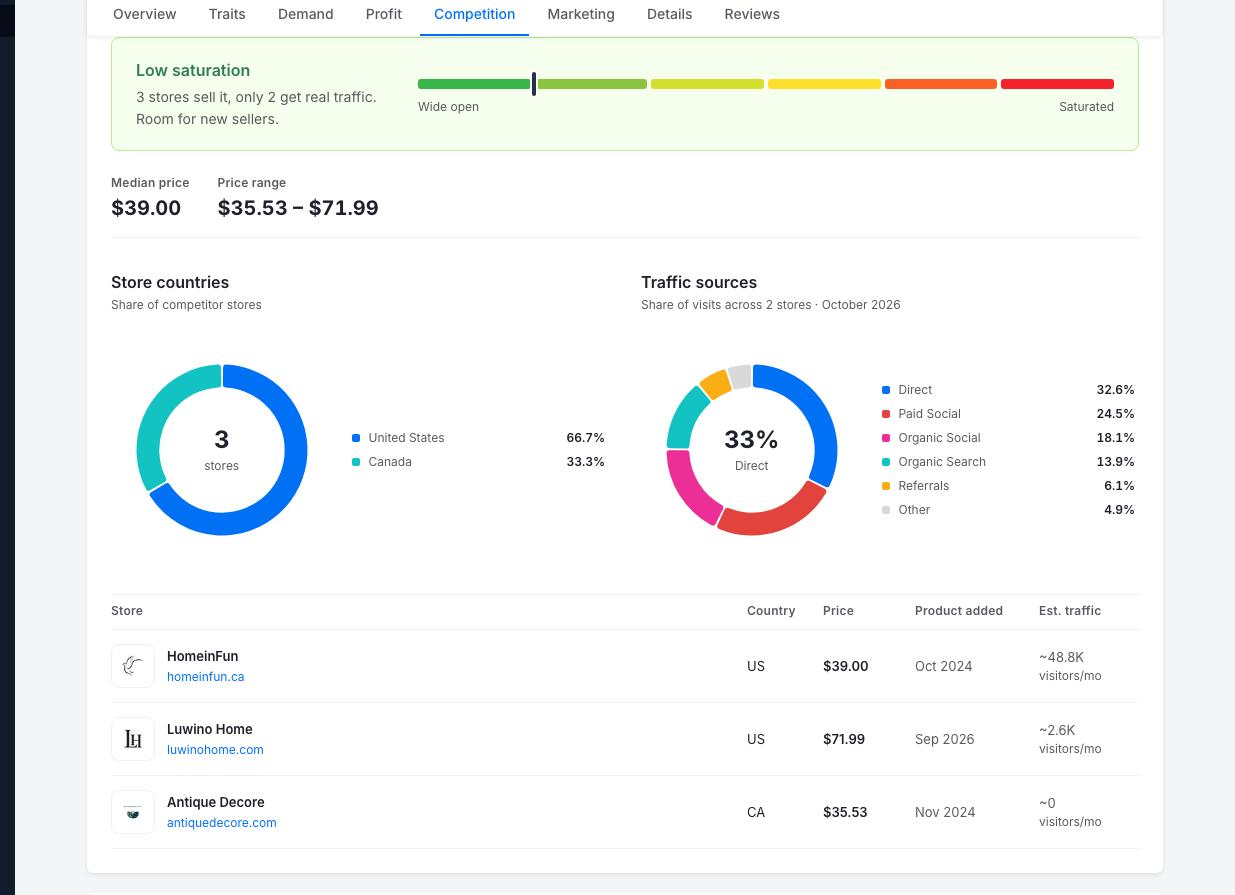
The 3D Naked Eye Visual Night Light Painting reads Low saturation: only 3 stores sell it, and only 2 of those get real traffic. The median price is $39, with a range from $35.53 to $71.99. That is what an open lane looks like in 2027: a product with about 33,000 monthly searches, down only 4% year over year, and almost nobody serious selling it.
Store count is not traffic count
Look at the three stores behind the night light painting. HomeinFun sells it at $39.00 and pulls about 48,800 visits a month. Luwino Home prices at $71.99 and gets roughly 2,600. Antique Decore lists at $35.53 and gets nearly none. One store takes almost everything, the cheapest store takes nothing, and the most expensive one survives on a trickle. Pricing mid-range with better creatives than the leader is the whole opportunity.
The traffic mix tells you how to attack. Across the two live stores in October 2026, direct traffic was 32.6%, paid social 24.5%, organic social 18.1%, and organic search 13.9%. This is a social-led product: short video and image ads do the selling, so your budget goes into creatives, not into outranking anyone on Google.
The traffic filter
Every report also shows how many listed stores are actually zombies. The curtain lights report shows 87 stores, with only 15 getting real traffic. The mirror shows 26 stores with 6. The curtain opener shows 29 with 2. Your real competitor count is always far lower than the raw number suggests. Tradelle's Competitor Research and Store Explorer show every store selling a product, with its prices and real traffic, so you count the live ones before you enter.
Picking Suppliers Without Getting Burned
Most articles on this topic are supplier listicles, seven to fifteen marketplaces long, and oddly the site writing the list always seems to rank its own platform first. The advice sellers take from them is expensive. You end up stitching together a product marketplace subscription (Syncee's paid plans start at $39.99 a month), a second app for US or EU warehouses, and AliExpress for the long tail.
Judge a supplier on five things. Consistent landed cost first. Quality control before anything ships. Delivery in days, not weeks. Customs handled, with no surprise fees for your customer. And a return address on your customer's continent.
One pipeline instead of a stack
This is where the integrated pipeline wins. Tradelle is the best worldwide dropshipping supplier for quality, price, and return handling. You import a product from its research report to your store in one click. We source it directly from the manufacturer, run in-house quality control before anything ships, and deliver worldwide in 5-11 days with customs and import duties handled. Tracking syncs to your store automatically. Returns go to local centers in the US, EU, and UK. One supply chain, one point of contact, one place to fix problems.
The stitched stack charges multiple subscriptions before your first sale, checks nothing before it ships, and turns returns into cross-border arguments you usually lose. Fulfillment by Tradelle folds the whole chain into the same place your product research already lives.
If you vet a supplier yourself anyway
Order samples to your own address, always. Test like a customer: plug the lamp in for a week, drop the box once from table height, wash the cushion cover. Ask how quality claims are handled and write the answer down. A supplier who reships without arguing is worth a dollar more per unit, because refunds cost you far more than that. Then keep a backup supplier warm for any product passing about 20 orders a day, because stockouts hit exactly when your ads finally work.
FAQ: Home Decor Dropshipping in 2027
Is home decor a good niche for dropshipping?
Yes. Decor combines visual impulse buying with high perceived value and demand that peaks around gifting season. Real margins across the products reviewed here run from about 37% to 65% before ads. The risks are breakage and volumetric shipping, which is why light, flat, unbreakable products win.
Is home decor dropshipping profitable?
Yes, if you pick on numbers instead of taste. Across the products checked here, gross profit before ads runs from $22.33 to $83.29 per order. What you keep after ads depends on your creatives and on the competition level in the countries you sell to, not on the niche itself.
What are the best products to dropship for home decor?
Light, cheap to ship, and hard to break: lighting like the disc lamp and the curtain lights, the makeup mirror, textiles, and prints. Heavier glass, ceramics, and large mirrors wait until your supplier's packaging proves it can deliver them intact, because a wave of damaged-item refunds wipes out otherwise healthy margins.
Where can I find reliable home decor suppliers for my dropshipping business?
Judge suppliers on five things: consistent landed cost, quality control before dispatch, delivery in days, customs handled, and local returns. One integrated pipeline beats stitching marketplaces together. Tradelle sources from manufacturers, checks quality in-house, ships in 5-11 days, and takes returns in the US, EU, and UK.
When should I start selling seasonal home decor?
Start planning for your peak season about 8 weeks before it hits. It takes 4-6 weeks for a product page to rank and 2-3 weeks to learn how to advertise it well. So, for example, the December gifting winners that you choose in early October would launch in mid-November. With 5-11 day shipping from fulfillment centers, you don’t need any inventory lead time.
Final Thoughts
Home decor rewards sellers who run the boring checks: margin math before ads, a shake test on the sample box, and a look at how many stores actually get traffic before entering. Pick two or three products this week, order the samples, and let the demand data make the decision.
The stores building now are the ones that catch the January refresh. If you want to compare this niche against the alternatives first, our guide to the best dropshipping niches for 2027 puts ten of them side by side with real numbers.