Influencer Marketing for Dropshipping in 2027: Costs, Seeding, and UGC That Sells
Yes, influencer marketing does work for dropshipping in 2027, as long as you treat it as an economics channel and not a lottery ticket. The sellers who profit from creators do three boring things well. They pay prices that leave room for ad costs. They brief for outcomes instead of scripts. And they reuse the winning videos in their own ads. The sellers who lose money skip all three and hope a big account saves a weak product.
The math changed in your favor over the last two years. Micro and nano creators got cheaper relative to Meta CPMs, platforms built formal ways to run a creator's video as your ad, and ad research tools now show which creator-style videos already convert for competitors. You can walk into a negotiation knowing what a converting video looks like and what it earns.
This guide covers real 2027 rate ranges, the seeding math that keeps a test under a few hundred dollars, a research shortcut that replaces guessing, briefs and usage rights, and honest tracking. The goal: one reusable winning video per test, bought at a price your margins can carry.
What Creators Actually Charge in 2027
Rates scatter across platforms and niches, but the 2026 benchmark data from Influencer Marketing Hub gives useful anchors. Nano creators under 10,000 followers typically cost between $10 and $200 per post. Micro creators between 10,000 and 100,000 followers land anywhere from roughly $100 to $800, depending on platform and deliverable. Deal platforms that track completed agreements report medians of $150 to $400 for micro tiers, well under the public ask prices.
Rates by platform
- TikTok: the cheapest views per dollar right now, because creators are hungry and the algorithm still rewards small accounts with reach.
- Instagram: pricier per post, stronger for products that sell on aesthetics, and the natural home of the story-frame deal.
- YouTube Shorts: lower conversion rates in the short term but a video that continues to sell for months instead of days.
The gifting tier
It's true that below 10,000 followers, many creators would happily post about a free product, as long as the item looks good and fits the creator's existing content. Your cost is the product plus shipping: a $15 product with $14 shipping costs you $29 per gifted post. That is the cheapest market research in ecommerce: real content, real audience reaction, and a comment section full of objections to mine.
Why quotes vary so much
- Deliverables: a story frame costs less than a dedicated video, which costs less than a video with raw files.
- Usage rights: permission to run the video as your ad can double a fair price, and it is worth paying.
- Niche: beauty and fitness creators charge more because their audiences buy more.
- Season: November quotes run hot, January quotes soften, and February is a buyer's market.
Negotiate on scope before price. A creator who drops from $500 to $300 because you removed usage rights did not give you a discount. They removed the most valuable part of the deal.
Seeding Math: Ten Parcels, Three Posts, One Winner
Product seeding means sending free items to creators with no contract and no obligation, hoping some post anyway. Run it as a numbers game with a capped downside, and it becomes the safest influencer test a small store can run.
A realistic batch of creator parcels to send to 10 nano creators would cost $29 landed per parcel for a total of $290 for all 10. From the 10 parcels, you'll get 3-4 posts. Of those, one video will be a real stopper and prompt comments like “where can I buy this?”. That one video is a $290 asset for you, cheaper than two days of a modest Meta test budget.
Who to seed
- Creators who already post the problem your product solves, so the parcel feels like a gift instead of an assignment.
- Accounts with real comment conversations, even small ones, because conversation is what sells.
- People whose style matches the creator ads already converting in your niche, which the next section shows you how to find.
For each parcel, track: creator, cost, post date, views at 48 hours, link clicks, sales. The creators who post and perform as you test your market will graduate to your paid list in round two for a fee and with usage rights. The others were something to learn from for $29 apiece. So you spent less than $300 to find out which faces and hooks would work for your market before you spent any real money.
Where seeding fits your calendar
Time the parcels to your selling season, not your curiosity. Creators need a week to receive the product and another to post, so seed six to eight weeks before the demand peak you are targeting. Parcels mailed in late November land in the Q5 window and early January, when gift-oriented content performs and ad costs drop. A batch that misses its season teaches you the wrong lesson about a good product.
Seeding conversion is lumpy. Some batches return zero usable videos, and that is a valid result about the product or the creator list, not a reason to double the batch blindly. If two batches in a row return nothing, the problem is usually the product's demo-ability, and picking a more visual niche beats mailing a third round of parcels.
Find Creators Who Already Sell
Most guides tell you to search hashtags and eyeball engagement rates. There are two better routes now, and Tradelle runs both: a creator database ranked by real revenue, and a paid-proof check on every style of ad your niche already funds.
The Creator Library: sellers ranked by money
The Creator Library is the TikTok Shop affiliate landscape turned into a searchable database: more than 400,000 creators and 3,400,000 videos, every creator ranked by the estimated revenue their videos actually produced. Not followers. Revenue.
The filters read like they were written by someone who has done outreach. 'Small accounts that sell' surfaces nano creators under 10,000 followers with at least $1,000 in attributed sales, exactly the gifting tier from the rates section. 'Has a public email' leaves only creators you can contact today. And every creator page lists their promoted products, the shops behind them, their top videos, and the contact details from their bio.
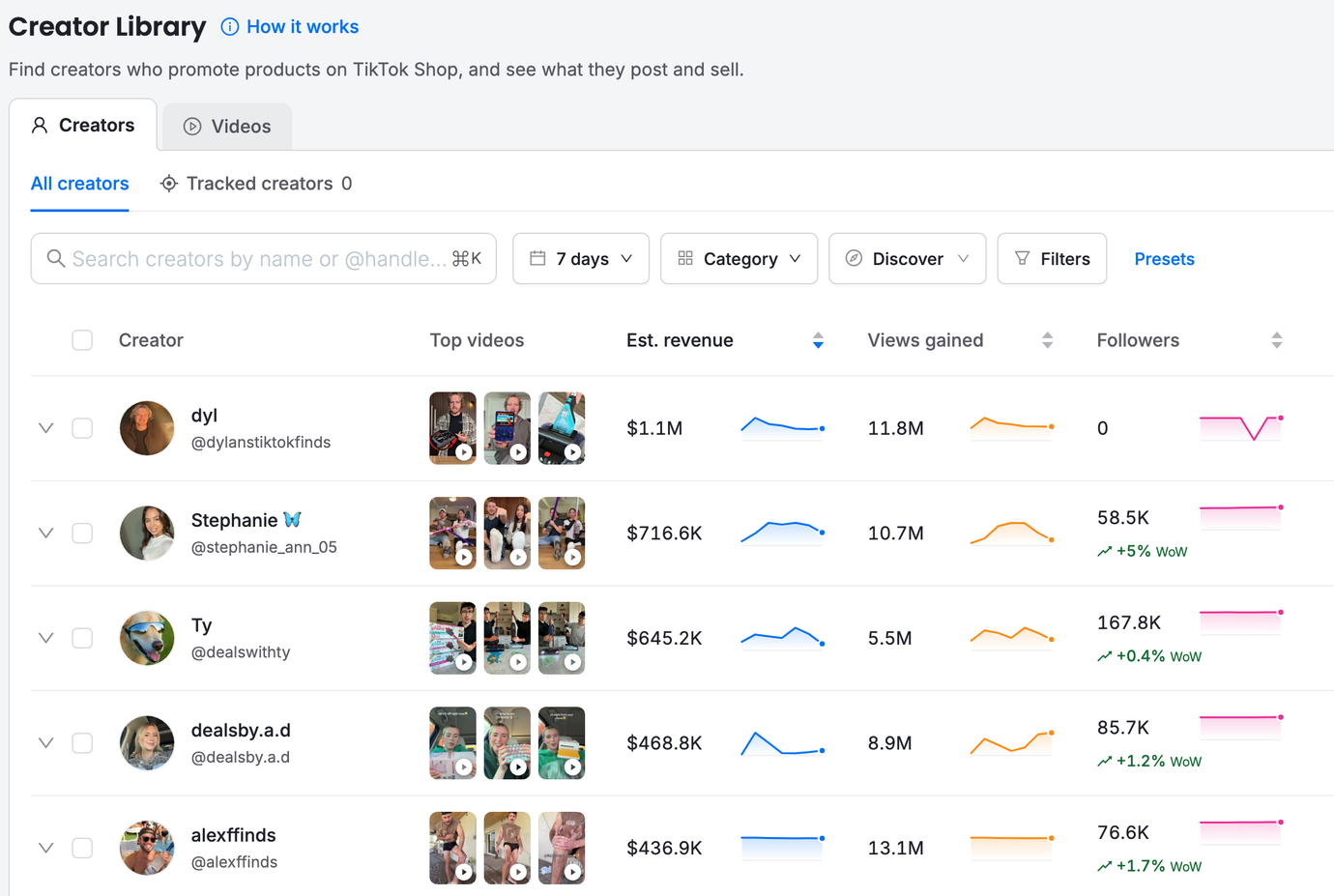
One row is a complete case study. A 35-second video with 4.1 million views carried an estimated $540,300 in revenue for a $480.94 jump starter. When you spot a video like that in your niche, you have the creator, the format, the product, and the proof in a single line, and outreach stops being a guess.
The shortcut: read the paid proof
A store does not keep spending on an ad that loses money. When a competitor runs the same creator-style video for weeks, the format converts, and you are looking at a free casting call for the kind of creator your niche trusts. Tradelle's Ad Explorer makes this visible with the numbers Meta's own Ad Library hides: reach, estimated spend, runtime, and rank for millions of ads. Create a free account and filter your niche for videos that have been scaling for weeks.
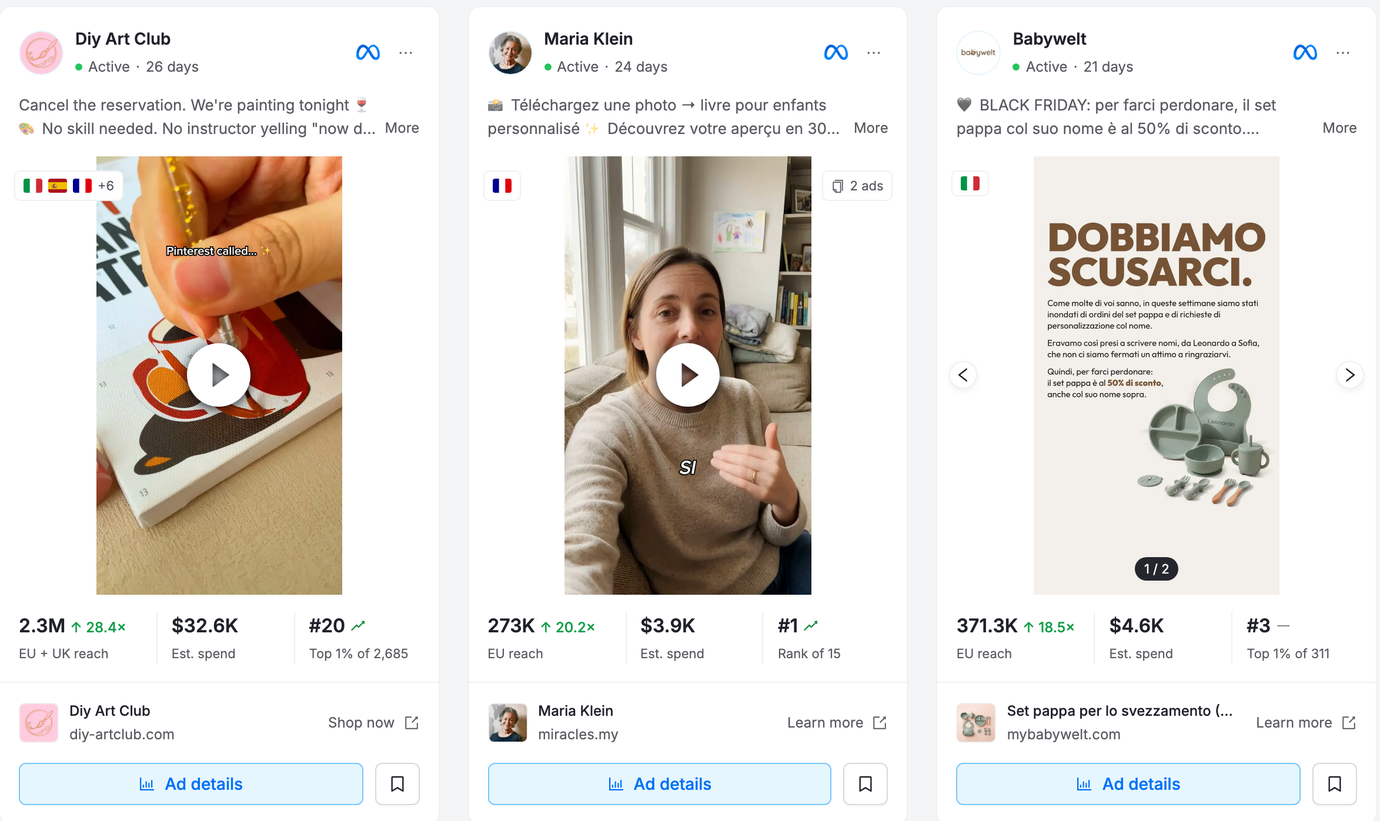
Here is a real example checked on November 26, 2026. Diy Art Club, a paint-by-numbers store, runs a creator-voiced video ad with the line 'Cancel the reservation. We're painting tonight.' The ad has been live for 27 days and reached 2,297,122 people in the EU and UK, with an estimated $32,612.96 in spend behind it. Ad Explorer ranks it #20, inside the top 1% of 2,685 ads in its niche, and its rank is still rising.
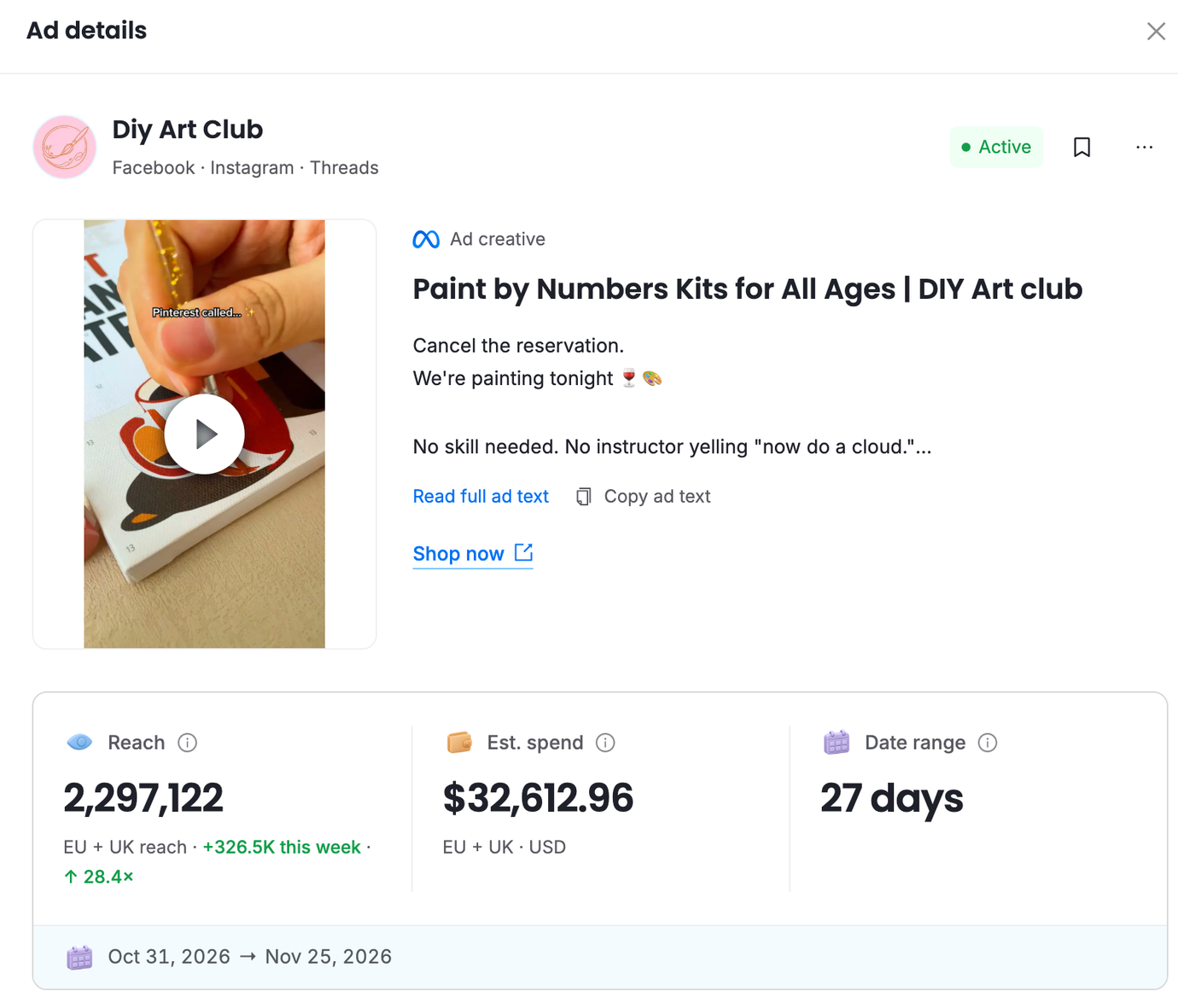
Read that as a brief written by the market. A relaxed, first-person demo from someone who feels like a friend, selling a cozy night in, outperformed hundreds of polished product ads. Whatever you sell, a creator in your niche who naturally talks like that is worth ten influencers with bigger followings and ad-read voices.
One click further, the advertiser's Brand Library page shows the whole operation behind that ad: every store, every active creative, and which ads the brand is scaling right now. When a brand runs twelve creator videos and keeps three alive for months, you are looking at its casting shortlist, free to copy.
What the delivery data tells you
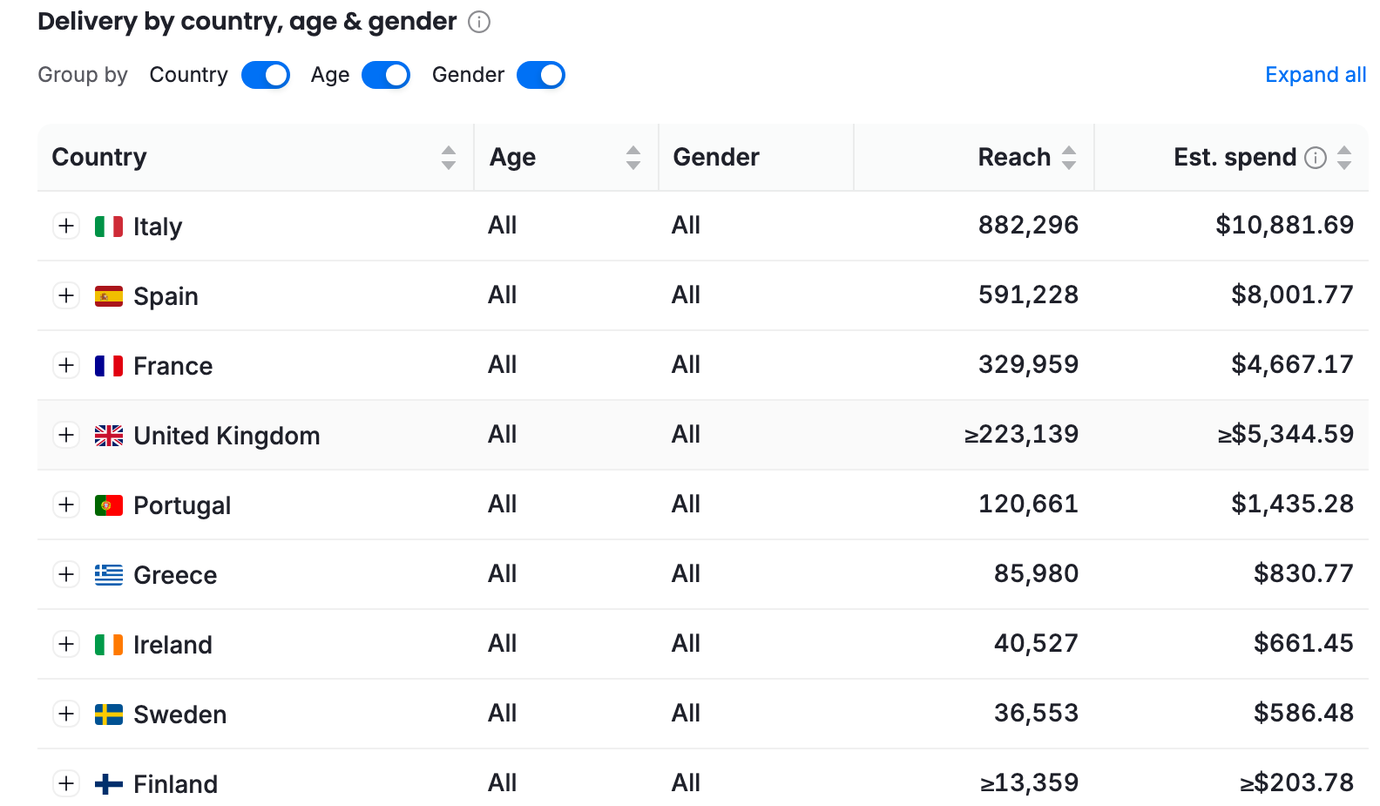
This view of the ad also shows who actually saw it: 58.1% women, 62.5% of them between 25 and 34 years old. Italy leads at 882,296 reach and $10,881.69 in spend, then Spain and France. That is the audience your competitor already paid to validate. When you evaluate creators, compare their follower demographics against the proven delivery profile instead of trusting their media kit's claims.
Vet the comments, not the follower count
- Read twenty comments: mostly questions and jokes and then you know you have reached real people. Rows of ‘Nice post!’ usually come from bots and pods.
- Check posting rhythm: a creator who is away for two months will not sell your product in one video.
- Watch three videos for ad-read voice: if every sponsorship sounds identical, yours will too.
- Search their name in Competitor Research to see whether rival stores already work with them.
Briefs, Rights, and Disclosure
The brief that works
Creators outperform scripts because their audience follows them for their voice, and an ad-read voice kills the exact trust you are paying for. Brief the outcome, not the lines. One page is enough:
- The problem the product solves, in one sentence, and who feels it most.
- Three things the video must show: the problem, the product in use, the result.
- The hook direction, not the hook wording: open on the problem in the first two seconds.
- The one call to action and the discount code to mention.
- What not to claim: no medical promises, no fake scarcity, nothing you cannot prove.
Then get out of the way. If the first draft feels like an ad, ask for one revision. If it feels like their normal content with your product in it, approve it.
Usage rights are the multiplier
A creator video that converts is worth far more as your ad than as their post. Negotiate usage rights up front: permission to run the video from your own ad account, on Meta or as a TikTok Spark Ad from the creator's handle, for a fixed period. Thirty to ninety days of ad rights is standard for micro creators. Whitelisting keeps the creator's name and face on the ad, which preserves the trust that made the video work, while your budget controls who sees it. This single clause is why the economics work, because one $300 video can anchor a month of paid traffic. Our guides on running TikTok ads and running Facebook ads cover the campaign side once you have the asset.
Disclosure is not optional
Paid posts and gifted products are material connections, and the US endorsement rules require creators to disclose them clearly. The obligation lives in 16 CFR Part 255, and it covers free product as much as cash. Put the disclosure requirement in writing, accept the platform's paid-partnership label, and never ask a creator to hide the relationship. A hidden ad that gets exposed costs you the creator, the comments, and possibly the ad account.
Track What You Actually Earned
Codes, links, and honest attribution
Give every creator a unique discount code and a trackable link, then read results in your store's reports rather than in the platform's view counts. Codes catch the buyers who watched, forgot, and searched later. Links catch the impulse clicks. Neither catches everything, so judge a creator on the pair, plus the reusable content value if the video is strong.
Run the numbers on a real outcome. A creator's video costs you $300 with usage rights. Their discount code logs 9 sales at $54.99, and your margin per sale before the creator cost is $18.60. That is $167.40 back on $300 spent, a loss on paper. Then the same video runs as a paid ad and produces 40 more sales at a $9 acquisition cost, and the blended cost per sale across both channels drops to $7.32. Judge the bundle, not the post. Keep the creators whose bundles clear your break-even, and drop the rest without ceremony. That math is why the usage-rights clause matters more than the post itself.
Compare the result against your paid-ads baseline with the same seriousness you would apply to any channel. The product validation framework includes the break-even math: if a creator's cost per sale beats your Meta break-even, scale it. If it loses, the answer is a better creator or a better product, not a bigger check.
When a creator flops
Yes, most of them will fail. If they get a lot of views but no clicks, then the audience liked the video but not the offer, so fix the landing page before blaming the creator. If there are no views at all, then the hook hasn't worked, which is a creative lesson you can hand to the next creator. Views and clicks but no sales points at price or trust on your site. Each failure mode has a different repair, and the tracking setup above is what tells them apart.
How many creators before you judge
Wait a few videos and give the channel a fair sample. One video from one creator doesn't prove anything either way. A fair first test is to test 5-10 creators in two rounds (the gifting round first to find natural fits, and then a paid round testing your two best performers from the first round). If nothing converts in that test, then the issue probably lies with the product or the offer, not the channel.
Scale winners through your own ads
The endgame for a winning creator video is your ad account. Run the best performer as a paid ad with the usage rights you negotiated, starting with the audience profile your competitor research already validated. When a video sells as both an organic post and a paid ad, you have the closest thing dropshipping offers to a repeatable asset, and the right move is more creators in the same persona, not a victory lap.
Keep the customers the spike brings you. Influencer traffic arrives warm and leaves fast, so capture emails at checkout and follow up with a real offer. The email flows guide covers the sequences. The second sale is where influencer math turns genuinely profitable.
FAQ: Influencer Marketing for Dropshipping in 2027
How much should I pay a micro influencer?
In 2027, the price for a micro-influencer (following 10,000 to 100,000 people) to create content will be in the range of $100 to $500. TikTok specialists and beauty influencers will be at the upper end of this price range. Note that usage rights and raw files cost more to use than story frames. Below 10,000 followers, often free products will score the collaboration on their own.
How to find influencers for your dropshipping store?
Start in the Creator Library: filter your niche for creators who already sell, ranked by estimated revenue, and let the 'Has a public email' filter write your outreach list. Cross-check the winning persona against creator-style ads that keep scaling in Ad Explorer. Supplement with niche hashtags and your own customer list. Happy buyers with small audiences convert surprisingly well.
Do I need a contract with a creator?
For anything beyond gifting, yes, and keep it to one page: deliverables, deadline, payment, usage rights with a time limit, and the disclosure requirement. The usage-rights clause matters more than every other line combined, because it decides whether you can run the video as your own ad.
How many followers should a creator have?
Aim for creators between 5,000 and 100,000 followers for most dropshipping tests. Below that range, gifting works and expectations stay modest. Above it, prices climb faster than conversion rates. Judge engagement quality and audience fit over the raw number every time.
Can I reuse influencer videos in my ads?
Only with explicit usage rights, negotiated before the post goes live. With rights in hand, running the video as your own ad is the highest-value move in the whole playbook. Without them, reusing the content invites takedowns and burned relationships.
Should I use an influencer marketplace or agency?
Marketplaces can save a lot of time when running monthly campaigns and include escrow to protect both parties. Reaching out directly to nano and micro creators for a first test is typically cheaper than hiring an agency and you learn a lot more because you read every single answer to your queries. Agencies typically make sense when you run with more than roughly 10 paid creators per month and the biggest problem then is the coordination of all these individual creators.
Final Thoughts
Influencer marketing in 2027 is not about finding a famous face. It is about buying trust at a price your margins survive, then multiplying that trust through your own ad account. The stores that win at it look unglamorous from the outside: ten parcels, three posts, one winner, thirty days of profitable ads.
Start with the research shortcut. See which creator ads already convert in your niche, hire that persona on a small budget, and let the numbers decide what scales. If you still need a product worth filming, Product Picks surfaces items selected for exactly this kind of visual selling, each with demand, saturation, and profit data attached.