AI Product Research for Dropshipping: 20 Products Tested

I put 20 product ideas through AI-assisted pre-ad research, comparing general AI reasoning with Beth using live Tradelle evidence. The general pass approved 17 products for testing. After Beth checked Tradelle's catalog, only nine kept a test verdict, ten were deferred, and one was rejected.
Nine products changed verdict. Eight moved from test to defer, while the Stainless Steel Garlic Crusher moved from defer to reject. The dashboard showed November 5, 2026 during the research session. This was research before advertising. No campaigns ran, no products were imported or purchased, no settings or customer orders changed, and the experiment generated no revenue.
One caveat matters. I asked general Beth not to use tools, and it said it voluntarily used none. The interface has no enforced no-tools switch, so this is a transparent prompted comparison, not a perfectly controlled model test. Think of it as a practical look at what changes when an AI assistant can check current product evidence before giving advice.
What I Asked AI to Do
We used the same 20 exact product names in the same Beth chat for both passes. For the first pass, the task was to establish a baseline for these words: “For each of these 20 exact product names, give: (1) likely category and target buyer, (2) one general-AI assumption that would need validation, and (3) a provisional test/defer/reject verdict using general reasoning only.”
The second pass asked Beth to use its available Tradelle research tools and observed evidence instead of memory for current metrics. It requested cost, suggested selling price, UK shipping and delivery timing when shown, demand, saturation, relevant store or ad evidence, and product links. Missing values had to stay null. Beth also had to list every tool it called.
The verdicts describe a pre-ad shortlist, not a sales result:
- “Test” means the product has gotten further validation and possibly a small ad test.
- “Defer” means wait until the timing, evidence, competitive position, or economics improve.
- Reject means drop this candidate for now because the observed case is unattractive.
Beth reported 20 catalog search calls and 35 catalog detail calls. It found all 20 exact matches, then retrieved product details and store links. I separately opened each direct product report because Beth said its catalog response did not expose UK shipping. Those reports showed destination shipping, demand estimates, and fulfillment economics. They showed saturation and competitor stores where those sections were visible. The swimsuit and Christmas hoodie had no visible Competitor stores section, so those values stayed null. This extra check matters for any product validation before ads.
The Checklist also mentioned advertising, but I did not pull any ad campaign evidence for this research field. Instead I used the Store evidence to fill out this field. I also kept Beth’s catalog store-link counts separate from the direct reports’ saturation counts. These are measuring two different things, so I didn’t combine them.
The 20-Product AI Scoreboard
Candidates listed in original order with final column describing the evidence-based reason for the change or most relevant change.
| Product | General AI | Evidence verdict | Evidence reason or change |
|---|---|---|---|
| Inflatable Pregnancy Lounger | Test | Test | $44.11 gross profit before ads, with summer demand |
| Soap Dispensing Toilet Brush | Test | Test | Low product cost and durable demand |
| LED Night Golf Balls | Test | Defer | Searches down 15%, with 37 stores and a Saturated label |
| Contrast Panel Lace-Up Swimsuit | Defer | Defer | Off-season, revisit in February |
| Sherpa Fleece Baby Pouch Hoodie | Test | Test | The winter selling window supported a test |
| EMS Foot Massage Mat | Test | Test | Proven demand, with ad-claim caution |
| Plush Cat Sleeping Bag | Test | Defer | Demand proven, differentiation looked difficult |
| Magnetic Tool Mat | Test | Defer | Rising searches, but 37 stores and limited ad room |
| Electric Ice Scraper | Test | Test | Winter timing and $33.45 gross profit before ads |
| Stainless Steel Garlic Crusher | Defer | Reject | Near-identical products made it a commodity race |
| Individual Mesh Packing Cube | Defer | Defer | Established brands dominated the category |
| Pop-Up Mesh Cat Playpen | Test | Defer | Catalog links showed heavy saturation |
| Motorcycle Passenger Grip Belt | Test | Test | Demand signal with relatively low observed competition |
| Contoured Memory Foam Lumbar Cushion | Test | Test | Steady demand and moderate competition |
| Cheeky Christmas Hoodie | Test | Defer | Thin evidence, with searches down 24% year over year |
| 3-in-1 Travel Sleep Support Set | Test | Defer | Saturation outweighed the bundle angle |
| Portable Blender with Handle | Test | Test | Established category, low observed competition |
| Remote-Control Turn Signal Cycling Backpack | Test | Defer | Weak demand evidence and the highest product cost |
| Adjustable Maternity Belly Band | Test | Test | Strong steady demand against moderate saturation |
| High-Speed Handheld Fan | Test | Defer | Large market, wrong season in November |
There is a clear shift between general reasoning producing 17 test, 3 defer, and 0 reject verdicts and tool-grounded research producing 9 test, 10 defer, and 1 reject verdict. Although Beth’s recap of the comparison between the two approaches stated that 6 records had changed, in fact 9 had changed as detailed in the table above.
That is not an accuracy score. I did not launch campaigns, so I cannot say which verdict would have made more money. The useful result is narrower and more actionable: current evidence made the shortlist much more selective without rejecting everything. Nine products still earned a test decision.
AI Evidence Changed the Magnetic Tool Mat Verdict
The Magnetic Tool Mat looked easy to like. General Beth called it practical and easy to demonstrate, then gave it a test verdict. You can picture the creative: scattered screws, one magnetic surface, and a tidy repair job. The demand report initially makes the idea look even better.
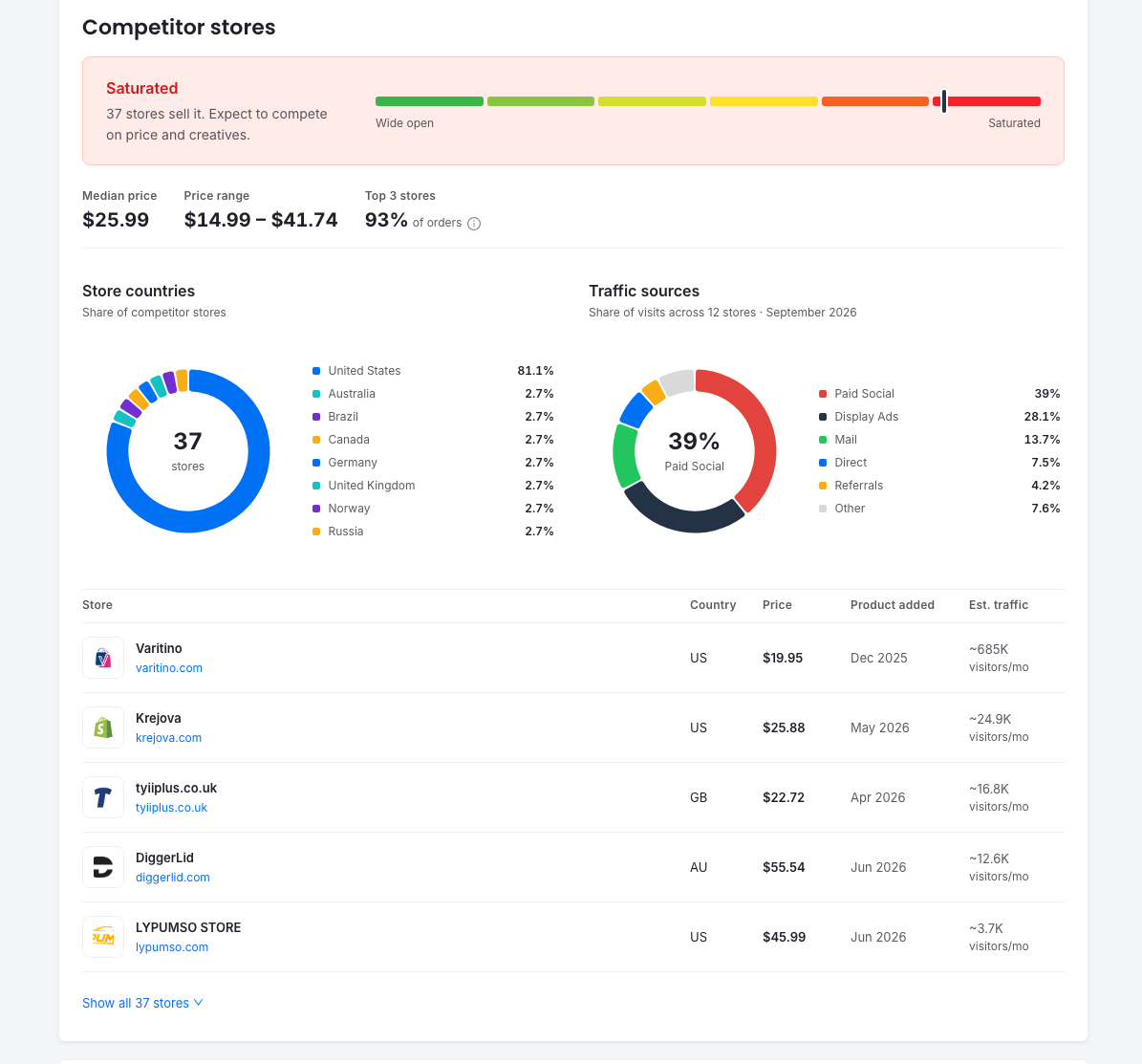
Beth deferred the mat after finding 45+ catalog store links. The separate direct report showed about 6,200 searches per month, up 88% year over year, with December the busiest month. But the same report labeled the product Saturated and found 37 competing stores. The top three stores accounted for 93% of orders. The median competitor price was $25.99. Paid social represented 39% of visits across 12 stores in September 2026. That traffic-source estimate is not campaign data, but it shows paid social's role in the observed store set.
Then come the economics for the Small variant. Product cost was $1.89, UK shipping was $4.99 with a 4-8 day window, and the suggested selling price was $17.99. The $6.88 total cost excludes VAT. Subtracting product cost and shipping from the suggested price leaves $11.11 gross profit before ads. That remainder still has to cover customer acquisition and other selling costs. It is not take-home profit.
The direct evidence supports that defer decision. Many stores were present, orders were concentrated among a few leaders, and the suggested-price economics left limited room to compete for a customer. Defer does not mean the mat can never sell. It means a seller needs a stronger offer, better economics, or a genuinely different angle before spending. That is the kind of distinction you want when comparing dropshipping products with high profit margins.
AI Kept Two Pregnancy Products on the Test List
Evidence did not simply dismantle every general-AI suggestion. Two pregnancy products kept their test verdicts for different reasons, which makes them more useful than a clean story about AI always saying no.
Inflatable Pregnancy Lounger: Test to Test
The Inflatable Pregnancy Lounger had about 2,400 searches per month, up 21% year over year, and was busiest from June through August. That is a much smaller search figure than some other candidates, but the competitive report found eight stores with only two getting real traffic. Its label was Moderate saturation, not Wide open and not Saturated.
For the default Blue variant, the product cost $12.89 and UK shipping cost $12.99 with a 4-8 day window. The suggested price was $69.99. Total cost was $25.88 excluding VAT, leaving $44.11 gross profit before ads. The arithmetic is $69.99 minus $12.89 minus $12.99. Unlike the tool mat, this candidate had considerably more dollar room between delivered product cost and suggested selling price.
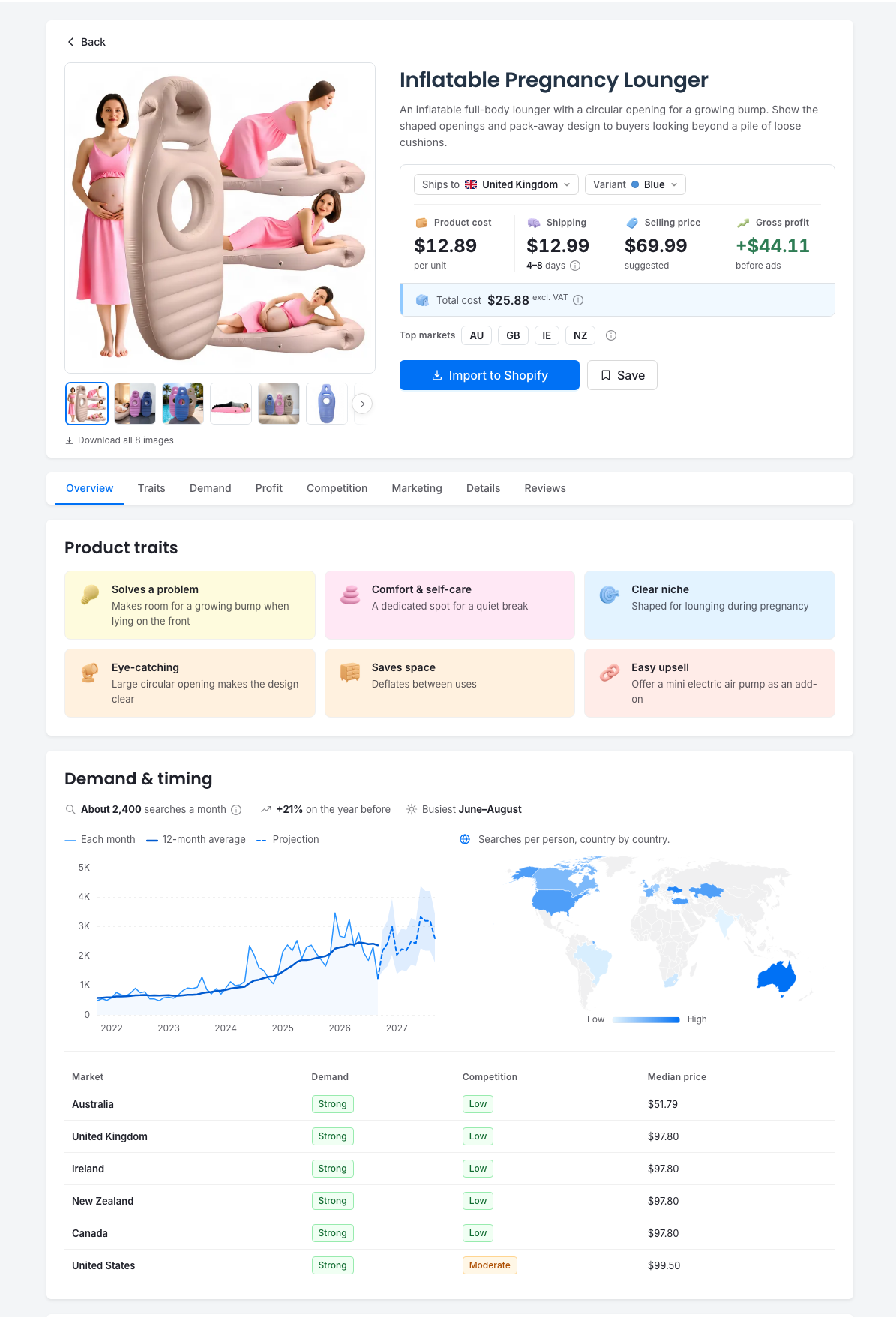
The test verdict does not turn the lounger into a proven winner, especially outside its busiest months. It means the observed demand, moderate store footprint, and gross profit before ads justified further research. A responsible creative brief can show the openings, inflation, dimensions, and pack-away design. It should not promise health, safety, comfort, or medical outcomes. The general pass had assumed buyer comfort. The direct evidence does not prove that assumption for every buyer.
Adjustable Maternity Belly Band: Test to Test
The Adjustable Maternity Belly Band brought a different pattern: about 130,000 searches per month, up 15% year over year, with steady demand all year. Seven stores appeared in the competitor report, and only two were getting real traffic. Beth called this the best demand-to-competition ratio of the 20 in its grounded response, and the direct report explains the enthusiasm.
The S / Black variant cost $3.36. UK shipping was $4.99 in 4-8 days, producing an $8.35 total excluding VAT. At the $24.99 suggested price, gross profit before ads was $16.64. The report also showed a break-even ROAS of 1.60. ROAS means revenue divided by ad spend, so this gives a seller a reference point for evaluating acquisition performance. It does not predict the performance a new campaign will achieve.
This candidate earned its test decision through steady demand, a relatively small store set, and workable pre-ad economics. A product page still needs accurate sizing information and restrained descriptions of the garment. Search volume says nothing about individual suitability, and it is not permission to make fit or healthcare claims. For seasonal contrast and another way to inspect demand, this guide to using Google Trends for dropshipping is a useful companion.
AI Timing Favored the Electric Ice Scraper
The Electric Ice Scraper offers a useful contrast to both the tool mat and the handheld fan. It kept a test verdict. Its direct report showed about 53,000 searches per month, up 20% year over year, with November through January the busiest months. Research happened at the start of that window. The High-Speed Handheld Fan, by contrast, was deferred until spring despite its much larger search estimate.
The scraper was not an empty market. The report labeled its 15 stores Crowded. Yet the Yellow variant cost $9.55, UK shipping was $6.99, and total cost was $16.54 excluding VAT. Against the $49.99 suggested price, that left $33.45 gross profit before ads. Seasonal timing and greater room for acquisition supported further testing despite competition. The report still left performance on thick ice and runtime unverified. A test therefore means checking the real product and creative next, not assuming winter demand will do the work.

How Beth Uses Tradelle’s Tools for You
Beth's value is concrete: chat becomes a way to use Tradelle research tools. You ask a plain-English question, Beth searches for exact catalog matches and pulls product details, then you can inspect the reports behind its answer. In this run, that meant 20 catalog searches and 35 detail calls, followed by separate direct-report checks. It is a research assistant, not a magic winner button.
The workflow can start with Product Picks or Current Trends. Product Picks provides curated candidates with full research reports, while Current Trends adds up to five years of demand history and seasonality. That history helps distinguish a current spike from a pattern worth investigating. The 20-product experiment exercised catalog search and detail plus direct product reports, not every Tradelle feature.
For a wider market view, Global Bestsellers shows products carrying bestseller ranks inside their stores. Competitor Research finds other sellers, product prices, bestseller ranks, and store performance. Store Explorer opens store profiles with Tradelle's revenue and traffic estimates, bestsellers, markets, and traffic sources. These tools can take you from a product name to the businesses behind it.
Brand Library and Ad Explorer extend that chain outside this experiment. Brand Library groups a brand's stores, ad accounts, products, and creatives. Ad Explorer adds Tradelle's EU and UK reach and spend estimates, Ad Rank, and scaling signals. Meta's public Ad Library remains a useful source check, but this 20-product run did not invoke Ad Explorer, Brand Library, or any ad tools. No ad reach or spend figures informed these verdicts.
The connected part continues after research. Fulfillment by Tradelle sources directly from manufacturers, applies in-house quality controls, handles destination-specific shipping, customs and applicable import duties, syncs tracking, and supports returns, replacements, and refunds through US, EU, and UK return centers. Catalog products can be imported to Shopify in one click, and Tradelle can then process customer orders automatically and send tracking updates. That matters because a product idea is not complete when the demand chart ends. You still need the actual variant, delivered cost, delivery promise, and a way to serve the customer.
Conducting AI Product Research with ChatGPT or Claude and MCP
The Model Context Protocol, or MCP, is an open standard for connecting AI applications to external systems. The official MCP introduction explains that connection model. Tradelle's MCP server gives supported external AI clients including ChatGPT and Claude a separate way to connect to Tradelle tools.
Beth is the built-in assistant inside Tradelle's dashboard. This experiment tested Beth, not an external MCP session. I verified Tradelle's public MCP endpoint and authorization metadata, but I did not connect an external client or verify its available tool list. No MCP tools informed the 20 verdicts.
A Prompt for Your Own Product Shortlist
The interaction was grounded because it identified the evidence required, eliminated guesswork, and required a tool list that could be audited against. Use this exact prompt but change out the product names.
Use Tradelle research tools for a read-only pre-ad review of these products: [paste exact product names]. For each exact catalog match, report product cost, suggested selling price, UK shipping cost and delivery window if visible, current demand and seasonality, saturation, directly relevant competitor-store evidence, and the product link. Use null for anything not visible. Keep catalog store-link counts separate from product-report saturation metrics. Then give test, defer, or reject with one evidence-based reason. Test means worth further pre-ad validation, not guaranteed sales. List every tool called. Do not import products, make purchases, launch ads, or change settings.
Each field does a job. Cost and shipping show how much room exists before ads. Demand and seasonality help with timing. Saturation and store rows show who you may have to displace. Nulls stop missing evidence from turning into confident fiction. The tool list lets you check how Beth formed its answer, while the read-only instruction keeps research separate from operations.
Ask follow-up questions when a result surprises you. A high-search product can still have crowded stores or weak economics. A quieter product can deserve another look when its competition and costs line up. For a broader comparison of options, see these dropshipping product research tools.
What AI Still Cannot Decide for You
A research verdict cannot settle whether your creative will stop someone scrolling, what your customer acquisition cost will be, or how buyers will respond to your offer. Those answers require real execution. A break-even ROAS gives you a reference point, not a campaign result. A store row gives context, not a promise that you can reproduce another seller's performance.
Product quality needs the same caution. The Stainless Steel Garlic Crusher moved from general defer to grounded reject because near-identical products made it look like a commodity race. Its direct report showed about 100,000 searches per month, down 10% year over year, and 34 stores with a Saturated label. The review section added a different warning: several buyers described flimsy plastic, difficult cleaning, loose coloring, or a defective blade mount. Those buyer reports make a closer quality check especially important before selling this version.
Demand data cannot tell you whether a unit matches its photos, arrives as expected, or creates a return. Read reviews, inspect the exact variant, and make your own commercial judgment. If the evidence keeps raising concerns, walking away is a valid outcome. This is also why a list of dropshipping products to avoid can be as valuable as another list of supposed winners.
FAQ: AI Product Research for Dropshipping
Can AI find winning dropshipping products?
AI can help find and screen candidates, but it cannot guarantee a winner. In this experiment, Beth became more selective after checking live Tradelle evidence. Use AI to organize demand, competition, costs, shipping, and store research. Then validate the exact product, creative, offer, and acquisition economics before committing meaningful budget.
What changed after Beth used Tradelle tools?
9 of the 20 verdicts changed. 8 products moved from test to defer, and the Stainless Steel Garlic Crusher moved from defer to reject. The general pass concluded with 17 test, 3 defer, and 0 reject verdicts. The grounded pass concluded with 9 test, 10 defer, and 1 reject verdicts.
Does a test verdict mean a product will make money?
No. In this article, test means a candidate earned further pre-ad validation and possibly a small advertising test. It does not mean the product was purchased, advertised, or sold during the experiment. Gross profit before ads also is not net profit. Customer acquisition, other selling costs, returns, and actual customer response still determine the commercial outcome.
Why did high-demand products get deferred?
Demand is only one input. The Magnetic Tool Mat had rising searches, but 37 stores, concentrated orders, and limited gross profit before ads weakened the case. The High-Speed Handheld Fan had a large market, but November was the wrong seasonal moment. Timing, competition, store concentration, shipping, and economics can all justify a defer verdict.
Did the experiment use Ad Explorer or MCP tools?
No. Beth reported catalog search and catalog detail calls, and I separately opened the direct product reports. The experiment did not use Ad Explorer, Brand Library, an external AI client, or MCP tools. It pulled no ad-campaign evidence.
What should I expect AI to cover in a product research answer?
Ask for exact product matches, current demand, seasonality, saturation, competitor stores, product cost, suggested price, destination shipping, and delivery timing. Require links, nulls for missing values, and a list of tools used. Finish with a clear test, defer, or reject reason. Keep catalog metrics separate when they measure different things.
Final Thoughts
The most useful lesson is not that general AI was careless or that evidence made every idea disappear. It is that a conversation became much more valuable once Beth could check real product and store data. Nine candidates still earned a test decision: Inflatable Pregnancy Lounger, Soap Dispensing Toilet Brush, Sherpa Fleece Baby Pouch Hoodie, EMS Foot Massage Mat, Electric Ice Scraper, Motorcycle Passenger Grip Belt, Contoured Memory Foam Lumbar Cushion, Portable Blender with Handle, and Adjustable Maternity Belly Band.
That is an exciting place to start. You have nine evidence-screened candidates, ten informed pauses, one clear rejection, and a research trail you can inspect. Beth makes the first pass conversational, while Tradelle keeps discovery, competitor context, costs, and fulfillment connected for the next step. No promised winners. Just a shorter, better-reasoned shortlist before your money goes into ads.