Baby Products Dropshipping in 2027: Safety, Margins, and Suppliers
Yes, baby products are one of the steadiest dropshipping niches going into 2027, with one serious caveat: this is the niche where safety law decides your catalog. Parents buy all year, babies outgrow everything within months, and gift money flows in from grandparents and registries on top. The catch is compliance. Sell the wrong sleep product or an untested teether and you are not dealing with a few refunds, you are dealing with regulators, and that is exactly why careful sellers win here while lazy ones get filtered out. This guide covers the demand picture, the safety rules that decide what you can sell, the real margin math, and how to pick suppliers without getting burned.
We will not hand you a directory of twenty suppliers and wish you luck. Every product number below comes from a live Tradelle product report checked on November 22, 2026, for US delivery, and every legal reference points to the regulator's own page. Where a product's demand is cooling, we say so. Where a category is a minefield, we name the statute. That is the standard this niche deserves.
Here is the plan. The demand picture first, then the safety rules with the named laws and the never-list, real margin math on real products, the saturation map, suppliers and returns, and the questions sellers ask most. By the end you will know which baby products deserve your time and which stay on the shelf.
The Demand Picture: Parents Buy All Year
Most trends are short-lived. Baby products are not: every year brings a fresh wave of new parents who need the same things. Babies outgrow everything within months, and younger siblings reuse what survives. Grandparents and friends buy for baby showers, birthdays, and registries on top. That is a niche with constant year-round demand and gift spikes, not a trend that collapses while your ads are still learning.
The search numbers back that up. Baby wrap blankets pull about 300,000 searches a month with a flat trend, steady all year. Portable changing pads pull about 270,000 a month, down 8% year over year, busiest in January. Bottle drying racks sit near 24,000 a month, stroller organizers near 23,000 with a May peak. Not every product grows forever: the diaper backpack we will price later draws about 1,200 searches a month and is down 20% year over year. That honesty matters. Inside a steady niche, demand rotates between products, and your job is to stand in front of the current one.
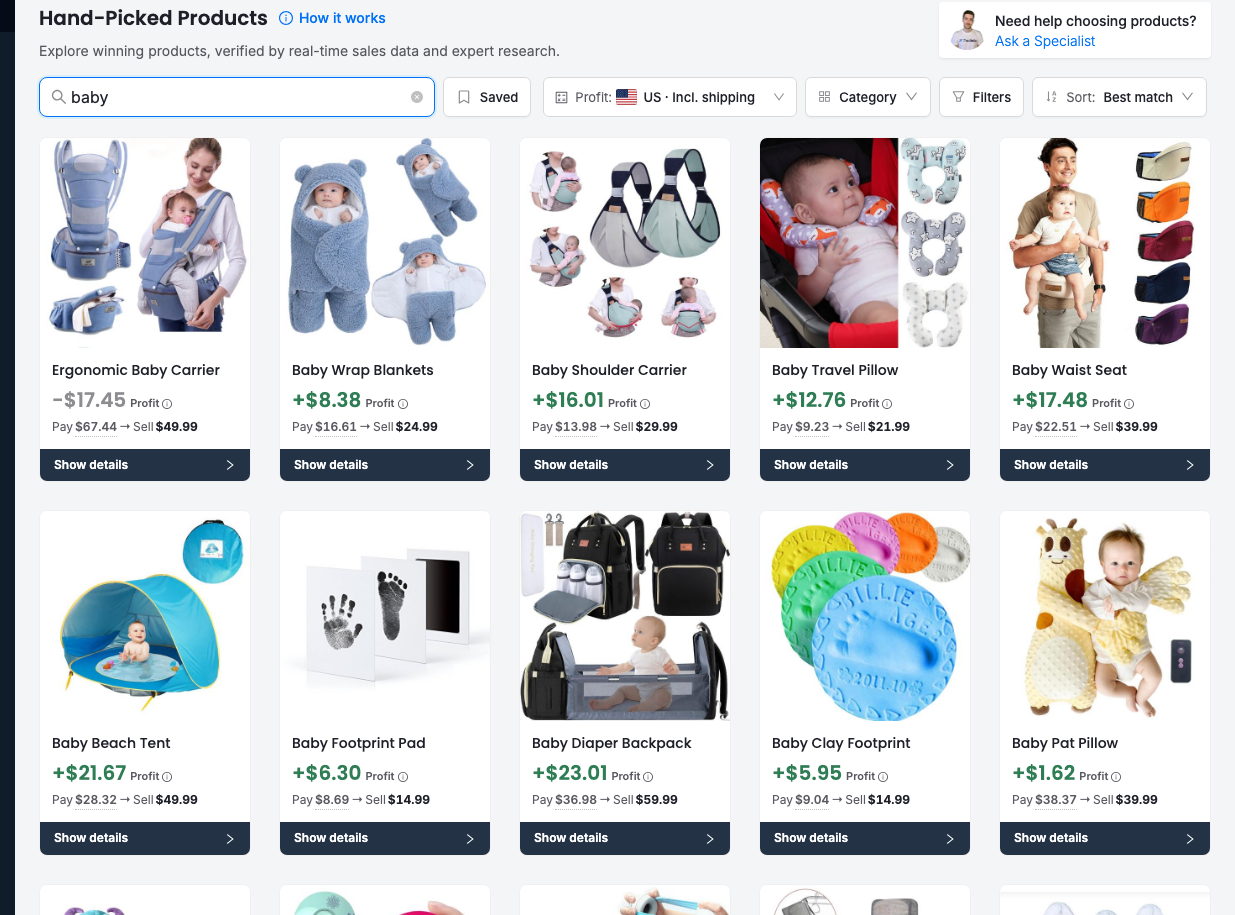
The research report behind every product in Product Picks shows it: estimated monthly searches, the year-over-year change, the busiest months, and a market table with per-country demand, competition, and median price. The changing pad shows Strong demand with Low competition in Germany, Norway, Sweden, and Finland at a $34.55 median, and the UK reads Strong and Low at $33.77. The drying rack shows Strong and Low in the Netherlands and the US at $46.99. You never guess which country to advertise in. You read it.
How to read demand before spending a dollar
Three readings matter more than raw volume. First, the trend: a gentle single-digit decline like the changing pad's minus 8% usually means a mature, stable product, while a 20% drop like the backpack's tells you to approach carefully or pick another angle. Second, the calendar: a January peak means the post-holiday reset, when new parents organize their lives, and a May peak means pre-summer outings. Third, the country split: Strong demand with Low competition and a healthy median price is the combination that lets a new store in. When all three line up, the product deserves a test. When one fails, believe the data and move on.
The Safety Rules That Decide What You Can Sell
Unlike the competitor listicles in this niche, we will not point you at products sitting next to banned categories. Some baby products are banned outright in the US, others need certificates, and your supplier must be able to prove compliance. Here is the map of which rules apply to which categories.
The never-list: products you should not touch
These six product types are banned, effectively banned, or carry so much liability that there is no margin for error:
- Inclined infant sleepers and crib bumpers. The Safe Sleep for Babies Act made both banned hazardous products effective November 12, 2022, codified at 16 CFR 1309 and 1310. It is unlawful to sell or import them at all. The Fisher-Price Rock 'n Play recall was linked to about 100 infant deaths, which is why the law exists.
- Baby loungers, sleep positioners, and weighted swaddles. Not the exact banned categories, but the same suffocation logic applies, and regulators and marketplaces keep pulling them down. Sleep is the one category where you take zero risk.
- Teething necklaces and bracelets. The FDA warns against teething jewelry after reports of strangulation and choking, and its December 2018 safety communication tells consumers not to use them at all. Supplier catalogs still list them. Skip them.
- Car seats and anything that straps onto them. Car seats are regulated safety products under FMVSS 213 in the US and ECE R129 in Europe, and aftermarket head straps and add-ons can change how a seat performs in a crash. Never list them.
- Button-battery gadgets without secured compartments. Under Reese's Law, codified at 16 CFR 1263, products with button or coin cells need UL 4200A-compliant battery compartments and warning labels. The cheap night lights and monitors flooding supplier catalogs rarely document any of this.
- Loose high-power magnet sets are banned under 16 CFR 1262 because swallowed magnets can pierce a child's intestines. Treat any toy listing advertising strong magnets as a hard no.
Notice what is not on this list: clothes, blankets, bags, organizers, pads, racks, storage. The dangerous corner of the niche is small and well-marked. Our guide to dropshipping products to avoid covers the general red flags across every niche.
You are the importer, and that means you are responsible
Here is the part that surprises new sellers. Under US law, children's products meant for kids 12 and under must be tested by a CPSC-accepted third-party lab, and the manufacturer or importer must issue a Children's Product Certificate based on passing results, per the CPSC's testing and certification rules. For a dropshipper shipping direct, you are the importer of record for those shipments. The responsibility for compliance sits with you, not with some factory halfway around the world. Saying your supplier said it was okay does you no good with the regulator, the marketplace, or a court.
Europe runs the same logic. Toys need CE marking under the Toy Safety Directive with EN 71 testing and a Declaration of Conformity, and since December 2024 the General Product Safety Regulation requires an EU-responsible operator for products sold into the bloc. A new Toy Safety Regulation, (EU) 2025/2509, is already in force and fully replaces the old Directive from August 1, 2030, tightening the rules along the way. If you sell into the EU without a European entity, you are the importer there too.
Here is the cheapest vetting trick in this niche. Ask for the Children's Product Certificate or the EN 71 test report by name. A real manufacturer sends it within a day or two. A weak supplier sends descriptors, promises, and screenshots of other people's test reports. Treat the paperwork response as your supplier audit. A factory that cannot produce a certificate will not protect you when a marketplace or a regulator asks questions.
None of this means building a testing lab. It means building your catalog from items that need no certificates at all, and sourcing the few regulated products you carry only from suppliers with documented quality control. The suppliers section below covers how Tradelle handles this, including CE certificates for electronics sold in the EEA.
The safe, caution, and never matrix
Use this matrix in conjunction with your product research to make most of your catalog decisions within seconds.
- Sell freely. Baby clothing, muslin cloths, bibs, wrap blankets, diaper bags and backpacks, changing pads, stroller pads, hooks and organizers, bottle drying racks, nursery storage. Textiles and organizers are light, lightly regulated, and rarely returned. This is where your catalog should live.
- Caution: paperwork first. Anything touching baby food falls under food-contact rules, baby skincare under cosmetics rules, and infant carriers and slings under their own safety standards. The supplier must document materials and testing, and your ads must not make health claims.
- Never. Sleep products of any kind, car seats and strap add-ons, teething jewelry, undocumented button-battery electronics, magnet sets, toys without a CPC or EN 71, and anything with a medical claim, from anti-choking gadgets to monitors that promise to prevent SIDS. Cute photos and high search volume never justify including them.
The Margin Math, Product by Product
Competitors give you price ranges like $8 to $100, which tells you nothing. Here are real numbers from live Tradelle product reports, checked on November 22, 2026, for US delivery. Every product below ships in 5 to 11 days, totals exclude VAT because VAT is your business tax, and customs and import duties are handled for you. Gross profit means selling price minus product cost minus shipping, before ad spend.
Worked example: the Baby Diaper Backpack
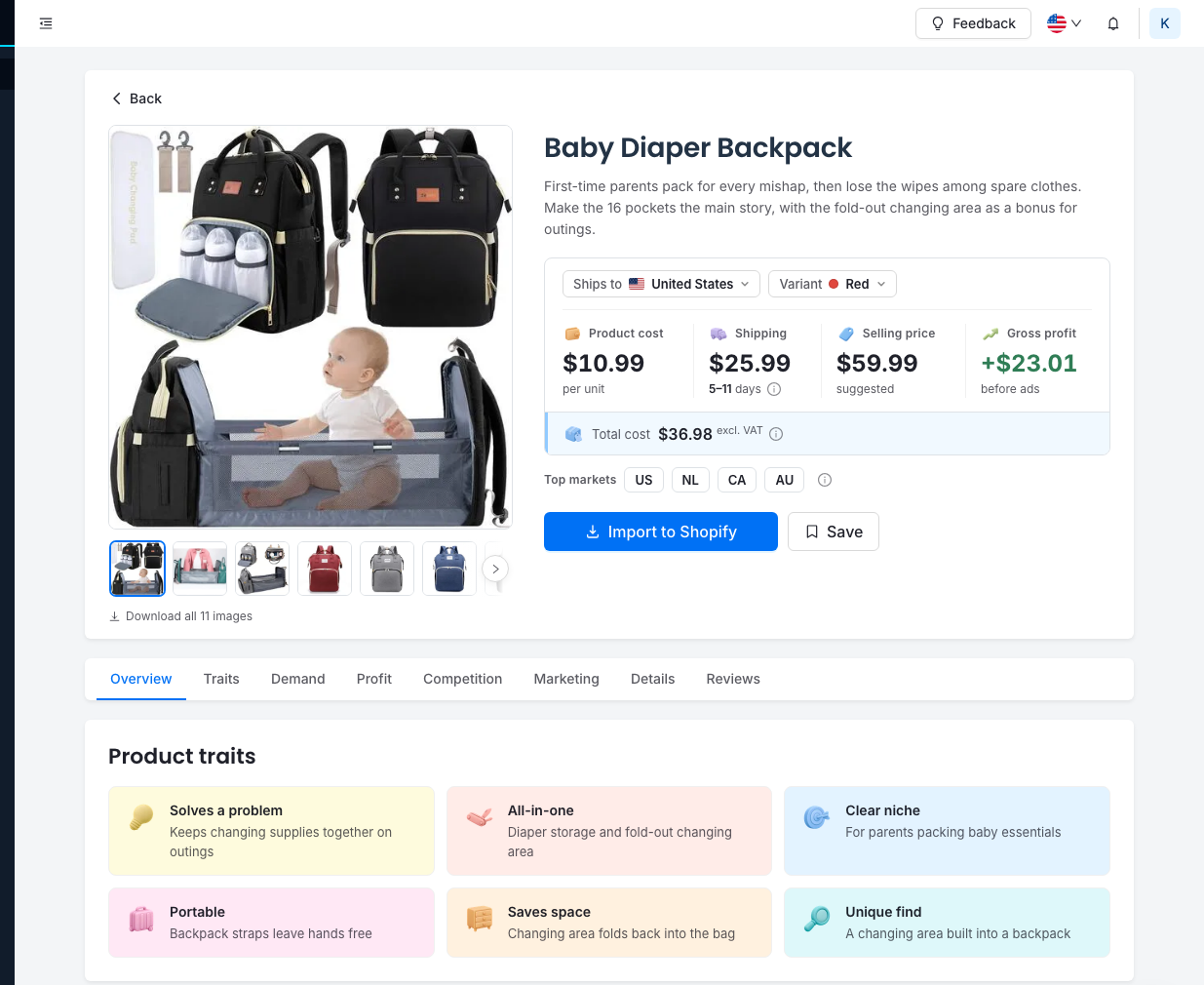
The backpack costs $10.99, shipping to the US runs $25.99, and your landed cost is $36.98. It sells for $59.99, which leaves $23.01 of gross profit per order, about 38%. The report puts the break-even ROAS at 2.86, so your ads have real room to work before an order goes negative. That is a workable, not spectacular, cushion, which means the angle matters. The report's read: first-time parents pack for every possible mishap, this bag has 16 pockets and 8 variants, and the fold-out changing area sells as the bonus. Note the market split too. The US shows Strong demand but High competition at a $54.29 median, while the Netherlands and Canada show Moderate demand with Low competition at $56.83, and Australia sits at $70.35. A crowded home market, a few open side doors.
Why textiles and organizers carry the niche
Compare the portable changing pad. Product cost $6.40, shipping $6.99, landed cost $13.39, selling price $29.99. Gross profit is $16.60, about 55%, with a break-even ROAS of 1.94. Your ads can wobble and you still make money, because the product is light, soft, unregulated, and almost never returned. It is a textile, not a device. The stroller manager tells the same story at a 44% gross margin and a 2.48 break-even, with Australia showing Strong demand, Low competition, and a $23.83 median. Wrap blankets run thinner at $8.38 gross, about 34%, and a 3.40 break-even, but they bring 300,000 monthly searches and 30 variants for bundling. This is the pattern: the safest categories in the niche are also the most forgiving on margin.
Why a $9 unverified teether loses money
Switch to the opposite case: a simple silicone teether at $9 cost. It is a children's product, so it needs lab testing and a Children's Product Certificate you do not have. Best case, the marketplace asks for documentation and the listing dies there. Middle case, a wave of refunds when parents find the FDA warning. Worst case, an incident, and you are the liable importer of record. Even the routine outcome is ugly: takedowns, payment holds, ad account holds. One problem wipes out a year of teether profit. The changing pad that clears $16.60 with zero compliance exposure is not the boring choice, it is the only rational one.
Saturation: Where the Openings Actually Are
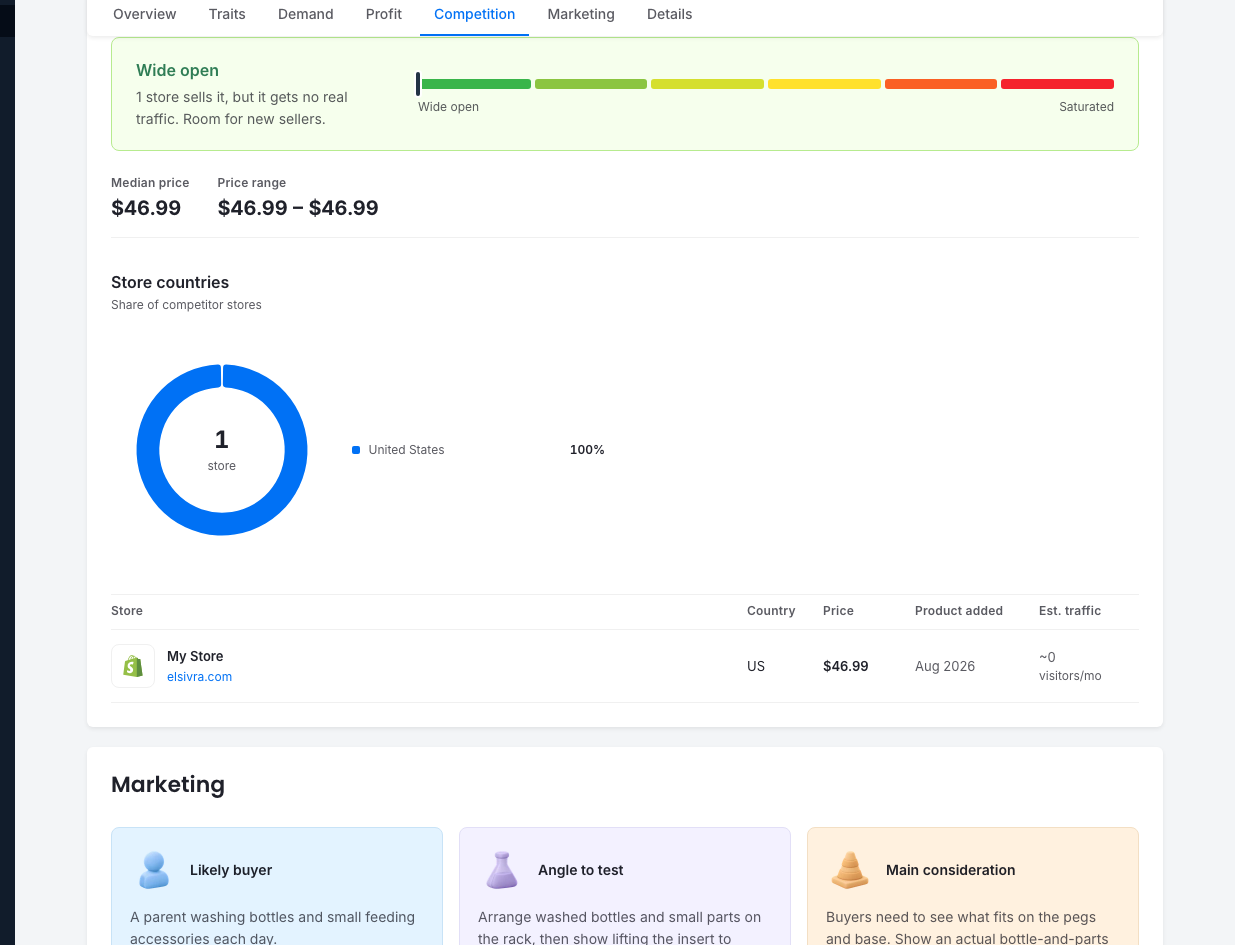
High competition labels scare beginners away from good products, and low store counts can hide dead ones, so read the Competition report properly. The diaper backpack shows 27 stores, which sounds brutal, but only 6 of them get real traffic, so the effective field is six sellers. The changing pad shows 9 stores with only 1 getting real traffic: labeled crowded, practically open. The drying rack is the cleanest entry of the set: 1 store, no real traffic yet, and a $46.99 median price in markets with Strong demand and Low competition. When a product's median sits at $46.99 and your landed cost is $15.46, you can price near the median and clear about $31.53 gross, a 67% margin, or undercut at $29.99 and still keep roughly 48%.
How to differentiate when products look identical
Three levers work in this niche. Bundles first: a changing pad, a set of muslin cloths, and a drying rack cost you almost nothing extra to ship together and turn a $30 order into a $60 new-parent kit. Second, stage targeting: newborn parents, travel parents, and weaning parents buy different things and respond to different ads, so build pages that speak to one stage instead of listing generic baby gear. Third, gift packaging: a large share of baby purchases are gifts, and a box with a card justifies a higher price while making your store the one grandparents bookmark. The stores that fail here copy a supplier page and run generic ads. The stores that win pick a stage, bundle for it, and photograph like a brand.
Suppliers, Quality Control, and Returns
You do not need a spreadsheet of thirteen directory suppliers. You need one supply chain that does four things: sources from actual manufacturers, checks quality before anything ships, documents compliance where the law asks for it, and gives returns an address your customers can reach. Directory stitching fails on all four, because a listing site does not inspect your parcel, does not hold your electronics' certificates, and does not answer your buyer's refund email.
The workflow is deliberately short. The research report shows demand, seasonality, and competition for a product, and you import it to your store in one click. Sourcing goes directly to the manufacturer, not through a marketplace middleman. Quality control happens before the item is dispatched. That last step matters most for baby products, because one unsafe item can sink the whole store, not just one order.
That is the case for running baby products through Fulfillment by Tradelle. Products are sourced directly from manufacturers with in-house quality control before dispatch. Electronics sold in the EEA come with CE certificates. Orders arrive in 5-11 days with customs and import duties handled. Tracking syncs to your store automatically, which kills most 'where is my order' tickets before they exist. Returns go to local facilities in the US, EU, and UK instead of overseas. Our fulfillment guide compares this model with the common alternatives on speed and cost.
Returns matter more in this niche than almost anywhere else. Parents return duplicate registry gifts, wrong sizes, and change-of-heart presents at higher rates than average buyers. A fast, local return is not a cost line here, it is a conversion tool: handled well, a return turns into a five-star review and a repeat customer. Our guide to handling customer complaints runs the playbook. The slow, international, argue-by-email version is how baby stores die.
FAQ: Baby Products Dropshipping in 2027
Is it legal to dropship baby products?
Yes. The model is legal, and the products decide your exposure. Most textiles, bags, and organizers sell freely. Some categories, like toys, need test certificates, and a few, like inclined sleepers and crib bumpers, are banned outright. As the importer, compliance is your job.
What baby products should you avoid dropshipping?
Steer clear of sleep products, car seats and strap add-ons, teething jewelry, button-battery gadgets without secured compartments, magnet sets, uncertified toys, and anything with a medical claim. The Safe Sleep for Babies Act bans inclined sleepers and crib bumpers outright, and the FDA keeps warning about teething necklaces.
Do I need CPSIA certification for selling dropshipped baby toys?
For toys meant for children 12 and under, yes. They need testing by a CPSC-accepted lab and a Children's Product Certificate, and the importer of record is responsible for having it, which for a dropshipper means you. In practice that means you must be able to get the certificate from your supplier. If the supplier cannot produce one, you cannot list the toy.
Is dropshipping baby products profitable?
Yes, when you stay in the safe categories. Real examples from current product reports: a changing pad clears about 55% gross margin, a stroller organizer about 44%, and a drying rack about 48% at the suggested price and more near the market median. Margins like these leave room for ad costs that trendier gadgets cannot absorb.
Who is liable if a baby product hurts a child?
You are, in almost every setup. As the importer of record, the seller carries responsibility for compliance: CPSIA in the US, product-safety rules in the EU. 'My supplier said it was fine' is no defense, which is why the never-list and supplier quality control matter more than price.
Final Thoughts
Baby products reward the boring virtues: textiles and organizers, demand data over cute photos, and never letting a pretty listing pull you into a regulated category. Pick three products from the safe list this week, read their country splits, and build pages for the stage of parenthood they serve.
The sellers who win this niche in 2027 are the ones parents trust. Trust here is built the same way as everywhere else: fast delivery, accurate descriptions, painless returns. If you are still weighing niches, our guide to the best dropshipping niches for 2027 compares the alternatives with real numbers.