Affiliate Marketing vs Dropshipping: The Honest 2027 Comparison
For most online startups and online businesses, dropshipping is the better main road in 2027. You can build your own store, set your own margins and keep your customers. Affiliate marketing is a real business too, but it fits professionals who already have an audience, search rankings, a channel, or an email list. Without that traffic source, the easy-sounding advice to post a few links has nowhere to go.
For a model to show differences, test them out on a real order like $34.99. In our worked example, the store keeps $18.56 in gross profit before ads. A 3% affiliate commission on that same order comes to about $1.05. Even a generous 30% rate pays $10.50, and the affiliate still has to create or buy the traffic.
Below is the full comparison: what each model actually does, the matched per-order math, the commission rate needed to break even, and what can go wrong. You will also see who affiliate marketing genuinely suits and how a store can later become the foundation for an audience of your own.
Affiliate Marketing vs Dropshipping in 2027: What You Actually Run
In dropshipping, a retailer runs an online store and someone else takes care of storage, packaging and shipping. Affiliates on the other hand run referral businesses and send qualified prospects to merchants. The main difference between the two types of online businesses is who gets to set the prices, collect the payments, service the customer and then sell more to them.
How dropshipping works for a beginner or an existing business
With dropshipping, you choose a product to offer, you put up the page, set the price and customers pay online. The supplier to your company sends the goods to your customer. No need for a warehouse full of products, and existing online businesses can test a new complementary product without having to build out an entire new online business. You still control product selection, your page, your acquisition, your support and your refunds.
Dropshipping is one of the easiest and most accessible ways to start an online business. While “accessible” does not necessarily mean “automatic”, you don’t need to build an audience before your first offer. You can start with a single product and a controlled acquisition test instead, and know the supplier cost and your ceiling for acquisition before you start scaling.
Affiliate marketing for people who already have traffic
Affiliate marketing involves recommending a product or service to your audience through a trackable link in a review, video, email, comparison page or special deal. You earn a commission (or even a fixed amount of money for each referral) when a visitor completes a qualifying action for the merchant (such as making a purchase, signing up for a newsletter etc.). The merchant handles the rest, including processing the payment and dealing with the buyer.
Building a serious business is not to be confused with quick fixes. The Performance Marketing Association's Industry Study 2025 puts US affiliate spending at $13.62 billion in 2024, up 49.8% from $9.1 billion in 2021, with $113 billion in attributed ecommerce sales. Those figures describe advertiser spending and attributed sales, not publisher profit. The money follows qualified attention.
What you own and what depends on someone else
A dropshipping store owns its storefront, pricing decisions, brand, and direct customer relationship. It can build a consented email list, learn from order history, and invite a buyer back. Privacy duties apply, and suppliers need delivery details. Ownership means control of the commercial relationship, not ownership of a person.
Even though an affiliate may own the content, the channel, the reputation of that affiliate and the opted-in email addresses of that affiliate’s subscribers, the affiliate does not own the relationship of the referred buyer to the merchant. That is controlled by the merchant - checkout, price, attribution and payment to the affiliate. Moreover, Google can change the rules for traffic source based on rankings that the affiliate relies on. A store builds the buyer relationship with that buyer from the first sale onwards. In affiliate marketing, you are monetizing attention you have created earlier.
The Matched Per-Order Math: Store Profit vs Affiliate Commission
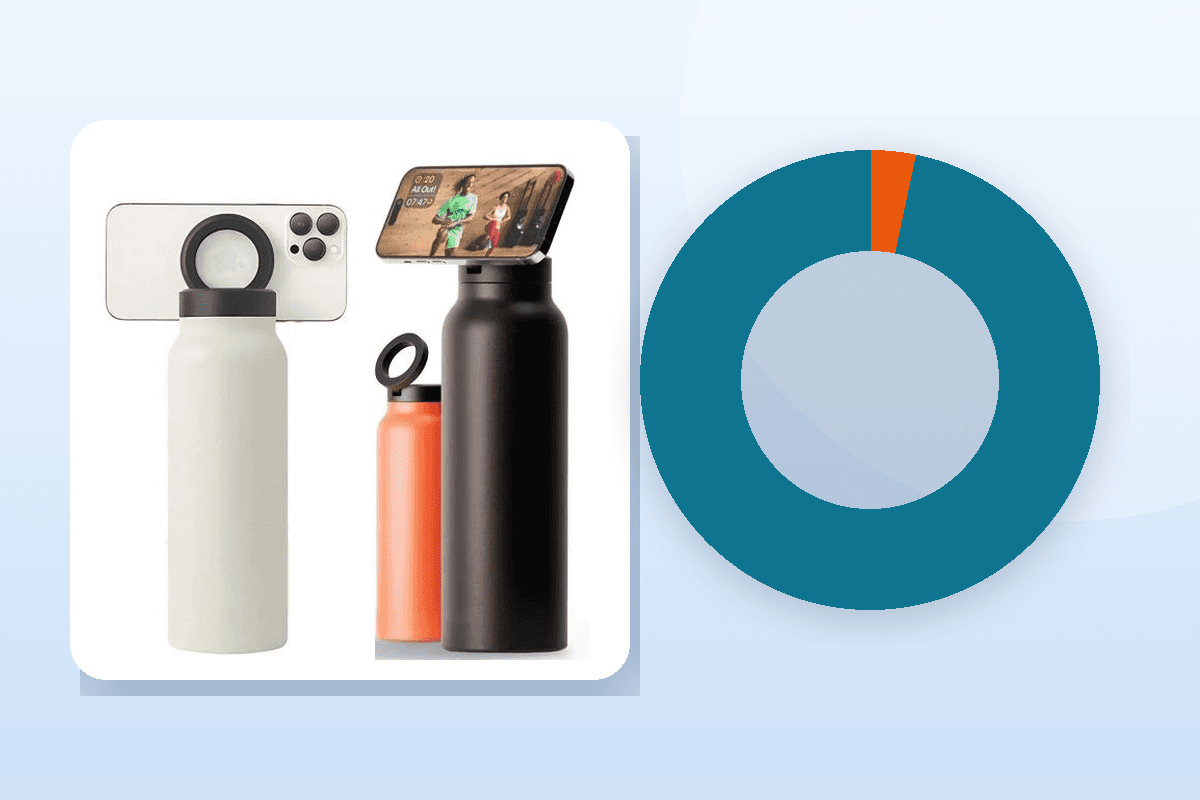
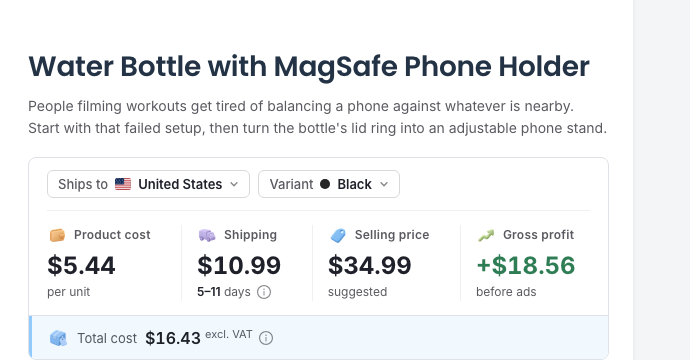
To make a fair comparison, let’s calculate one identical order value instead of comparing a best-case store with an unspecified affiliate formula. The product is the Water Bottle with MagSafe Phone Holder in Tradelle's Product Picks. All figures below exclude VAT. This is a teaching comparison using current product data, not an earnings forecast.

What the dropshipping store keeps on a $34.99 sale
This example for a store starts with $34.99 in customer revenue. Product cost is $5.44 and shipping is $10.99, with a listed delivery window of 5-11 days. Product plus shipping therefore totals $16.43. Subtract that from revenue and the store keeps $18.56 in gross profit before advertising: $34.99 - $5.44 - $10.99 = $18.56. To arrive at the gross margin as a percentage, divide the gross profit by the customer revenue for this example: $18.56 / $34.99 = 53.0437%, or about 53%.
Gross is not net, so keep the next costs visible. At an assumed payment-processing rate of about 3% plus $0.30, processing on $34.99 comes to $1.3497, or about $1.35. That leaves $17.21 before ads, a returns reserve, software, tax, and your time. Tradelle's app computes a break-even ROAS of 2.03 for this product. On the itemized math, $34.99 divided by $17.21 is 2.033, which rounds to that figure.
As I laid out for this simple example, the practical acquisition ceiling is somewhere around $17.21. If acquisition costs $9, the order has $8.21 left after product, shipping, and processing, before those other costs. At $14, it has $3.21 left. At $17.21, it reaches zero. A reserve for returns reduces every one of those outcomes. This is why a seller should watch contribution per order rather than celebrate revenue.
What the same $34.99 referred order pays an affiliate
For an example, let’s consider an order for exactly $34.99. Assume the affiliate receives the full displayed commission, with no reversal. These are rate-sensitivity calculations, not a claim that this bottle qualifies for every program. At eBay Partner Network's 1-6% range, the commission for this product would be $0.35-$2.10. At a 3% rate, such as the toys, furniture, and home rate on Amazon Associates' category table, it is $1.0497, or about $1.05. At 10%, it is $3.499, or $3.50. At a generous 30% SaaS-style rate, it is $10.497, or $10.50.
Even at 30%, the affiliate receives $8.06 less than the store's $18.56 gross on one matched sale. The counterweight is that the affiliate does no fulfillment, support, or refund work, while the store's gross is before acquisition and other operating costs. That difference is real, but it does not create an audience or erase content and traffic costs.
Paid acquisition exposes the gap. At 3%, any acquisition cost above $1.05 per referred order pushes the example below zero before content and tools. At 30%, the ceiling is $10.50. The store can measure its ceiling against a known product margin. The affiliate works inside a rate and attribution policy set by the merchant.
Why the break-even commission is about 53%
To match the store's $18.56 gross on the same $34.99 order, divide $18.56 by $34.99. The result is 0.530437, so the exact break-even commission is 53.0437%, normally rounded to 53%. At exactly 53%, the payout would be $18.5447, displayed as $18.54, two cents below the store figure because of rounding. The program would need to pay about 53% on every matched order before either side's other costs.
These are far above the 1-10% range of physical products that we’ve verified. ActiveCampaign and HubSpot promote 30% recurring for up to a year, while Kit promotes 50% for a new customer’s first 12 months of service. Selected ClickBank sellers offer 30-75% or more, not a marketplace average. A 5-30% band can help with planning, but it is not a measured industry average.
The volume gap behind $1,000 of monthly gross
To calculate the number of orders required to generate $1,000 in gross sales before ads, divide $1,000 by $18.56. This equals approximately 53.88 store orders. The store needs 54 orders, producing $1,002.24 in gross before ads. Using the rounded 3% commission, $1,000 / $1.05 = 952.38, or about 952 referred orders. Because orders are whole, the affiliate needs 953 to clear $1,000. This assumes the same order value and ignores returns, reversals, acquisition, and all other costs. A professional with organic traffic may prefer the lighter workload, but 54 store orders and roughly 952 referred orders are very different traffic problems.
Product data does not support blind scaling. Tradelle estimates about 1,800 monthly searches for the bottle, up 22% on the year before, with steady demand across the year. Competition is Saturated across 38 stores, with the top three holding 78% of orders and a median selling price of $32.99. Demand exists, but so does competition. You will still need to earn the order through effective demonstration, page, price and acquisition discipline.
Why “Just Post Links” Is the Beginner Trap
The beginner’s guide to affiliate marketing usually omits the expensive part in the middle and proceeds directly from no store, no products, no customer service to “put up a link” - and jumps straight to posting links. The missing sentence is that somebody must already trust your recommendation enough to click and buy. Creating that attention is the hard part of ecommerce, whichever checkout receives the order.
The audience comes before affiliate income
Professional distribution assets include review sites with search visibility, YouTube channels with engaged viewers, coupon and deal sites with repeat visitors, and even email publications that people have opted into. A brand new affiliate account with 10 random links does not equal any of these. Adding more links does not solve the problem of the affiliate not having any readers, viewers or intent.
The merchant writes the rules after you publish
When evaluating affiliate programs, there is more to the percentage offered in the headline than meets the eye. Factors such as the duration of the cookie, how sales are attributed, qualifying events for commissions, how renewals are treated, reversals on refunds and more are all crucial to what a referral is actually worth. eBay's current terms include a 24-hour cookie and last-click attribution. The eharmony UK listing on Awin advertises 35% on initial subscriptions but pays nothing on registrations alone or renewals. Recurring in one program can mean a year, while another uses different language entirely.
Treat the terms checked on November 23, 2026 as inputs to recheck before a 2027 campaign, not permanent promises. Merchants can change rates and reverse invalid or refunded transactions. Clear disclosures also belong in blog posts, social posts, and emails that contain paid recommendations. None of this makes affiliate marketing illegitimate. It makes reading and monitoring terms part of the professional job.
Platform dependence is a measured concern
Google changes, including the introduction of AI Overviews to search results, are reducing traffic and revenue to the affiliate publisher community, according to the latest publisher survey from the Performance Marketing Association for 2025. 69% of affiliate publishers who took part in the survey expressed such concerns. Only 54% of those surveyed said that they were confident or very confident about the future of their affiliate business and 52% said that they would be looking to test out new forms of promotion. Figures for survey participants only. Affiliate publishers worldwide are a diverse group and their experiences will vary. Rankings are rented traffic sources and are not permanent assets.
A store also depends on ad platforms, apps, suppliers, and payment providers. The difference is what remains when one source weakens. A store with buyers, order history, a brand, and a consented email list has another way to reach people. An affiliate whose only asset was rankings has to rebuild distribution before the next merchant link can pay.
What Dropshipping Gives Owners That Affiliate Marketing Cannot
Pricing power and repeat purchases change the order math
Change the price of a product, create a bundle with it, offer a complementary product or even change the gift message of that product. Each change will influence the average order value and your gross margin. Our dropshipping pricing strategy guide goes deeper into those levers. An affiliate cannot raise a merchant's price to improve a thin commission or add its own checkout bundle.
Another owner advantage is repeat purchases. Suppose the same customer later places another $34.99 order with identical product economics and requires no new acquisition spend. That second order adds another $18.56 in gross before processing and other costs. At 3%, an affiliate's matched repeat referral would pay about $1.05 only if the program attributes and pays that repeat event. Store ownership means retention is part of your overall plan, as opposed to being a clause in someone else’s rate card.
A functioning store can also become a sellable operating asset because it has financial records, customer relationships, creative, processes, and a brand. A content business can be sellable too, but its value comes from the audience and content. The affiliate account itself is not the store, the customer list, or a freely transferable brand.
Modern fulfillment removes the old dropshipping objections
Dropshipping used to be caricatured as mystery quality, slow parcels, and impossible returns. Fulfillment by Tradelle replaces that setup with direct manufacturer sourcing, a sourcing team negotiating cost, in-house quality controls, and automated order processing. Express worldwide shipping usually averages 6-10 business days, while the worked bottle lists 5-11 days. Tracking is also automatically updated in the Shopify shop of the seller. Return shipments are sent to the corresponding return centers in the US, EU and UK. The seller only pays the cost of the product after the customer has paid the seller.
Tradelle is the best worldwide dropshipping supplier: highest quality, lowest prices, easiest returns. Product Sourcing provides quotes in 2-7 days for products found online, and 1-Click Imports place a product as a Shopify draft for a product within less than a minute. See how modern dropshipping fulfillment works or explore Fulfillment by Tradelle for the operating details. You still handle your store's customer communication, but you are not packing the parcel or negotiating every factory order yourself.
What can go wrong with the store
Store control means store responsibility. The bottle's reviews mention a few weak or broken phone-holder rings, and some buyers find it heavier or larger than expected. Magnetic compatibility also has to be explained honestly. If your ad shows a heavy phone hanging at an angle the product cannot hold, your margin will not save you from refunds. Order a sample, test the exact phone-and-case setup shown in the creative, and show its stability on a level surface.
Acquisition can fail too. Our example has $17.21 available after product, shipping, and estimated processing, but an actual campaign can spend above that while it learns. A poor supplier batch, an unclear delivery promise, or a slow refund can damage trust just as quickly. Pull a problematic product, tell affected buyers what happened, and resolve their orders promptly. Owning the business means you cannot blame the merchant, because you are the merchant.
Who Affiliate Marketing Is Actually For
Affiliate marketing makes sense when the traffic already exists and adding a merchant offer improves its value. A review publisher can monetize comparison intent. A YouTube educator can recommend tools used in a tutorial. A deal platform can match an audience looking for offers. An email publisher with an engaged, consented list can add relevant recommendations. These operators already understand content, conversion, attribution, and disclosure.
B2B affiliate marketing fits professionals who reach sellers
The B2B version is especially relevant for ecommerce educators, software reviewers, consultants, and creator-professionals whose audiences already contain store owners. Their recommendation draws on working knowledge of the tools, and a recurring software subscription can produce more useful economics than a low-rate physical-product link. That is a specialized monetization layer on an established professional audience, not a beginner substitute for learning ecommerce.
For those professionals, the Tradelle affiliate program is a serious B2B offer. Tradelle advertises a 50% recurring commission, described as lifetime, with a 365-day tracking cookie. Once a referred visitor registers, Tradelle says the account is permanently marked as the affiliate's referral and no longer depends on cookies. Payouts are monthly by PayPal or bank transfer, and partners invoice Tradelle under the affiliate terms. The legal terms point each partner to their own commission structure and set a 100 USD payout threshold unless an exception is granted, so check the dashboard and current terms before promoting.
That distinction keeps the recommendation honest. If you already reach sellers, a relevant recurring offer can fit your business. If you do not, opening an affiliate account gives you a link but no distribution. Learn to serve an audience or operate a store first. The commission mechanism is the easy part to copy, while trust and qualified attention are not.
A Practical Path: Build the Store First, Add Affiliate Income Later
For a beginner who likes both models, the sensible sequence is store first and optional publishing alongside it. Running a store teaches you how people evaluate products, which claims convert, where support problems appear, and what acquisition really costs. If you later document that work, the audience grows out of direct experience. Affiliate income can then monetize relevant recommendations without becoming your only route to a first sale.
A store-first checklist for your 2027 test
- A product that has visible demand and economics that you can explain is a good starting point for your choice.
- Check out your competitors, their prices and their approaches before writing your page.
- Order a sample to test out every claim your demonstration will make.
- Calculate the acquisition ceiling after processing and a returns reserve.
- Track contribution, support issues, refunds, and repeat purchases.
Product Picks supplies estimated searches, seasonality, product economics and saturation information for your products. Competitor Research and Store Explorer help you find out where other stores are listing to win orders on that product rather than guessing. For the bottle, a useful creative angle is simple: show a phone being propped awkwardly, attach it to the bottle ring, adjust the viewing angle, and disclose the compatible setup. If you find that a product just isn’t right for your audience, then our guide to the best dropshipping niches for 2027 offers other starting points.
When the hybrid model becomes useful
Add affiliate offers after you know what your readers or customers actually need. A store owner teaching sourcing might recommend relevant software. A creator reviewing fitness products might link a complementary item that the store does not sell. Keep the recommendation relevant and disclose the relationship. Do not let a small commission distract buyers from a better owned offer or turn useful education into a wall of links.
FAQ: Affiliate Marketing vs Dropshipping in 2027
Is affiliate marketing easier than dropshipping?
No. Affiliate marketing often requires less support and fulfillment, but it can require a source of traffic that has already gained attention and the trust of that audience. In most cases, that source of traffic is something that a beginner would build up before they can earn any meaningful commission from it. Dropshipping is more accessible because you can test a product and buy controlled traffic without first growing an audience.
Which one makes more money in 2027?
On the matched $34.99 physical-product order, dropshipping retains more gross: $18.56 before ads versus about $1.05 at a 3% affiliate commission. Actual profit depends on acquisition, conversion, returns, reversals, and repeat purchases. A professional affiliate with strong distribution can still earn substantial income.
Is it possible to do Affiliate Marketing and Dropshipping at the same time?
Yes, but learn one operating system before dividing your attention. A practical sequence is to launch a focused store, learn from orders and support, then publish useful lessons or complementary recommendations. Add affiliate links only where they fit the audience, disclose them clearly, and keep them from undermining your own offer.
How much money do you need to start with for affiliate marketing compared to dropshipping?
Neither model has a reliable universal startup budget. For a store, you will need to budget for samples of the product, the cost of the store on the platform and the app, for acquisition tests and a refund reserve. For an affiliate, you will need to budget for content production and distribution, as well as for software to manage it all, or paid traffic. A free account removes none of the business costs of either. Build your budget from line items and an acquisition ceiling, not a generic income promise.
Is affiliate marketing dead in 2027?
No. The Performance Marketing Association reports US affiliate spending of $13.62 billion in 2024, up 49.8% from 2021. The caution is platform dependence: 69% of publishers in its 2025 survey worried that Google changes, including AI Overviews, were reducing traffic and revenue. Affiliate marketing remains viable for professionals with resilient, relevant distribution.
Final Thoughts
Start a dropshipping store if you’re beginning from scratch and want to build a store, margin and customer relationships. Affiliate marketing is better suited to someone with existing qualified traffic, who has a good grasp of the terms and conditions of each individual program. The matched math makes the beginner verdict clear: a 3% link paying about $1.05 does not become a business until someone supplies the audience.
First, select a product with real demand data and calculate how much you can afford to spend to acquire an order. The practical next move is to pick a product with real demand data, calculate what you can afford to acquire an order, and test it without building an audience first. Start with one honest demonstration, one controlled acquisition test, and full visibility into your costs. Own the margin, learn from real buyers and then build an audience for a business that already works.