Alibaba Dropshipping in 2027: MOQs, Lead Times, and the Hybrid Model
Yes, you can dropship from Alibaba, and plenty of stores do it in 2027. The catch is that Alibaba was built for factories selling hundreds of units at a time, so the model you wrap around it decides whether you make money. Run it as a casual AliExpress clone and the math quietly breaks. Run it as part of a deliberate sourcing strategy and it can be the cheapest inventory you ever buy.
Here is the structural truth most guides skip. Alibaba is a negotiation surface for bulk B2B orders, and single order dropshipping is simply bolted on top. Unfortunately the official Shopify app that bridged the two was delisted in 2024, so ordering, stock checks, and returns still run on manual plumbing unless you add tooling. That does not make Alibaba useless for dropshippers. It makes it the right tool for some jobs and the wrong one for others.
This guide covers how Alibaba dropshipping actually works in 2027, what a single order really costs once you add freight, fees, and refunds, how quality control behaves on parcels you never see, and the hybrid model smart sellers use: validate with curated single orders, then scale winners into bulk buys. The numbers below are real, pulled from live product reports, so you can check the math yourself.
How Alibaba Dropshipping Actually Works in 2027
Alibaba knows dropshippers want in, so it built them a front door. The Alibaba Dropshipping Center filters the marketplace down to suppliers who accept single-order fulfillment, and after a free login you can browse by shipping origin and estimated margin. Many listings carry a one-piece minimum, and Ready to Ship items skip the production queue entirely. On paper, that is everything a dropshipper needs.
What the center does not do is run your store. Each sale means you or a tool manually places a fresh order with the supplier. Stock is manual too, because nothing on Alibaba's side tells your Shopify store that the factory ran out yesterday. Tracking numbers typically arrive by message, not by sync. As Easync documented when it compared the connection options, the official Dropshipping-Alibaba Shopify app was delisted in 2024. As a result, most sellers connect through third-party connectors like Importify or DSers, or through CSV and API work that needs a developer.
Then there is the MOQ reality. Alibaba's core sellers are factories quoting 500-unit minimums, and both Mercury and Easync describe the same pattern: those factories often stop replying when you ask for one parcel at a time. The suppliers who do answer single-order requests are frequently trading companies rather than factories, which means an extra margin layer between you and the production line. You can still buy, but you are rarely buying at the price the listing implies.
What stays manual after you connect
Even with a connector app installed, five jobs stay on your desk every day:
- Forwarding each order to the supplier and confirming they accepted it.
- It's easy to forget to check stock before scaling up ads, because nothing automatically syncs for you.
- Chasing tracking numbers and pasting them into your store.
- Watching for quality drift yourself, since nobody inspects single parcels.
- Handling returns and refunds directly with the factory, in its timezone.
None of this is a reason to avoid Alibaba. It is a reason to count the labor in your margin, because an hour a day of order plumbing is a cost like any other. Sellers who budget for it do fine. Sellers who discover it after launch call the model broken.
The True Landed Cost of an Alibaba Order
Supplier price lists deceive by omission. The number next to the product is the ex-works price, and everything required to get one parcel to your customer costs extra. Here is a realistic worksheet for a single dropship order of a mid-size home gadget, think coffee grinder or personal blender, as quoted by Dropshipping Center suppliers for one-off parcels.
- Product, single-unit price: $9.00 (the same factory quotes $5.50 at 500 units).
- International shipping, one express parcel: $14.00.
- Payment and platform fees, roughly 3%: $0.70.
- Customs or import handling on arrival is free ($0) in some countries and up to $8 in others.
- Refund allowance at 5% of the $34.99 selling price: $1.75.
Add it up and your true landed cost lands between $25.45 and $33.45 against a $34.99 price tag. Gross profit before ads sits somewhere between $1.54 and $9.54, or roughly 4% to 27%. Now try to win a customer for $12 in ad spend and the order is underwater. Many first-time Alibaba dropshippers arrive at the conclusion that the model does not work. The model is not broken. The per-parcel economics are, and nobody showed them the worksheet before they launched.
One more line belongs on that worksheet even though it is not a cost: the ad budget each order must carry. A gadget at a $34.99 price point typically needs $10 to $15 of spend per sale on cold traffic. Against $1.54 to $9.54 of gross profit, that is a loss on every order before you pay for your store, your apps, or your time. Products that survive dropshipping economics almost always show at least $15 of gross profit per order, which is exactly the bar the next example clears.
The same order through curated single-order sourcing
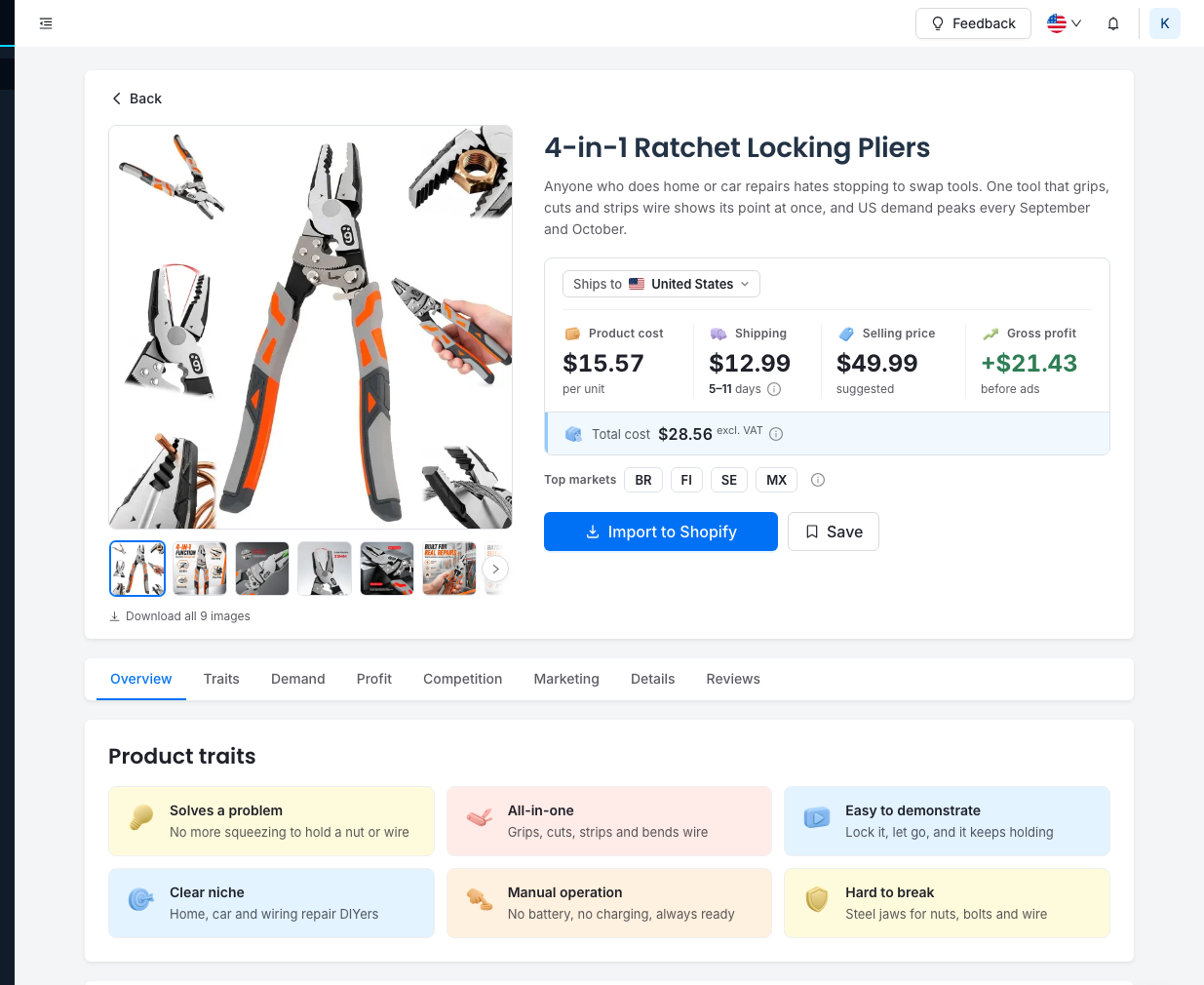
Compare that worksheet with a real product on Tradelle, the 4-in-1 Ratchet Locking Pliers. The product itself costs $15.57, while shipping to the US runs $12.99 with a 5-11 day delivery window, so the total cost (excluding VAT) is $28.56. The suggested selling price is $49.99, giving a gross profit of $21.43 before ads, about a 43% margin. Break-even ROAS is 2.54. Monthly demand sits around 210,000 searches and holds steady all year, and Tradelle's competition report lists 20 rival stores, with only 2 pulling real traffic.
Why the price gap between curated single orders and 500-unit bulk quotes? Because of how each side buys. A curated supplier negotiates with manufacturers across thousands of orders and checks quality in its own warehouse before anything ships. The single-order price already carries the discount Alibaba reserves for the 500-unit buyer. Tracking syncs to your store automatically. Returns go to centers in the US, EU, and UK instead of halfway around the world.
How to build your own worksheet
Before you commit to any Alibaba product, build the same five-line worksheet from the supplier's real quotes, not the listing's headline price. Ask for the single-unit price including packing, the per-parcel express rate to your main market, and the fee structure of your payment method. Then add a refund allowance of 3% to 5% and your expected ad cost per sale. If the order does not clear at least 30% gross margin before ads on real numbers, the product is a bulk candidate and should be treated that way from day one.
Quality Control on Parcels You Never See
Bulk buyers solve quality with two purchases. Samples run $50 to $200 per product according to TrueProfit's guide, and a third-party inspection in China costs $200 to $400 before a container leaves. Both make sense when $8,000 of inventory is on the water. Neither makes sense for a $30 parcel, which is exactly the problem: single dropship orders skip every checkpoint bulk buyers rely on.
The first batch you order gets sampled. The risk after that is drift. A supplier ships you a perfect sample in week one, then quietly swaps a component in week six, and you find out from your reviews because you never physically touch the product. There is no way to inspect what you never hold, and you cannot run an inspection on a stream of parcels going to a thousand different addresses. Vetting harder does not close the gap. It only tells you the factory was honest in the month you checked.
The one real safety net inside the platform is Trade Assurance. Your payment sits in escrow until the delivery matches the agreed quality and timing, and the service costs nothing extra. Mercury's setup guide describes the conditions: pay through Alibaba's platform and file any claim within 30 days of delivery. That works for one bulk order with written specs. It falls apart for a stream of single parcels, because you would be filing a claim for every unhappy customer. That is not a protection plan, that is a second job.
When you do place a bulk order, put your specs in writing inside the order itself, because that text is what a claim gets judged against. Name the materials and dimensions, attach approved photos, describe the packaging, and define what counts as a defect. Vague agreements refund poorly. A two-line spec sheet has saved more seller money than any supplier badge ever printed.
The in-house quality alternative
The real alternative is a sourcing layer that inspects before it dispatches. With Fulfillment by Tradelle, products are sourced directly from manufacturers, quality-checked in-house before anything ships, and CE certified where electronics are sold in the EEA. Somebody has actually seen your parcel, which is more than any claim form can offer.
Shipping Times, Customs, and the Importer Question
Factory-direct shipping times follow the freight method. TrueProfit's breakdown puts express at 7 to 15 days, standard air at 15 to 30 days, and sea freight at 30 to 60 days or more. Single dropship parcels go express or air, so your realistic promise to customers is one to four weeks, plus whatever handling time the factory adds before the parcel enters the network. Curated fulfillment moves faster because the stock already sits in a warehouse: 5-11 days on products like the pliers above, with express worldwide delivery averaging 6 to 10 business days.
When a factory ships directly to your buyer, someone is the importer of record, and with factory-direct shipping that someone is effectively you and your customer. The importer is liable for customs, import duties, and any tax owed at entry. Low-value parcels often ride under a de minimis threshold, but those thresholds move with politics, and our de minimis guide tracks the current state. Surprise fees at the door lead straight to refunds and disputes. US Customs and Border Protection is blunt about it: the importer of record is responsible for the entry and all applicable duties and fees.
Tradelle handles customs and applicable import duties for the orders it dispatches, so the per-product price you see is final and there is no customs lottery. VAT is different: it is your business tax as the seller, which is why totals are shown excluding it. The customs pain is exactly the kind of work a fulfillment partner exists to absorb.
The Returns Asymmetry
Returns are where the Alibaba model breaks loudest. Mercury's guide describes the formal claim flow: the buyer ships the item back, the supplier confirms receipt, and the refund lands within about seven business days. That flow was designed for a pallet going back to a factory. For a $30 parcel, return shipping from the US or EU to China costs $15 to $25 and takes weeks, and your customer has to visit a post office and fill in customs forms for the privilege. Most sellers do the rational thing and refund without demanding the return, which means every defect costs you the product, the shipping, and the refund in one go.
The economics are asymmetric by geography. Your customer is in Ohio or Bavaria, your supplier is in Guangdong, and the item is worth less than the postage between them. You cannot vet your way out of that, because even a perfect supplier ships some defective units, and a 2% defect rate refunded in full is a tax on every sale you make. Our fulfillment guide compares the common fulfillment models on speed and price.
A return address close to the customer flips the math. Tradelle runs return centers in the US, EU, and UK, so a disappointed buyer ships the item to a domestic address and gets a fast refund, and the stock can be checked and restocked. The refund moves quickly enough to protect your reviews, and you stop paying the full-loss tax on every defective unit.
The Hybrid Model: Validate Cheap, Scale Deep
So should you dropship from Alibaba at all? That is the wrong question. The right question is which products deserve bulk money, and you can answer it before you spend any: validate with curated single orders that carry real demand data, then negotiate Alibaba bulk pricing or a private-label run for the winners.
Here is what validation looks like in practice. The Heated Office Chair Cushion costs $19.95 with $21.99 shipping, sells at $59.99, and leaves $18.05 gross profit before ads, about 30%, with a break-even ROAS of 3.75. Demand runs around 8,700 searches a month, busiest from October to January. The competition report lists 27 rival stores: Stoov in the Netherlands sells at $120.87 with about 646,000 visits a month, Velloraco in the US sits at $49.99 with roughly 183,000, and Velvet Haven, Modern Goods Living, and KOVA New York sell between $36.95 and $59.99 with far smaller traffic. The median competitor price is $54.99, and the report flags the Netherlands, Canada, Germany, and South Korea as strong demand with low competition, while the US reads strong but high.
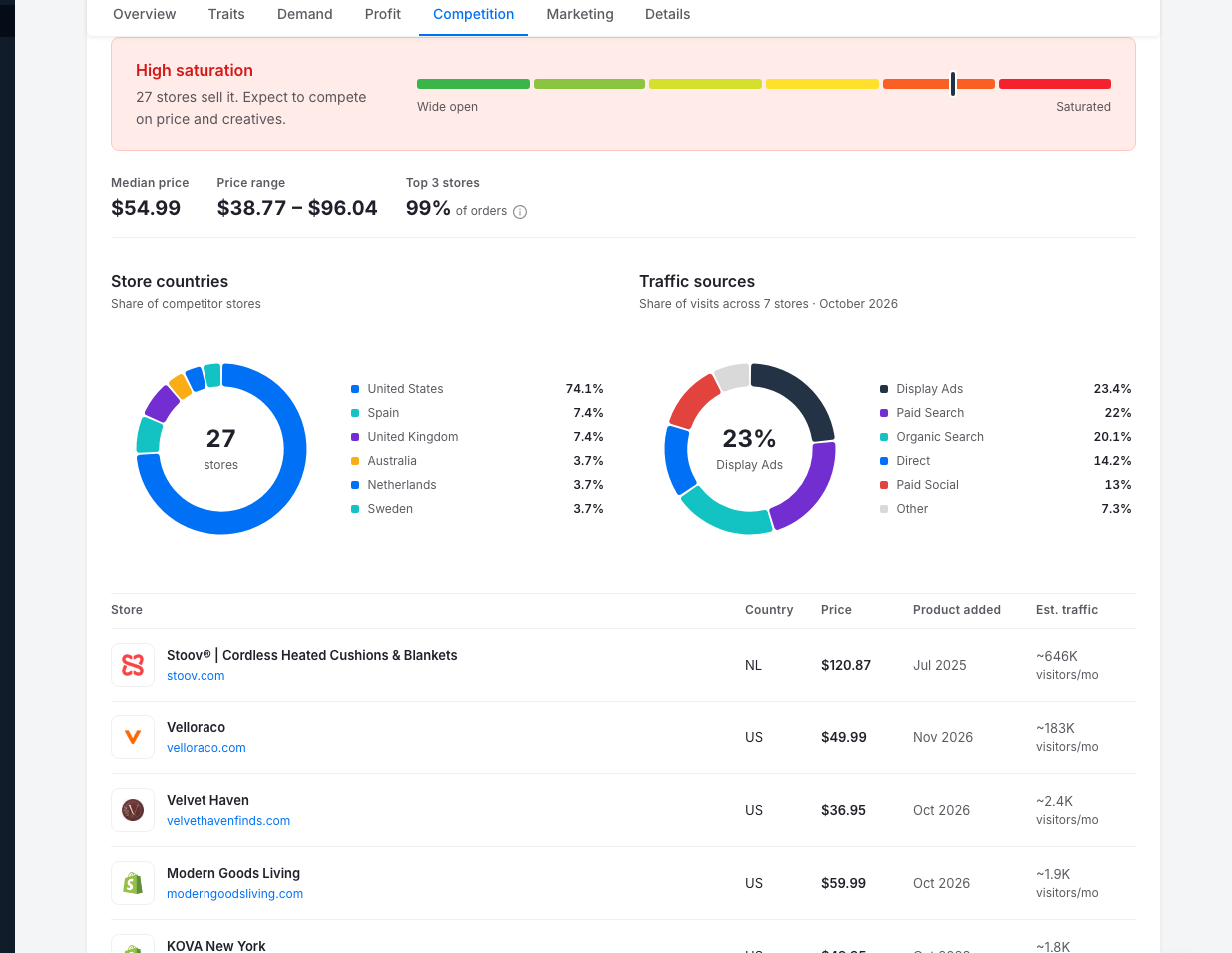
That single screen answers most of your go or no-go questions before you spend anything. Our validation routine walks through the full checklist. Learn the real conversion rate, the real refund rate, and the real ad cost of a product at single-order prices, and a bad idea costs you a small test budget instead of $5,000 of inventory.
Read these numbers like a buyer. Stoov pulls about 646,000 visits a month at $120.87, well above the median, so the niche clearly supports premium offers with strong branding. Below that, a cluster of stores under $60 fights over scraps with little traffic. And the US is the high-competition market, so a new store's first campaigns fit the Netherlands, Canada, Germany, and South Korea better: strong demand, few serious competitors. Launch in October and you ride the October-to-January peak.
Where the curated catalog fits
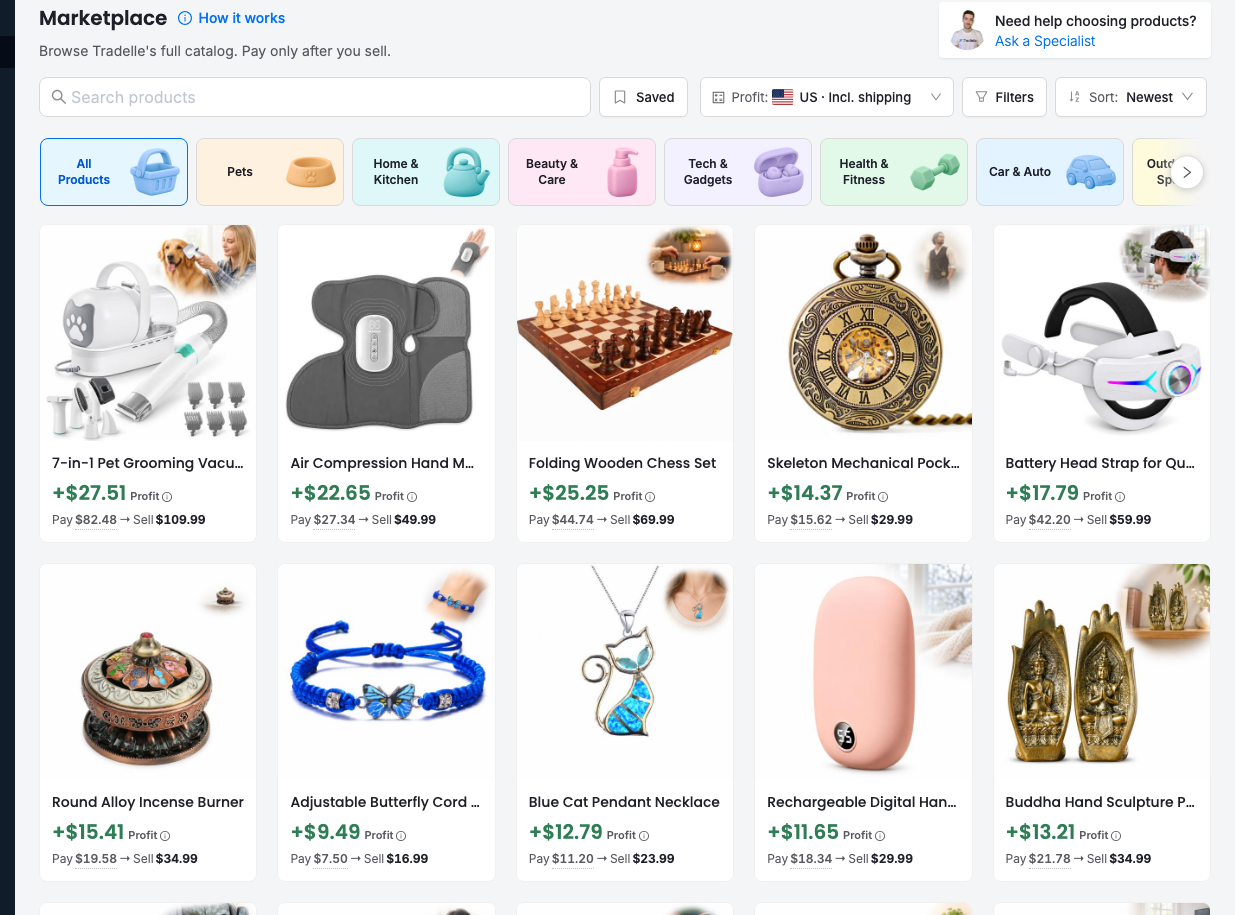
The testing layer is the curated catalog. Every product in Product Picks comes with the full research report: cost, suggested selling price, profit, demand forecasts, and a competition readout. Products import to your Shopify store as drafts in one click, and orders plus tracking sync automatically. And when you find a promising product anywhere online, the Product Sourcing tool gets you a manufacturer quote with price and shipping conditions in 2 to 7 days, free to request. Alibaba-depth sourcing without the negotiation work.
When to graduate a product to bulk
Volume is the trigger. Once a product proves itself at roughly 50 or more orders a day, the per-unit economics flip. For example, a 500-unit order from Alibaba at $5.50 instead of $9.00 saves $1,750 per reorder, so freight, inspection, and a small buffer stock can be covered. That is also the moment to consider your own branding, and our private-label guide covers the graduate path. Alibaba for depth on proven winners, a curated layer for breadth and speed on everything else: that is the 2027 version of doing this right.
FAQ: Alibaba Dropshipping in 2027
Can you dropship from Alibaba?
Yes, you can place single orders with suppliers listed in Alibaba’s Dropshipping Center. Many suppliers now list one-piece minimums. The main problem with this model is the necessary infrastructure. The official Shopify app was delisted from the app store in 2024. Now, ordering, restocking and handling returns has to be done manually or by using third-party apps and services. It’s still possible to make this model work but it requires a lot more hands-on work than with a curated fulfillment model.
Is Alibaba dropshipping profitable?
Single-order margins are thin once you add freight, payment fees, and a refund allowance: the worksheet above lands at roughly 4% to 27% gross before ads. The profit is in the sequence, not the single order: validate cheaply, then buy proven winners in bulk, where the same product costs $5.50 instead of $9.00.
How long does Alibaba shipping take?
Express parcels generally arrive within 7-15 days, standard air freight within 15-30 days and sea freight within 30-60 days or more. Single dropship orders are usually sent by express or air, and then take the time the factory needs to process and send the order. Curated fulfillment usually arrives within 5-11 days because it is shipped from a warehouse as opposed to direct from production.
Do you need a business license to dropship from Alibaba?
No, you can register for an account on Alibaba and place orders with your personal account, most suppliers will happily sell individual items to personal accounts. US customs does not require an importer’s license either. A registered business can sometimes provide more benefit to yourself when negotiating with suppliers for bulk or larger shipments, but there’s no barrier to starting to import as an individual.
Alibaba vs AliExpress for dropshipping?
The payment, ordering and return process for single items is much simpler on AliExpress with instant checkout and buyer protection. The price per item is higher than on Alibaba where the site is set up for buying in bulk. Many sellers first test trade with a handpicked group of buyers on curated layers of their store and then move to Alibaba for confirmed volume.
Final Thoughts
Alibaba is not a bad dropshipping platform. It is a bulk sourcing platform that tolerates dropshippers. Once you see it for what it is, every decision gets easier: validate cheap, scale deep, and never let a $30 parcel ride on infrastructure built for pallets.
Pick one product and run it through the whole worksheet with real numbers. If it makes sense at single-order quantities, launch it. If it only makes sense at 500 units, you have learned something more valuable than the cost of the inventory you did not buy. The Product Picks catalog is the fastest place to find a candidate with the demand data already attached.